


NOBEL PRIZE FOR ECONOMICS 2022
Editorial . . . . . . .
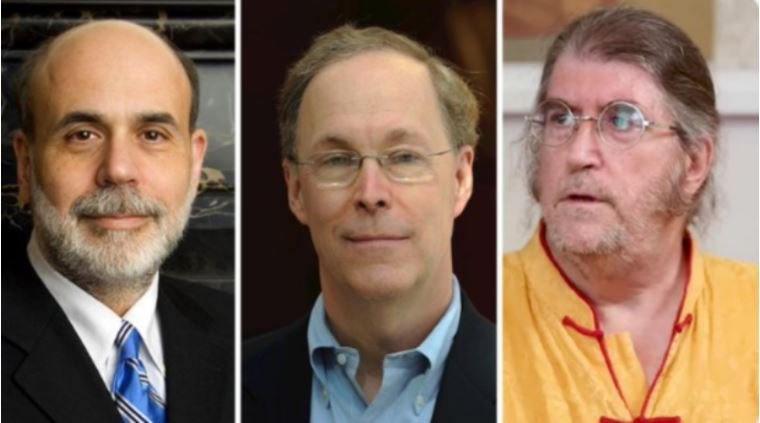
Ben S. Bernanke, Douglas W. Diamond, and Philip H. Dybvig, three members of the US Trio, were awarded the Sveriges Riksbank Prize in Economic Sciences 2022 (Nobel Prize for Economics 2022) in Alfred Nobel’s memory “for research on banking and financial crises.” The study of banks and financial crises was the focus of three American economists’ work that was recognised with this year’s Nobel Prize in economics. The understanding of the function of banks in the economy, particularly during financial crises, was greatly improved, according to the Royal Swedish Academy of Sciences, which awards the Nobel Prize in economics each year. According to the academy’s statement, Ben Bernanke, Douglas Diamond, and Philip Dybvig’s contributions have advanced studies that have increased our understanding of banks, bank regulation, banking crises, and how financial crises should be managed. Their research examined the function of banks and their susceptibility to confidence crises in ways that influenced policy. According to the academy, their discoveries improved how society handles financial crises. The importance of preventing bank failures is one of their study’s major findings. Ben Bernanke looked to the Great Depression of the 1930s, the biggest economic disaster in recent memory. He highlighted, among other things, how bank runs were a major factor in the crisis’s progression and length. Bernanke’s investigation revealed which elements contributed significantly to the decline in the gross domestic product using historical data and statistical techniques. He found that factors directly connected to failing banks were the main drivers of the recession. Douglas Diamond and Philip Dybvig, the laureates in economic sciences for 2022, created theoretical models that explain why banks exist, how their social function makes them susceptible to rumours of impending failure, and how society might minimise this vulnerability. Government-backed deposit insurance was suggested by Diamond and Dybvig as a solution to the vulnerability of banks. When depositors are aware that the government has insured their funds, they are less likely to rush to the bank when rumours of a bank run the first surface. Diamond also demonstrated the crucial role that banks play in society. Banks are better suited to determining the creditworthiness of borrowers and ensuring that loans are utilised for sound investments because they act as a middleman between savers and borrowers. Banks work as middlemen between savers and borrowers, but the marvel of fractional-reserve banking, which allows depositors to withdraw money as needed even as loans last for years, also has a fundamental weakness: Shocks can amplify and exacerbate the economic damage, worsening and prolonging the agony, if panic leads to bank runs, as it did during the Great Depression. A mea culpa was once issued by Bernanke on behalf of the Fed for its lack of action during the Great Depression. For many years, pre-emptive support for weak banks in the event of a liquidity crisis that is deemed to be contagious, like the US offered during the Great Recession, has been seen as a must-do for central banks.
The prize illustrates how the mainstream view has solidified in favour of supporting banks that are “too large to fail” because they are systemically important. But what this does to incentives and the difficulty of cutting off crisis support should be the subject of further investigation. The probability of the next significant economic crisis stemming only from the banking sector has decreased as a result of these experts’ work making cross-border bank regulation practicable (as it did during the Great Depression of 2030 and the Great Recession of 2007). Though the rise of overleveraged economies, which are experiencing a slowdown in growth and production capacity, maybe the main cause for concern, the real issue may be the excessive public-private debt accumulation around the world. This could end up being a crucial catalyst that starts the next major world economic catastrophe.

