


Pax Silica: Can India End China’s Grip on the Global Semiconductor Supply Chain?
Entry into US-led tech alliance marks strategic shift in global chip race
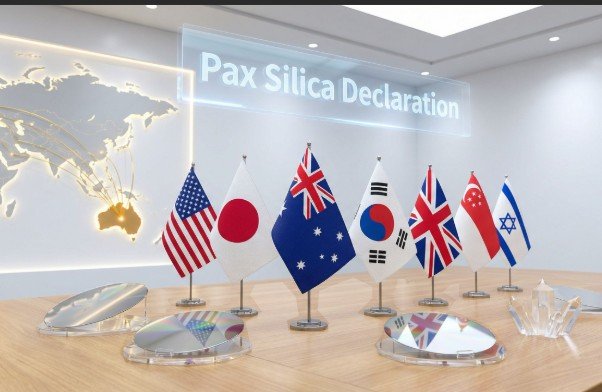
India, Feb 20 : India’s decision to formally join the US-led Pax Silica coalition signals a major strategic move in the global semiconductor race. Signed during the India AI Impact Summit 2026 in New Delhi, the declaration brings India into a grouping focused on securing critical technologies and strengthening semiconductor supply chains amid rising geopolitical tensions.
Launched in Washington in December 2025, the Pax Silica initiative aims to reduce dependence on concentrated supply networks and build trusted industrial partnerships across the silicon ecosystem from mineral extraction to chip fabrication and AI deployment. The coalition includes countries such as Israel, Japan, Australia, the United Kingdom, Singapore, the Republic of Korea, Qatar, the United Arab Emirates and Greece.
Strategic backdrop: rare earth dominance and tech leverage
The semiconductor push comes against the backdrop of China’s overwhelming dominance in rare earth production and processing. According to estimates cited by the International Energy Agency and reported by the BBC in October 2025, China accounts for roughly 61 per cent of global rare earth output and about 92 per cent of processing capacity. These minerals are essential for semiconductors, electric vehicles, defence systems and advanced electronics.
Recent export controls imposed by Beijing have heightened concerns among major economies about supply vulnerabilities. Analysts say such concentration gives China significant leverage in trade and technology negotiations, prompting partner nations to accelerate diversification efforts.
US Ambassador to India Sergio Gor described the coalition as a defining partnership for the 21st century economic and technological order. Calling India a co-founder, he framed the alliance as one aimed at ensuring that innovation and advanced manufacturing remain within trusted democracies.
Building resilience across the silicon stack
Pax Silica has been positioned as a comprehensive framework to secure the entire semiconductor ecosystem — from critical minerals to fabrication plants and high-performance computing infrastructure. The declaration emphasises that stable chip supply chains are central to economic security and recognises artificial intelligence as a transformative force shaping long-term prosperity.
Union Electronics and IT Minister Ashwini Vaishnaw termed India’s entry a historic step, underscoring the need for resilient technology networks in a world where supply chains can be disrupted or weaponised. He highlighted that India is advancing in semiconductor design, including work on 2-nanometer chips, while multiple fabrication facilities are under development.
Ten semiconductor plants are at various stages of progress, with commercial output expected in phases. According to the government, a broader ecosystem covering manufacturing equipment and materials is also taking shape.
The India AI Impact Summit 2026 described as the first global AI summit hosted in the Global South saw participation from more than 110 countries and several international organisations, reinforcing India’s growing role in shaping emerging technology governance.
By aligning with Pax Silica, New Delhi has positioned itself deeper within the global semiconductor value chain, signalling its intent to move from technology consumer to strategic technology partner in an increasingly competitive landscape.

