


PM Modi, Japanese PM Sanae Takaichi Hold Summit Talks in New Delhi
Prime Minister Narendra Modi and Japanese Prime Minister Sanae Takaichi discuss semiconductors, critical technologies, resilient supply chains, minerals and pharmaceuticals as both sides prepare to issue key statements on economic security and artificial intelligence cooperation.
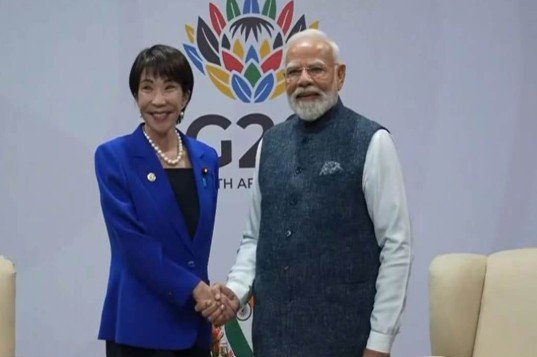
New Delhi, July 2: Prime Minister Narendra Modi on Thursday held summit-level talks with Japanese Prime Minister Sanae Takaichi in New Delhi, with the two leaders focusing on strengthening the strategic and economic pillars of the India-Japan partnership at a time of growing global emphasis on resilient supply chains, technological self-reliance and trusted economic cooperation. The summit underlined the shared determination of the two countries to expand collaboration in semiconductors, critical and emerging technologies, artificial intelligence, critical minerals and pharmaceuticals, while also reaffirming the broader strategic convergence that has steadily deepened bilateral ties over the past decade.
The high-level engagement came as Takaichi began a three-day visit to India, a trip that assumes significance not only because of the range of issues on the table but also because it takes place at a moment when New Delhi and Tokyo are looking to position their partnership as a central pillar of stability and trusted cooperation in the Indo-Pacific. Officials indicated that the summit would result in a joint declaration on economic security cooperation and a separate joint statement on artificial intelligence, reflecting the expanding scope of bilateral ties beyond traditional diplomatic and economic exchanges into the domain of future technologies and strategic industrial resilience.
The emphasis on economic security marked one of the most consequential aspects of the Modi-Takaichi talks. In recent years, the idea of economic security has moved to the centre of policymaking in major economies as countries confront the vulnerabilities exposed by geopolitical tensions, pandemic-era disruptions, supply chain bottlenecks and growing technological competition. For India and Japan, both of which are seeking to diversify production ecosystems and reduce dependence on concentrated manufacturing networks, the concept has particular relevance. Thursday’s summit discussions appeared aimed at translating this shared concern into a more structured bilateral agenda.
Semiconductors emerged as a key focus area in the talks, underscoring the strategic importance both governments now attach to the sector. The global semiconductor industry has become a crucial theatre of economic and geopolitical competition, with chips powering everything from consumer electronics and electric vehicles to telecommunications systems, defence equipment and artificial intelligence infrastructure. India has been pushing to build a domestic semiconductor ecosystem through incentives, manufacturing partnerships and design capabilities, while Japan has been actively seeking to reinforce its own role in advanced manufacturing and secure reliable production and supply chains in collaboration with trusted partners. Against that backdrop, the summit discussions on resilient semiconductor supply chains signalled a recognition that India and Japan can complement each other in technology, manufacturing, investment and strategic planning.
The talks also reportedly covered critical technologies more broadly, indicating that the India-Japan relationship is increasingly being shaped by sectors that will define economic power and national competitiveness in the coming decades. These include not only semiconductors and artificial intelligence but also advanced materials, digital infrastructure, quantum-related research, next-generation telecommunications and other frontier domains where technological capability is closely tied to strategic influence. By prioritising these areas, New Delhi and Tokyo are effectively moving their partnership into a phase where economic cooperation is no longer viewed simply through the lens of trade and infrastructure, but through the larger framework of national resilience, technological sovereignty and secure industrial ecosystems.
Artificial intelligence is set to receive dedicated attention through a joint statement expected after the summit, a development that highlights the growing importance of AI in bilateral engagement. For India, which has positioned itself as a major digital economy with ambitions in public digital infrastructure, AI applications and innovation, cooperation with Japan offers opportunities in investment, research collaboration, standards-setting and responsible technology development. For Japan, partnership with India provides access to a large talent pool, expanding digital markets and a trusted democratic partner with scale in software, data systems and emerging innovation ecosystems. A joint statement on AI suggests that the two sides are seeking to formalise this convergence and create a framework for cooperation that could span research, industrial use cases, ethical principles, talent development and cross-border innovation.
Another major theme of the summit was expected to be critical minerals, an area of growing global competition because of its central role in clean energy transitions, electric mobility, advanced electronics and defence manufacturing. Minerals such as lithium, cobalt, rare earths and other strategic inputs have become essential to the global race for batteries, renewable technologies and high-tech manufacturing. India and Japan both have strong incentives to build secure and diversified access to these resources. For India, which is trying to accelerate domestic manufacturing in electronics, electric vehicles and strategic sectors, critical mineral partnerships are becoming indispensable. For Japan, which has long focused on supply chain resilience and resource security, cooperation with India offers a way to strengthen sourcing networks and develop long-term industrial collaboration in a rapidly shifting global market.
Pharmaceutical cooperation also figured in the agenda, reflecting another important area where India and Japan can expand collaboration in both commercial and strategic terms. India’s position as a major pharmaceutical producer, particularly in generic medicines and vaccine manufacturing, complements Japan’s strengths in advanced research, healthcare technology and quality-focused pharmaceutical systems. In a world still shaped by lessons from the pandemic, health security and pharmaceutical resilience have acquired greater importance in bilateral and multilateral diplomacy. Deeper India-Japan cooperation in this sector could extend from manufacturing and supply chain integration to research partnerships, healthcare innovation and medical preparedness.
The political messaging around the summit emphasised continuity, trust and strategic convergence. External Affairs Ministry spokesperson Randhir Jaiswal described the engagement as taking forward a partnership anchored in trust, shared values and strategic alignment, a formulation that captures the broad trajectory of India-Japan ties over the past decade. The relationship, elevated in 2014 to a Special Strategic and Global Partnership, has grown far beyond its earlier emphasis on economic cooperation and Japanese investment in Indian infrastructure. It now encompasses defence and maritime security, regional strategic coordination, industrial cooperation, connectivity, digital transformation, skill development, green technologies and people-to-people exchanges.
That expansion has been driven by both structural and political factors. Structurally, India and Japan find themselves increasingly aligned in an Indo-Pacific environment marked by strategic uncertainty, supply chain vulnerabilities and concerns over coercive economic practices. Both countries support a free, open and rules-based regional order and see value in working with trusted partners to reduce exposure to geopolitical shocks. Politically, the relationship has benefited from sustained top-level engagement and a conscious effort by both governments to institutionalise cooperation across sectors. The fact that the bilateral framework now includes more than 70 dialogue mechanisms illustrates how dense and multi-layered the partnership has become.
The annual summit between the prime ministers remains the flagship platform driving this relationship. It is through this summit format that the broad political direction of the partnership is periodically reset, major deliverables are announced and new areas of cooperation are folded into the bilateral agenda. Modi’s visit to Tokyo for the 15th Annual Summit in August last year had already reinforced the centrality of this mechanism. Takaichi’s visit to India and the latest summit now continue that trajectory, with an even sharper emphasis on economic security and strategic technology cooperation.
The timing of the talks is also notable because India and Japan are moving towards the 75th anniversary of the establishment of diplomatic relations in 2027. That milestone offers both governments an opportunity not just to celebrate a mature partnership but to define its next phase. Over the decades, the India-Japan relationship has evolved from cordial diplomatic ties into a broad strategic compact with significant implications for Asia’s economic and security architecture. As the anniversary approaches, there appears to be a conscious effort on both sides to ensure that the relationship is not merely commemorative in tone but forward-looking in substance.
Economic cooperation remains a foundational pillar of the partnership, and Thursday’s summit sought to build on that base while adapting it to a changing world. Japan has long been one of the most important sources of foreign investment and development assistance for India, playing a major role in infrastructure, transport, industrial corridors and urban development projects. Yet the current phase of bilateral ties appears to be moving toward a more strategic form of economic engagement, one that is concerned not just with investment volumes but with where that investment goes, how production ecosystems are secured and which technologies are jointly developed or protected.
This shift mirrors broader global trends. The world economy is increasingly being reorganised around questions of trust, resilience and strategic dependence. Countries are reassessing supply chains in sectors like semiconductors, batteries, pharmaceuticals and digital infrastructure, seeking to ensure that critical systems are not overly dependent on a single geography or vulnerable to geopolitical disruption. India and Japan, through their emphasis on economic security, are signalling that their partnership will be one of the vehicles through which they respond to this new environment.
For India, closer coordination with Japan offers several strategic advantages. Japan brings advanced manufacturing capabilities, capital, technological depth, high-quality industrial processes and a longstanding reputation for infrastructure execution. It also offers a trusted partnership model at a time when India is trying to attract investment into sectors such as electronics, mobility, green energy and advanced manufacturing. For Japan, India offers market scale, demographic depth, digital capabilities and a growing role in regional supply chains. The partnership therefore rests not only on shared geopolitical interests but on a strong logic of economic complementarity.
The summit is also likely to be read in the context of the wider Indo-Pacific strategic landscape. India and Japan are both important players in regional forums and minilateral arrangements, and both have invested heavily in the idea of a stable Indo-Pacific anchored in openness, connectivity and rules-based conduct. Although Thursday’s official agenda centred on economic and technological cooperation, the strategic subtext of the relationship cannot be separated from the regional environment in which it operates. Stronger supply chains, trusted technology partnerships and secure access to critical resources are not just commercial objectives; they are also instruments of strategic resilience in an increasingly contested region.
As the summit concludes and the expected joint declaration and AI statement are released, the real test will lie in implementation. India-Japan relations have often benefited from high political goodwill, but translating summit intent into sustained institutional, industrial and technological outcomes requires follow-through. Semiconductor collaboration, critical mineral partnerships and AI cooperation all involve long gestation periods, coordination between governments and industry, regulatory clarity and investment commitments. The significance of the summit will therefore ultimately be measured by whether the two sides can convert strategic convergence into durable projects, financing arrangements, research partnerships and industrial linkages.
Still, Thursday’s summit has already served an important signalling function. It has shown that India and Japan are determined to deepen a relationship that is no longer limited to conventional diplomacy or infrastructure cooperation but is increasingly anchored in the strategic economy of the future. In bringing semiconductors, AI, critical minerals and pharmaceuticals to the centre of bilateral talks, Modi and Takaichi have underlined that the India-Japan partnership is being recalibrated for an era in which economic power, technological capability and national security are more intertwined than ever before.
The New Delhi summit thus represents both continuity and transition continuity in the long-standing political trust and strategic alignment between India and Japan, and transition in the sectors and priorities now driving that alignment. As the two countries move closer to the 75th year of diplomatic relations, the partnership appears set to become even more consequential, not only for bilateral ties but for the wider regional and global effort to build resilient, trusted and democratic frameworks of economic and technological cooperation.

