


POPULATION GROWTH
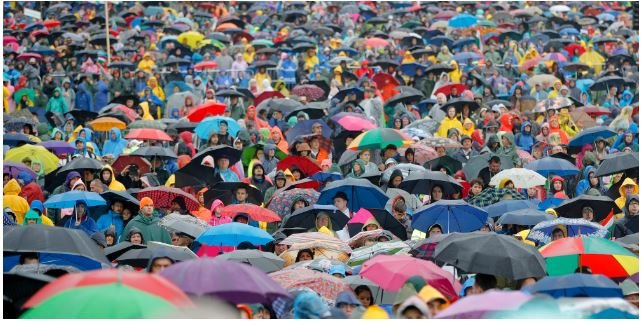
There are currently eight billion people living on earth, according to United Nations research (UN). UN Secretary-General Antonio Guterres said in a statement that the milestone presents a chance to celebrate diversity and achievements while keeping in mind humanity’s shared responsibility for the environment. The UN also noted that due to the gradual increase of human lifespan brought about by improvements in diet, personal hygiene, public health, and medicine, this growth is unparalleled. It is a result of rising fertility rates as well, which endanger the development of the world’s poorest nations, the majority of which are in sub-Saharan Africa. The effects of economic development on the environment have also been amplified by population growth. Although some people worry that there would not be enough space for eight billion people on Earth, most experts agree that the biggest issue is the overconsumption of resources by the richest individuals. However, the UN has a different opinion. Several people express concern that the globe is overpopulated, according to Natalia Kanem, director of the United Nations Population Fund. I’m here to state unequivocally that the staggering number of lives killed is not cause for alarm. In addition, despite claims to the contrary, India’s population is “still rising at 0.7% per year” and is predicted to surpass China as the world’s most populous country in 2023. China’s population is no longer growing, and the UN claims that it “may start declining as early as 2023.” According to a survey, India had a fertility rate of 2.1 children per woman, which was below replacement level. The UN also emphasized that although population growth was substantial in the second part of the 20th century, it may now be beginning to decelerate. There are 72.8 years left in the globe as of 2019, an increase of almost nine years since 1990. Current projections suggest that by 2050, people will live an average of 77.2 years. It’s fascinating to observe that only eight countries—the Congo, Egypt, Ethiopia, India, Nigeria, Pakistan, the Philippines, and Tanzania—are expected to produce the next billion people. The prediction is presented in the UN research World Population Prospects 2022. According to statistics, 50% of the world’s population now resides in just seven countries: China, India, the US, Indonesia, Pakistan, Nigeria, and Brazil. The UN projects that it will take until 2080 to reach 10 billion people, indicating that the rate of population increase worldwide is slowing generally. It may take 15 years to reach 9 billion people. According to the UN, declining fertility rates globally are what’s causing population reduction. The research also stated that some of the world’s poorer nations, such as those in sub-Saharan Africa, are where the majority of the world’s population increase is concentrated, and that this does not necessarily mean that the population of such nations is expanding quickly. It has been recommended that we should celebrate this achievement on two fronts: the accomplishment of species survival and the success of development, even in the world’s most underdeveloped regions. In turn, this contradicts the viewpoint of doomsayers who regard population growth as a major issue.
Whatever perspective we choose, the birth of the eighth billionth person on earth is no little accomplishment. It may be an opportunity to celebrate our differences, acknowledge our shared humanity, and marvel at medical advances that have lengthened lifespans and significantly lowered mother and infant death rates. Should we be concerned about population growth, particularly in a place like India? It has been argued that rather than concentrating on population growth, we should concentrate on how to properly educate the next generation and establish the framework for their gainful employment. Apart from other countries, the US, Germany, and the UK currently experience a severe labour shortage that is driving up salaries, impeding efforts to control inflation, and increasing reliance on technology and artificial intelligence. Large-scale immigration could solve this issue, yet it leads to tumultuous political situations. This demonstrates things to be concerned about in terms of population growth. It just isn’t about the sum of the numbers.

