


Protecting J&K’s Cultural Soul
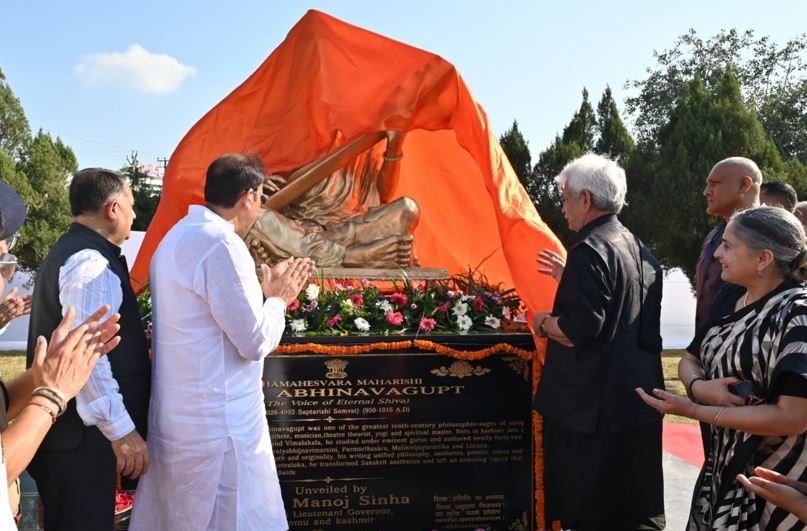
The unveiling of Acharya Abhinavagupt’s statue in Jammu, along with the release of two books, the launch of the new logo of the J&K Academy of Art, Culture and Languages and the introduction of a welfare scheme for artists and writers, is more than a cultural event. It is a reminder that Jammu and Kashmir has a vast intellectual and artistic inheritance which cannot be allowed to remain hidden in libraries, limited circles or ceremonial references. A society that forgets its thinkers, artists and writers slowly weakens its own cultural confidence.
Acharya Abhinavagupt was not only a philosopher of Kashmir’s past. He was a great mind whose work in Kashmir Shaivism, Pratyabhijna philosophy, aesthetics and the theory of rasa continues to hold relevance even today. His thought linked art with inner awakening, life with truth and creativity with higher consciousness. Such a thinker should not remain known only to scholars. His ideas deserve to reach classrooms, universities, cultural forums and young minds across Jammu and Kashmir. Lieutenant Governor Manoj Sinha’s call to correct historical oversights is important and timely. For too long, many civilizational contributions of Jammu and Kashmir have remained outside mainstream public awareness. This is not a small gap. When young people are not taught about the intellectual depth of their own land, they begin to see heritage only as monuments, festivals or rituals. Heritage is much deeper. It is also thought, philosophy, literature, music, language, memory and the continuous search for truth. The welfare scheme for artists and writers is equally meaningful. Artists and writers are often praised in public functions, but many of them struggle in silence. They preserve the emotional and cultural memory of society through songs, stories, books, paintings, theatre, research and performance. They keep languages alive, protect traditions and give voice to the feelings of the people. Supporting them is not charity. It is a duty towards culture itself. The release of Dr. Vaidehi Taman’s book on Abhinavagupt and Akriti Sharma’s work on Raghunath Temple, Channi Parat, also highlights the value of serious research. Cultural pride without study becomes shallow. Heritage must be documented, interpreted and brought before the public in an accessible way. The Raghunath Temple at Channi Parat, associated with the period of Maharaja Gulab Singh and Maharaja Ranbir Singh, is a reminder that many important heritage sites of Jammu and Kashmir still need wider recognition, preservation and scholarly attention. However, cultural revival must not stop at statues, speeches and book releases. These are important beginnings, but they must lead to sustained work. Jammu and Kashmir needs a stronger cultural ecosystem where research, translation, publications, archives, libraries, heritage mapping, artist support and youth engagement are treated as serious public priorities. If such efforts remain occasional, the impact will fade. If they are institutionalised, they can shape a new cultural confidence. Schools and universities have a major role to play. Students should be introduced to thinkers like Abhinavagupt, Kalhana, Lal Ded and other great voices of the region in a simple and meaningful way. Dogri, Kashmiri, Gojri, Pahari and other linguistic traditions must be supported with equal seriousness. Cultural institutions should organise regular lectures, reading programmes, exhibitions, heritage walks, digital archives and translation projects so that young people do not remain disconnected from their roots. The J&K Academy of Art, Culture and Languages must become an active centre of cultural energy. It should not only organise events, but also support writers, researchers, folk artists, translators and young scholars. Private institutions, civil society and universities should also come forward, because cultural preservation cannot be left to government alone.
Ultimately, Jammu and Kashmir must move beyond remembering its heritage and begin renewing it with purpose and pride. The statue of Acharya Abhinavagupt should open new doors of study and reflection, the books should encourage deeper reading and research, and the welfare scheme should give artists and writers the dignity, recognition and support they truly deserve. The practical way forward is to create research grants, translation missions, district-wise heritage documentation, youth cultural clubs and regular financial support for creators. A society becomes strong when it knows where it comes from and protects those who carry its memory. Jammu and Kashmir must ensure that its civilizational wisdom does not remain a matter of pride in speeches, but becomes a living force in education, culture and public life.

