


Rath Yatra 2026: Devotees Resume Pulling Sacred Chariots Amid Resonant ‘Jay Jagannath’ Chants
After an overnight halt caused by delayed rituals and rain, the divine chariots of Lord Jagannath, Lord Balabhadra, and Devi Subhadra resumed their journey toward Gundicha Temple amid immense devotion and elaborate arrangements.
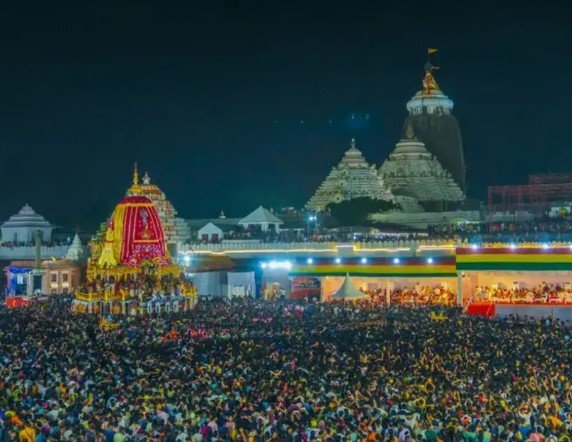
PURI, July 17: The spiritual fervour of Odisha’s world famous Rath Yatra 2026 continued on Friday as the majestic chariots of Lord Jagannath, Lord Balabhadra, and Devi Subhadra resumed their sacred journey towards the Gundicha Temple after halting overnight on the Grand Road. The annual festival witnessed an overwhelming gathering of devotees, with chants of “Jay Jagannath” filling the air as thousands joined hands to pull the towering wooden chariots.
The procession had begun on Thursday, but the chariots could not complete the 2.6-kilometre journey from the historic 12th-century Shree Jagannath Temple to Gundicha Temple due to delays in ceremonial rituals and the onset of darkness. As a result, the divine siblings remained on their respective chariots throughout the night before the procession recommenced the following morning.
Massive Crowd Marks the Second Day of the Festival
Devotees from across India and abroad gathered in Puri before sunrise to witness one of Hinduism’s most significant festivals. The atmosphere along the Grand Road was charged with devotion as pilgrims enthusiastically pulled the three elaborately decorated chariots while singing hymns and raising slogans in praise of Lord Jagannath.
Temple authorities and security agencies coordinated the movement of the enormous chariots, ensuring that devotees could safely participate in the centuries old tradition.
Gajapati Maharaja Explains the Overnight Halt
Gajapati Maharaja Dibyasingha Deb, regarded as the foremost servitor of Lord Jagannath, reassured devotees that extending the procession into the next day was neither unusual nor against tradition.
In his message, he explained that several Rath Yatras in the past had similarly continued beyond the scheduled day whenever circumstances prevented the chariots from reaching their destination. According to him, Thursday’s procession was halted after nightfall to ensure the safety of devotees and maintain the sanctity of the rituals.
His remarks helped calm concerns among pilgrims who were eager to understand why the sacred journey had been interrupted.
Progress of the Three Sacred Chariots
Each of the three divine chariots had covered different distances before the procession was suspended.
Lord Balabhadra’s Taladhwaja chariot advanced nearly 700 metres before stopping at Market Chhak.
Devi Subhadra’s Darpadalana chariot moved around 400 metres and halted near Marichikote Chhak.
Lord Jagannath’s magnificent Nandighosha chariot covered only a short stretch and remained close to the Singhadwar, or Lion’s Gate, of the Jagannath Temple.
These chariots resumed movement on Friday under the supervision of temple officials and volunteers.
Delay Linked to Pahandi Ritual
Officials of the Shree Jagannath Temple Administration (SJTA) clarified that the overall schedule was affected because the ceremonial Pahandi, the ritual procession during which the deities are brought from the sanctum to their chariots, took longer than expected.
SJTA Chief Administrator Arabinda Padhee explained that while most rituals proceeded according to tradition, Lord Jagannath’s idol remained stationary at the temple entrance for nearly forty minutes, resulting in an overall delay of more than an hour before the chariot pulling could commence.
He emphasized that the postponement was procedural rather than administrative and was handled according to temple customs.
Sibling Deities to Enter Gundicha Temple on Saturday
Temple authorities announced that although the chariots resumed their journey on Friday, the ceremonial entry of the deities into the Gundicha Temple would take place on Saturday.
The divine siblings were expected to remain on their chariots overnight before completing the final stage of the pilgrimage.
The Gundicha Temple occupies a unique place in Jagannath tradition and is believed to represent the birthplace or maternal home of the deities. Their annual visit symbolizes an important spiritual journey that attracts millions of devotees every year.
Rain Fails to Dampen Devotional Spirit
Intermittent rainfall throughout Thursday created additional logistical challenges, yet the festive atmosphere remained unaffected.
Pilgrims continued singing devotional songs, dancing along the Grand Road, and participating enthusiastically despite the wet conditions.
Authorities deployed teams to remove accumulated rainwater from the route, ensuring smoother movement of both devotees and the massive chariots.
Officials praised the coordinated efforts of municipal workers, emergency responders, volunteers, and police personnel for maintaining order during adverse weather.
Traditional Ornament Removed Due to Rain
Another notable development during the festival involved the absence of Lord Jagannath’s traditional Tahika, an ornate floral crown usually worn during the Pahandi ceremony.
Temple officials explained that persistent rain caused the decorative crown to become waterlogged and unusually heavy, prompting its temporary removal to facilitate the safe movement of the deity during the procession.
The decision was described as a practical measure taken without affecting the religious significance of the rituals.
Lakhs Participate in the Grand Festival
Authorities estimated an extraordinary turnout during the opening phase of the Rath Yatra.
While the Shree Jagannath Temple Administration placed attendance between 10 and 12 lakh devotees, the Odisha Chief Minister’s Office estimated participation at around 8 to 9 lakh pilgrims.
Regardless of the differing estimates, officials agreed that this year’s celebration attracted one of the largest gatherings witnessed in recent years.
Extensive security arrangements, traffic management plans, medical facilities, and emergency response systems were deployed throughout the city to accommodate the massive influx of visitors.
Centuries-Old Tradition Continues
The Rath Yatra remains one of India’s oldest and most revered religious festivals. Celebrated annually on the second day of the bright fortnight of the Odia month of Ashadha, it marks the rare occasion when Lord Jagannath, Lord Balabhadra, and Devi Subhadra leave the sanctum of the Jagannath Temple to bless devotees outside the shrine.
Before the procession began on Thursday, Gajapati Maharaja Dibyasingha Deb performed the sacred Chhera Pahanra ritual, ceremonially sweeping the chariots with a golden broom, symbolizing humility before the divine. The festival also witnessed the traditional visit of Puri Shankaracharya Swami Nischalananda Saraswati.
The rhythmic sounds of conch shells, cymbals, trumpets, and devotional chants transformed Puri into a sea of spirituality as devotees celebrated the timeless tradition with unwavering faith.
With the procession now moving steadily toward Gundicha Temple, pilgrims continue to await the completion of one of India’s most iconic religious events, reaffirming the enduring cultural and spiritual significance of the Rath Yatra 2026.

