


RBI Rate Hike Puts Pressure on Indian Markets as Oil Prices Surge
Higher borrowing costs, elevated crude prices and continued foreign outflows keep investors cautious despite strong domestic growth.
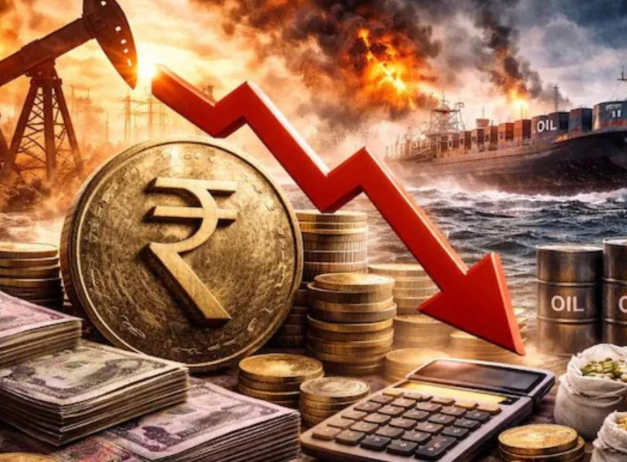
NEW DELHI, Oct 8: Indian equity markets remained under pressure on Thursday as investors assessed the impact of the Reserve Bank of India’s decision to raise the repo rate and growing concerns over higher crude oil prices amid geopolitical tensions.
The benchmark Nifty 50 and BSE Sensex extended their losses during Thursday’s trading session after both indices declined sharply on Wednesday. The Nifty was down around 0.54 per cent at 22,482.1, while the Sensex fell 0.48 per cent to 72,290.77 in early trading.
The weakness followed the RBI’s decision on October 7 to increase the benchmark repo rate by 25 basis points to 5.50 per cent. It was the central bank’s first rate increase in nearly four years and marked a shift in its policy approach as inflation risks have increased.
The RBI also moved its policy stance from neutral to calibrated tightening, indicating that policymakers are prepared to respond to persistent inflationary pressures if required.
The rate decision has significant implications for the broader economy because borrowing costs influence household spending, corporate investment and financial-market valuations.
Banks and financial institutions are likely to begin passing the higher policy rate into lending benchmarks. For borrowers with floating-rate loans, the change could result in higher interest payments or longer repayment periods.
Companies that depend heavily on bank credit could also face higher financing expenses. Businesses with substantial debt may need to reconsider expansion plans if borrowing costs remain elevated for an extended period.
At the same time, higher interest rates can benefit savers if banks increase deposit rates. However, the overall effect on consumption could be negative if households have less disposable income because of increased loan repayments.
The market reaction has also been influenced by movements in global crude oil prices. Brent crude rose above USD 100 a barrel as tensions in West Asia continued to raise concerns about supply disruptions. Brent was trading around USD 102.5 a barrel, according to market data cited by Reuters.
Higher oil prices are particularly important for India because the country relies heavily on imported crude. A sustained increase could raise the cost of transportation, manufacturing and logistics and could eventually feed into consumer prices.
The combination of higher interest rates and expensive energy creates a challenging environment for investors. While tighter monetary policy is aimed at containing inflation, higher input costs can simultaneously reduce corporate profit margins.
Foreign investors have also remained cautious towards Indian equities. Foreign institutional investors have recorded substantial outflows from Indian stocks during 2026, with geopolitical uncertainty and elevated US Treasury yields adding to the pressure on emerging markets.
Domestic institutional investors, however, have continued to provide some support. On October 7, foreign institutional investors sold equities worth around Rs 2,961 crore, while domestic institutions bought shares worth more than Rs 5,088 crore.
This divergence highlights the growing importance of domestic investment flows in cushioning the impact of overseas selling.
The performance of individual sectors has also varied. Banking stocks have shown some resilience following the RBI announcement, as investors assess the potential impact of higher lending rates on bank margins.
Technology stocks have performed relatively better, with the IT sector gaining as investors turned their attention towards the September-quarter earnings season. Tata Consultancy Services emerged as one of the stocks in focus ahead of its quarterly results.
The September-quarter earnings season is expected to provide important clues about the health of corporate India. Investors will examine revenue growth, margins, order books and management guidance to determine whether companies can withstand higher financing and input costs.
TCS is among the first major Indian IT companies scheduled to report its quarterly results, making the company’s performance particularly significant for the technology sector.
Meanwhile, several other companies have released operational updates. Senco Gold reported a 31 per cent year-on-year increase in second-quarter revenue, while Jubilant FoodWorks posted consolidated revenue growth of 11.9 per cent.
Tata Steel also reported an increase in Indian crude steel production, while other companies including Tata Power, Godrej Properties and HCL Technologies announced developments that could influence investor sentiment.
The mixed corporate picture suggests that the market is becoming increasingly selective. Companies with strong balance sheets, manageable debt and stable demand could be better positioned than businesses vulnerable to higher financing costs.
The currency market is another factor that investors are watching closely. The rupee remained weak against the US dollar, adding to concerns over the cost of imported commodities. A weaker rupee can make crude oil and other imports more expensive in domestic terms.
For the government and policymakers, higher oil prices also present a fiscal challenge. Sustained energy inflation can affect subsidies, transport costs and the broader inflation outlook.
The RBI’s latest decision therefore comes at a delicate point for the Indian economy. Growth remains comparatively strong, but external risks have increased.
The central bank has projected real GDP growth at 7.1 per cent for the 2026-27 financial year, suggesting that policymakers continue to see resilience in domestic economic activity.
However, the rate increase shows that controlling inflation has become a greater priority. If global energy prices remain elevated, the RBI could face a difficult balancing act between supporting growth and preventing a fresh inflationary cycle.
Market participants are now likely to focus on upcoming inflation figures, corporate earnings and developments in global crude markets.
The direction of foreign investment flows will also remain important. Continued overseas selling could keep pressure on Indian equities, while stronger domestic institutional participation may help limit the downside.
The immediate outlook is therefore likely to remain volatile. Investors are expected to monitor interest-rate expectations, oil prices, currency movements and company-specific earnings before taking larger positions.
For businesses, the current environment reinforces the importance of controlling costs and maintaining healthy balance sheets. For investors, it highlights the need to distinguish between companies that can absorb higher financing expenses and those whose profitability could be significantly affected.
With monetary policy tightening and global energy markets unsettled, India’s financial markets are entering a period in which economic fundamentals and corporate earnings will play an increasingly important role in determining the next phase of market performance.

