


Ship Engulfed in Flames in Strait of Hormuz Amid Escalating US-Iran Conflict
A vessel catches fire near Oman's coast amid heightened military operations, renewed US airstrikes, and Iranian missile attacks, raising fresh concerns over global shipping and regional stability.
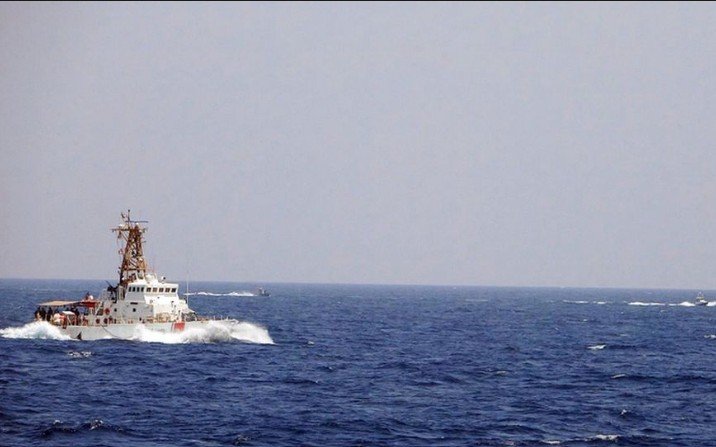
Dubai: A cargo vessel caught fire in the strategically vital Strait of Hormuz early Monday, adding to growing concerns over maritime security as hostilities between the United States and Iran entered a dangerous new phase. The incident occurred near the coast of Oman, one of the world’s busiest energy transit routes, where commercial shipping has already been severely disrupted by escalating military activity.
The United Kingdom Maritime Trade Operations (UKMTO), the British military’s maritime security monitoring agency, confirmed the incident and issued a navigational warning to vessels operating in the area. Officials said the exact cause of the fire remained unknown, while investigations were underway to determine whether the blaze resulted from an accident, military action, or another security related event.
The development comes at a time when international shipping companies have been exercising extreme caution while navigating the Strait of Hormuz, a narrow waterway through which a significant portion of the world’s oil and liquefied natural gas exports passes.
Critical Waterway Faces Mounting Security Risks
The Strait of Hormuz has become one of the most sensitive flashpoints in the Middle East since tensions between Washington and Tehran sharply escalated. The United States has advised commercial vessels to follow designated maritime corridors closer to Oman’s coastline in an effort to reduce exposure to potential attacks.
Iran, however, has repeatedly asserted its authority over the strategic passage and has accused the United States of militarizing regional waters. Recent attacks targeting vessels operating near recommended shipping routes have further heightened fears among global shipping operators and insurers.
Maritime analysts warn that continued disruptions in the strait could significantly impact international energy markets, freight costs, and global supply chains if security conditions continue to deteriorate.
Fresh US Airstrikes Target Iranian Military Infrastructure
The ship fire coincided with another round of large-scale American military operations inside Iran. The US military launched fresh overnight airstrikes against facilities linked to Iran’s Islamic Revolutionary Guard Corps (IRGC), marking the ninth consecutive night of military action.
According to US Central Command (CENTCOM), the strikes were aimed at reducing Iran’s capability to conduct attacks against commercial shipping and civilian maritime traffic transiting the Strait of Hormuz.
Military officials stated that precision-guided weapons targeted multiple strategic sites believed to support missile launches, drone operations, and other military infrastructure used in recent attacks against regional allies and commercial vessels.
American authorities emphasized that operations would continue until the perceived threat to international navigation and regional security is significantly reduced.
US Military Reports Additional Casualty
The Pentagon also confirmed the death of another American service member during military operations in Iraq.
According to military officials, the soldier lost his life during the controlled destruction of a downed Iranian drone recovered on Saturday. Investigators are also examining unidentified human remains recovered following an earlier attack that targeted US forces stationed in Jordan.
The latest casualty brings the total number of American military personnel killed since the conflict began to seventeen, underscoring the growing human cost of the expanding regional confrontation.
US defense officials reiterated that operations would continue in response to attacks on American troops stationed across the Middle East.
Iran Expands Missile Operations Across the Region
Iran responded by launching another wave of missiles and drones targeting several US-aligned countries in the Gulf region.
Air defense systems were activated across Bahrain, Jordan, and Kuwait after incoming projectiles were detected. Regional militaries reported intercepting several missiles before they reached populated areas, preventing major casualties.
Jordan confirmed that its defense forces successfully destroyed multiple incoming missiles while lodging a formal diplomatic protest with Tehran over repeated attacks violating its airspace.
Meanwhile, Israeli authorities warned residents near the southern city of Eilat that missile interceptions over neighboring Jordan could result in falling debris crossing into Israeli territory.
Security officials reported launching interceptor missiles to neutralize potential threats before they reached populated areas.
Nuclear Facility Construction Site Reportedly Hit
Iran’s Atomic Energy Organization claimed that one of the American airstrikes struck the construction site of the planned Darkhovin nuclear power facility in southwestern Iran.
State media reported that the project, still in its early development phase, sustained damage during the overnight attacks.
The International Atomic Energy Agency (IAEA) later stated that its most recent inspection found no nuclear material stored at the location because construction remained at an early stage.
Satellite imagery released before the latest escalation indicated that the project had only undergone preliminary site preparation and earth-moving work.
The incident nevertheless raises fresh concerns over the possibility of military operations affecting civilian nuclear infrastructure.
Regional Infrastructure Comes Under Pressure
The widening conflict has increasingly affected civilian infrastructure throughout the Gulf.
Kuwait confirmed that one of its major electricity generation and water desalination facilities came under attack for the second time within forty-eight hours. Authorities reported localized fires but assured residents that the national electricity grid continued operating normally.
Given that desalination plants supply the overwhelming majority of Kuwait’s drinking water, officials emphasized that emergency response teams acted quickly to contain the damage and prevent disruptions to public services.
Regional governments remain on heightened alert amid fears that additional attacks could target critical energy and utility infrastructure.
Growing International Concern
Regional organizations have expressed increasing concern over attacks affecting civilian facilities.
The Secretary-General of the Gulf Cooperation Council condemned strikes targeting essential infrastructure, warning that continued attacks on civilian installations could worsen humanitarian conditions across the region.
International humanitarian law generally prohibits deliberate attacks on civilian infrastructure unless such facilities are being used for military purposes. Even then, military operations are expected to follow the principles of proportionality while minimizing civilian harm.
Diplomatic efforts to restore the temporary ceasefire reached last month have so far failed, with both Washington and Tehran continuing military operations instead of returning to negotiations.
Global Shipping Industry Closely Monitoring Situation
The latest ship fire highlights the growing risks confronting commercial shipping companies operating through one of the world’s most important maritime corridors.
Shipping firms, insurers, and energy markets continue monitoring developments closely as repeated military activity threatens the uninterrupted movement of oil, natural gas, and commercial cargo through the Strait of Hormuz.
Analysts caution that prolonged instability could force shipping companies to reroute vessels, increasing transportation costs and extending delivery times for global trade.
With military operations showing no signs of slowing, regional security experts warn that the Strait of Hormuz is likely to remain at the center of geopolitical tensions in the coming weeks, carrying significant implications for international commerce, energy security, and diplomatic stability.

