


Sonam Wangchuk Launches Fast at Jantar Mantar as CJP Expands Protest to Election Concerns
Activist joins students demanding accountability in education while organisers announce the movement will also focus on electoral reforms and governance issues.
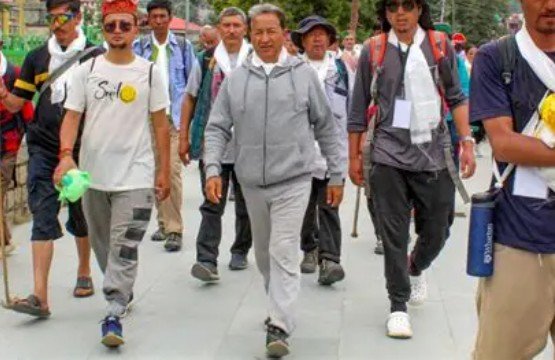
New Delhi, June 28: Activist Sonam Wangchuk on Sunday launched an indefinite hunger strike at Jantar Mantar in support of the ongoing protest demanding greater accountability in the country’s education system. The agitation, which initially began over alleged irregularities in competitive examinations, has now widened its scope to include electoral transparency and broader governance concerns.
The protest, organised by the Cockroach Janata Party (CJP), entered a new phase with Wangchuk joining the movement, lending support to students who have been raising concerns over examination management and demanding the resignation of Union Education Minister Dharmendra Pradhan.
Speaking to supporters, CJP founder Abhijeet Dipke clarified that the campaign would not remain confined to education alone. He said the movement aimed to raise larger issues of public accountability, including concerns related to the electoral process.
Addressing the gathering, Dipke urged people not to view the protest as a single-issue campaign. According to him, the struggle represents a broader demand for transparency and democratic accountability, with election related concerns also becoming part of the public discourse in the coming days.
He criticised recent developments concerning electoral roll revisions and alleged deletion of voter names, arguing that strengthening democratic institutions should remain a national priority. Dipke said his organisation would continue advocating reforms in the election system regardless of its electoral participation.
Explaining his decision to join the fast, Wangchuk said education had remained central to his life’s work for nearly four decades. He added that he could not ignore the concerns voiced by students who were questioning the fairness and credibility of the education system.
The 59-year-old activist said education and environmental protection have always been the two causes closest to him. According to Wangchuk, accountability is equally important in protecting nature and ensuring a transparent education system, and both issues require sustained public attention.
He maintained that peaceful democratic protests become necessary whenever institutions fail to respond adequately to genuine public concerns. Stressing the importance of non-violent movements, Wangchuk said dialogue and accountability remain essential pillars of democracy.
Before beginning his fast, Wangchuk and Dipke visited Rajghat to pay homage to Mahatma Gandhi. The protest commenced with participants observing a two-minute silence as a mark of respect before continuing with the day’s programme.
The activist also appealed to citizens across the country to participate symbolically by observing a one-day fast in solidarity with students and others seeking institutional accountability.
Large numbers of students, civil society representatives, social activists and farmer organisations gathered at Jantar Mantar during the day, significantly increasing the size of the demonstration.
Six student leaders also joined the indefinite hunger strike in solidarity with Wangchuk. They sat on a separate stage while extending support to the broader campaign for reforms in the education sector.
Dipke cautioned supporters against turning the movement into a personality driven campaign. He urged participants to keep public issues at the centre of the agitation rather than elevating individual leaders above the cause.
The protest also drew attention to several other matters. The family of Amaira, a Class VI student who died after falling from a school building in Jaipur last year, joined the demonstration demanding justice and faster legal action in the case. Her parents alleged that despite repeated appeals, no substantial progress had been made in the investigation.
Speaking at the gathering, Dipke alleged that ordinary citizens often struggle to secure justice despite fulfilling their civic responsibilities. He said such cases should remain part of the national conversation until accountability is ensured.
Representatives of the Sarv Khap Panchayat also attended the protest and expressed support for the movement. Community leaders symbolically presented a traditional pagdi to Dipke, describing it as a gesture of responsibility and public trust.
Farmer organisations from several states extended solidarity with the protesters. Some leaders alleged that many farmers intending to join the demonstration had been prevented from travelling to Delhi, although authorities have not officially responded to the claims.
Addressing the gathering, farmer representatives criticised the Union government over issues related to education, governance and public accountability. Some leaders warned that political consequences could follow if public grievances remained unaddressed.
The protest, which began on June 20 following controversies surrounding competitive examinations, continues to attract support from students, farmers and civil society groups. Organisers have indicated that the movement will continue until their demands for greater institutional accountability receive an appropriate response.

