


Sonia Gandhi Recalls How Rahul’s Friends Stayed Away From His Birthday After Indira’s 1977 Election Defeat
In her memoir Belonging: A Journey of Love, Sonia Gandhi describes how political tensions affected Rahul and Priyanka during their childhood, recalling that only one of Rahul’s invited friends attended his birthday party.
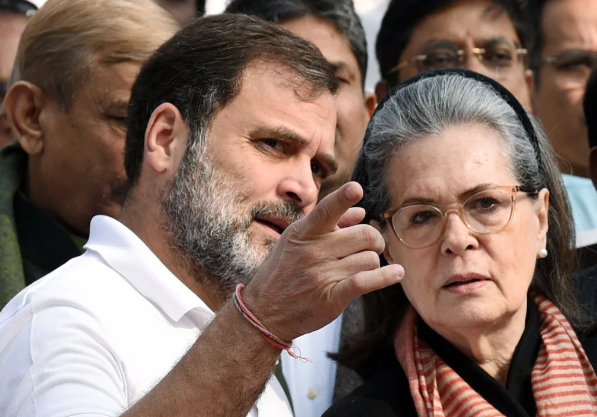
NEW DELHI, Nov 11: Congress leader Sonia Gandhi has recalled an emotional episode from Rahul Gandhi’s childhood, when most of his friends failed to attend his seventh birthday celebration following his grandmother Indira Gandhi’s defeat in the 1977 Lok Sabha elections.
In her memoir, Belonging: A Journey of Love, Sonia describes how a gathering planned with enthusiasm for Rahul on June 19 turned into a disappointing experience. She says the incident made her realise how political developments could affect even the personal lives of children.
According to Sonia, the family had recently moved into its new residence at 12, Willingdon Crescent. Despite the difficult political circumstances, she wanted to organise a modest birthday party for Rahul and invited children who had attended his earlier celebrations.
The preparations were simple, involving homemade cake, snacks, potato chips, balloons and decorative bunting. Rahul’s younger sister, Priyanka Gandhi Vadra, enthusiastically helped her mother decorate the verandah, with Rahul assisting her in hanging balloons.
Sonia also recalled a playful tradition involving Indira Gandhi, who owned a collection of clay toys from Bengal designed to resemble insects, lizards and flies. She would occasionally place the miniature figures on the dining table or children’s plates to surprise guests and create moments of laughter.
The family had expected the birthday gathering to be a cheerful occasion. However, as the scheduled time passed, only Rahul’s close friend Siddharth arrived.
Initially, Sonia assumed that the other parents might not have received the invitations. She began contacting them individually but received evasive responses. It was then that she understood that the other children would not be attending.
Sonia writes that the absence of Rahul’s classmates brought home the extent to which political developments had affected ordinary relationships. What should have been a simple celebration between schoolchildren had become entangled in the family’s political circumstances.
Although his parents and grandmother attempted to comfort him, Rahul was visibly disappointed. The family eventually cut the cake, but the celebration lacked its intended excitement.
Indira Gandhi, who had planned to use her collection of clay toys to entertain the children, returned the box to Sonia, remarking sadly that they could use it on another occasion.
Sonia also recounts how Rajiv Gandhi tried to explain the situation to his son. He told Rahul not to blame his friends, suggesting that their parents might be afraid of maintaining an association with the Gandhi family because of the political atmosphere.
The episode, Sonia says, became one of the early difficult lessons Rahul experienced about relationships and politics.
Her memoir also describes the challenges faced by Rahul and Priyanka during their school years. The children sometimes returned home upset after being subjected to remarks about members of their family.
Sonia recalls that they would ask why their grandmother and uncle were being called thieves and whether they had committed any wrongdoing. She would reassure them that the allegations were politically motivated and encourage them not to be frightened.
Another incident involved five-year-old Priyanka, who was once reported to be crying at school. Sonia rushed to the institution and found her daughter outside the classroom, attempting to wipe away her tears.
When asked what had happened, Priyanka explained that a boy had made an unpleasant remark about her. Sonia was angry and wanted to intervene, but her daughter requested her not to confront him because the teacher had already reprimanded him.
Sonia says the moment left her deeply moved, as her young daughter had demonstrated a sense of forgiveness that she herself was struggling to practise.
The recollections in the memoir offer a glimpse into the personal difficulties experienced by the Gandhi family during a period of considerable political uncertainty.
The Emergency, imposed by Prime Minister Indira Gandhi on June 25, 1975, had resulted in widespread political restrictions and the detention of opposition leaders. The proclamation was issued by President Fakhruddin Ali Ahmed on the government’s recommendation and subsequently received Cabinet approval.
On January 18, 1977, Indira Gandhi announced fresh parliamentary elections and ordered the release of political prisoners. However, the Congress suffered a major electoral setback in the March 1977 polls.
Indira Gandhi and her son Sanjay Gandhi both lost their Lok Sabha seats. The Emergency formally ended on March 21, 1977, bringing an end to the period of extraordinary restrictions.
Following the defeat, members of the Gandhi family faced several legal cases and political challenges. Indira Gandhi’s political fortunes began to improve after she won a by-election from Chikkamagalur in Karnataka in November 1978.
Sonia’s account focuses not only on the political consequences of the period but also on how its tensions entered the everyday lives of her children. Through memories of Rahul’s birthday and Priyanka’s school experience, she describes the difficulties of raising a family amid public criticism and political hostility.

