


Speaker Rejects BJP Motion on Vaishno Devi Track Workers’ Rehabilitation
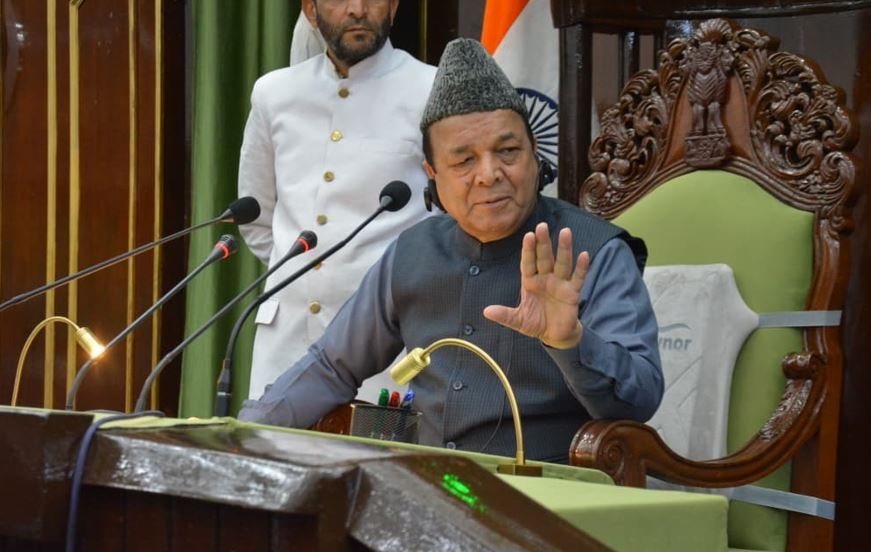
JAMMU, Feb 7: The Jammu and Kashmir Legislative Assembly on Friday witnessed a brief but pointed exchange after Speaker Abdul Rahim Rather rejected an adjournment motion moved by BJP legislator Baldev Sharma, who had sought a new rehabilitation policy for traditional service providers working on the Shri Mata Vaishno Devi Ji pilgrimage track.
Raising the issue after the Question Hour, Sharma, who represents the Katra Mata Vaishno Devi constituency, sought clarity from the Chair on the status of his adjournment motion. The Speaker informed the House that the motion had been disallowed as it did not meet the criteria required for adjournment proceedings.
Explaining his ruling, Speaker Rather said that an adjournment motion can only be admitted to discuss matters of urgent public importance arising from recent developments. He pointed out that the concerns highlighted by the MLA related to issues dating back to 2019 and therefore did not qualify as a matter of immediate occurrence. The Speaker also noted that Sharma himself had acknowledged having already raised the issue in the House earlier.
“Adjournment motions are meant for recent and urgent matters. Since this issue is not new and has already been discussed, it cannot be taken up under this provision,” the Speaker observed. However, he added that if the matter is of serious concern, it is for the government to examine it and take appropriate steps.
Despite the rejection of the motion, Baldev Sharma strongly reiterated his demand for a comprehensive and humane rehabilitation policy for traditional service providers associated with the pilgrimage. He said mule operators, pithu carriers, palki operators and mule owners have for decades formed the backbone of the yatra ecosystem and depend entirely on pilgrimage-related activities for their livelihood.
The BJP legislator argued that these workers have served pilgrims with dedication over generations and deserve policy support that reflects changing ground realities. He expressed concern that existing arrangements and policies are no longer adequate, especially in the context of evolving infrastructure, administrative decisions and modernisation along the pilgrimage route.
Sharma maintained that without a fresh rehabilitation framework, many of these traditional service providers face growing socio-economic uncertainty. He urged the government to recognise their contribution to the pilgrimage and ensure that their livelihoods are protected through a structured and forward-looking policy.

