


Supreme Court Refuses to Stay Bail Granted to Sonam Raghuvanshi
Top court expresses reservations over the Meghalaya High Court’s reasoning but refuses interim relief, noting the accused has already been released under strict bail conditions as the trial continues in the sensational Raja Raghuvanshi murder case.
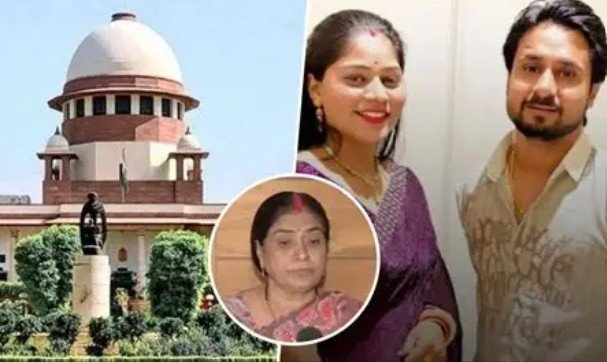
New Delhi, July 4: The Supreme Court on Friday refused to stay the bail granted to Sonam Raghuvanshi, one of the key accused in the sensational Raja Raghuvanshi murder case, even as it voiced prima facie reservations over the reasoning adopted by the Meghalaya High Court in upholding her release. The top court, however, declined to intervene at this stage, observing that Sonam had already been released from custody and was presently in Shillong in compliance with the conditions imposed by the trial court.
The matter came up before a bench of Justices M M Sundresh and Sheel Nagu after the Meghalaya government challenged the June 29 order of the Meghalaya High Court, which had upheld an earlier trial court decision granting bail to Sonam Raghuvanshi. The state, represented by Solicitor General Tushar Mehta, argued that the allegations against the accused were grave, the murder was pre-planned, and the high court had erred in granting relief on what he described as a technical ground linked to the alleged non-supply of complete grounds of arrest.
During the hearing, the Supreme Court made it clear that it was not entirely convinced by the manner in which the high court had addressed the issue. The bench noted that there were aspects of the order that raised concern, especially in view of the seriousness of the allegations and the fact that earlier bail pleas by the accused had reportedly been rejected on merits. Even so, the court stopped short of suspending the bail, saying it was reluctant to pass such an order after the accused had already been released from jail.
The case has attracted nationwide attention ever since the death of Raja Raghuvanshi, a businessman from Indore, whose body was recovered from a deep gorge in Meghalaya in June 2025 after he and his wife Sonam went missing during their honeymoon trip in the Sohra region. Investigators have alleged that the killing was the result of a criminal conspiracy involving Sonam and multiple accomplices, and that the murder was carried out for financial gain.
Appearing for the Meghalaya government, Solicitor General Mehta strongly opposed the continuation of bail and described the case as “really shocking.” He told the bench that the prosecution case was not of a sudden crime but of a carefully orchestrated murder allegedly executed with the help of hired assailants. According to the state’s version placed before the court, Raja Raghuvanshi was attacked and killed in Meghalaya while on a honeymoon trip with his wife, after which his body was thrown into a gorge. Mehta said Sonam was not merely linked to the conspiracy but was an active participant in the sequence of events, and had later absconded before being arrested from Uttar Pradesh.
The law officer urged the Supreme Court to stay the high court order immediately, warning that Sonam Raghuvanshi could abscond if the bail remained operational. He referred to the order passed by the magistrate in Uttar Pradesh at the time of her transit remand, arguing that the record itself showed that the grounds of arrest had been communicated to her. According to the state, this was crucial because the high court had attached importance to the argument that proper grounds of arrest were not supplied to the accused in accordance with legal requirements.
Mehta further argued that Sonam had filed multiple bail applications in the past, and in none of them had she raised the issue of non-supply of grounds of arrest. This, he suggested, showed that the argument was an afterthought and should not have formed the sole or primary basis for bail in a murder case of such gravity. He also contended that a reference in the arrest-related documents to Section 403(1) of the Bharatiya Nyaya Sanhita instead of Section 103(1), which deals with punishment for murder, was no more than a typographical error and could not be treated as a substantive illegality serious enough to justify bail.
The Supreme Court bench appeared to engage closely with this line of argument. Justice M M Sundresh observed that the material before the court indicated that the grounds of arrest had been explained to Sonam and that the magistrate’s order reflected such satisfaction. The judge also noted that the point had not been pressed in earlier bail proceedings. In a pointed observation during the hearing, the bench questioned whether a court should grant bail solely on a technical ground when earlier applications had already been rejected after considering the merits of the case.
The bench also asked the counsel appearing for Sonam Raghuvanshi whether such a plea could be raised belatedly, especially after multiple rounds of litigation. The court indicated that it was not immediately persuaded by the defence claim that the legal defect surrounding the arrest was so fundamental that it outweighed the prosecution’s allegations of a serious, premeditated crime.
In response, Sonam’s counsel maintained that the grounds of arrest had never been properly communicated to her at any stage in the manner required by law. He argued that what had been handed over to her was merely a memo, and that the magistrate’s proceedings in Uttar Pradesh related only to transit remand, at a time when she was not effectively represented by legal counsel. According to the defence, the failure to properly inform the accused of the grounds of arrest was not a minor procedural lapse but a violation affecting the legality of the detention itself.
The defence also sought to reassure the Supreme Court on the question of flight risk. Sonam’s lawyer submitted that the bail granted to her came with strict conditions and that she had been directed to remain in Shillong. Since she was under close judicial scrutiny and bound by those conditions, there was, according to the defence, no real possibility of her absconding or interfering with the trial process.
This assurance appeared to weigh with the bench while considering the state’s prayer for an immediate stay. The Supreme Court noted that Sonam had already been released from custody and was out on bail under the trial court’s conditions. The judges observed that they had initially been under the impression that she was still in custody. Once it became clear that the accused had already been released, the bench indicated that it was disinclined to suspend the bail order at this interim stage.
“If she is released, then we cannot stay the order,” the bench observed during the hearing, making it clear that while it had reservations about the high court’s reasoning, it was not inclined to send the accused back to custody through an interim order without fully hearing the matter. The court’s oral observations suggested a distinction between its doubts over the legal reasoning adopted by the high court and the practical question of whether bail should be immediately halted after the accused had already secured release.
At the same time, the Supreme Court’s remarks indicated that the Meghalaya government’s challenge has not been dismissed on merits. The bench’s observations suggest that the legality and correctness of the high court’s decision may still come under closer scrutiny in subsequent hearings. For now, however, the interim relief sought by the state has not been granted, and Sonam Raghuvanshi continues to remain on bail.
The case itself stems from one of the most closely followed murder investigations of 2025. Sonam Raghuvanshi, a resident of Indore in Madhya Pradesh, was arrested in June last year in connection with the killing of her husband Raja Raghuvanshi. The couple had travelled to Meghalaya for their honeymoon and had gone missing from the Sohra area on May 23, 2025. What initially appeared to be a missing persons case soon turned into a murder investigation after Raja’s body was found in a deep gorge on June 2, 2025.
The discovery of the body sent shockwaves across the country, not only because of the circumstances in which the couple had vanished but also because of the subsequent allegations made by investigators. Meghalaya Police later alleged that Sonam had conspired with hired attackers to eliminate her husband and that the murder was driven by financial motives. According to the prosecution, the crime was not spontaneous but planned in advance, with the honeymoon trip allegedly used as a cover to execute the murder away from the family’s home state.
The investigation led to the arrest of Sonam and several alleged accomplices. The state’s case has been that the accused played a central role in planning the killing and facilitating the attack on Raja Raghuvanshi. Prosecutors have repeatedly stressed the brutal nature of the allegations, claiming that the victim was assaulted in a remote hilly area before his body was disposed of in a gorge to destroy evidence and delay detection.
Against this backdrop, the bail granted to Sonam by the trial court had triggered strong objections from the Meghalaya government. The trial court had granted bail on April 27, and the state moved the Meghalaya High Court seeking cancellation of that relief. However, the high court, in its June 29 order, dismissed the state’s plea and upheld the bail. It found fault with the manner in which the grounds of arrest were prepared and recorded, observing that the process reflected a “total non-application of judicious mind.”
That finding became the central point of attack in the Supreme Court. The Meghalaya government argued that the high court had given undue importance to procedural lapses while overlooking the substance of the case, the gravity of the offence, and the earlier rejection of bail on merits. The state maintained that even if there was a clerical or technical defect in the documents, such an error should not automatically translate into bail in a murder prosecution involving allegations of conspiracy and premeditation.
The Supreme Court’s refusal to stay the bail order therefore does not amount to an endorsement of the high court’s reasoning. In fact, the bench’s remarks suggested quite the opposite. The judges openly recorded their reservations about how the high court had dealt with the issue and appeared to indicate that the legal basis of the order may be debatable. However, the court balanced those concerns against the fact that Sonam had already been released and was operating under strict conditions, making it reluctant to issue an immediate stay.
The hearing also touched upon a broader judicial concern over the increasing complexity of cases involving domestic relationships and violent crime. During the proceedings, the solicitor general referred to other recent cases involving women allegedly accused of killing partners or spouses, citing them to underline the seriousness of the trend. Justice Sundresh responded by saying that such developments call for introspection from all stakeholders, while also referring to another case from Bengaluru. Though these comments were not central to the legal dispute, they reflected the wider social concern that cases of intimate-partner violence are increasingly reaching the courts in disturbing forms.
For the family of Raja Raghuvanshi and for the prosecution, the Supreme Court’s order is likely to be seen as only a partial setback rather than a final blow. While the state did not get the immediate stay it sought, the court’s reservations about the high court order leave room for further contest in the ongoing proceedings. The trial itself is continuing before the lower court, and according to the state, 4 out of the 94 listed witnesses have been examined so far.
That means the criminal case remains very much alive, and the evidence stage is still at an early point. The prosecution is expected to continue pressing for a full hearing on the validity of the bail order, while simultaneously pursuing the trial against Sonam and the co-accused. The defence, on the other hand, is likely to rely on the high court’s findings regarding the arrest process and on the argument that Sonam’s continued compliance with bail conditions shows there is no need for custodial detention at this stage.
For now, the immediate legal position is clear: Sonam Raghuvanshi remains out on bail, the Supreme Court has declined to suspend that relief for the moment, and the Meghalaya government’s challenge to the high court order will continue to be examined in due course. The case, already one of the most talked-about murder prosecutions of the past year, is therefore set to remain in public focus as the trial progresses and the legal battle over bail moves ahead in parallel.
The latest development underscores the delicate balance courts are often required to maintain in high-profile criminal matters between safeguarding procedural rights of the accused, preserving the integrity of the trial, and responding to the gravity of allegations placed by the prosecution. In the Sonam Raghuvanshi case, that balance remains under intense judicial and public scrutiny, with the Supreme Court’s latest order ensuring that the legal battle is far from over.

