


Vikram-1 Soars from Sriharikota, Marking India’s First Private Orbital Rocket Launch
Skyroot Aerospace achieves a landmark breakthrough with Mission Aagaman, placing multiple technology payloads into Low Earth Orbit and opening a new chapter for India’s commercial space industry.
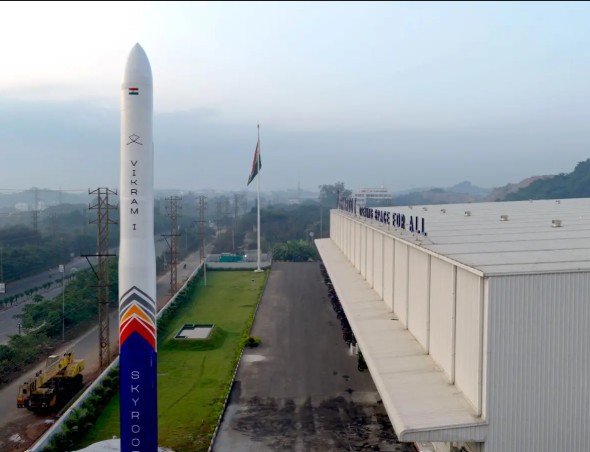
Andhra Pradesh , July 18: India crossed a major milestone in its space journey on Saturday as Skyroot Aerospace successfully launched Vikram-1, the country’s first privately developed orbital class rocket, from the Satish Dhawan Space Centre in Sriharikota. The mission, named Mission Aagaman, represents a defining moment for India’s fast-growing commercial space ecosystem and highlights the increasing role of private companies in advancing the nation’s space ambitions.
The launch, conducted from the First Launch Pad, marked the first time an Indian private company attempted to place multiple payloads into Low Earth Orbit (LEO) using an indigenously designed orbital launch vehicle. The successful mission underscores the rapid progress made by India’s private space sector following policy reforms that opened the industry to commercial participation.
Launch Delayed Briefly Before Liftoff
Originally scheduled for 11:30 a.m., the countdown experienced a planned hold after mission controllers identified a navigation-related issue during the final stages of launch preparations. Engineers carried out additional system checks to ensure all flight parameters were within safety limits before clearing the vehicle for flight.
At 12:05 p.m., the seven-storey-tall Vikram-1 thundered into the skies above Sriharikota, drawing applause from scientists, engineers, and invited guests gathered at the launch complex. The smooth liftoff marked the beginning of a mission designed to validate the rocket’s performance under actual orbital conditions.
Mission Designed to Reach Low Earth Orbit
Following liftoff, the four-stage launch vehicle embarked on a flight lasting nearly 16 minutes, aiming to deploy several technology demonstration payloads into Low Earth Orbit at an altitude of approximately 450 kilometres with an orbital inclination of 60 degrees.
The mission serves as a crucial demonstration of Skyroot Aerospace’s ability to provide commercial launch services for domestic and international satellite customers. Achieving the targeted orbit would establish the company as one of India’s leading private launch service providers.
Advanced Indigenous Rocket Technology
Vikram-1 showcases several advanced technologies developed within India. The launch vehicle has been constructed using an all-carbon composite structure, significantly reducing its overall weight while improving structural strength and efficiency.
The rocket is powered by propulsion systems designed and manufactured by Skyroot Aerospace, including 3D-printed rocket engines and powerful solid-fuel boosters. These innovations are expected to lower manufacturing costs, improve production timelines, and enhance launch reliability for future commercial missions.
The mission also validates a range of indigenous engineering capabilities, including flight control systems, avionics, navigation software, and propulsion technologies.
Payloads from Indian and International Partners
Mission Aagaman carried multiple technology demonstration payloads representing both Indian and overseas organisations.
Among the payloads onboard were spacecraft and experiments from:
Grahaa Space
Cosmoserve
DCubed
Skyroot Aerospace’s in-house SCOPE payload
The rocket also carried an artistic installation titled “Cosmic Bloom,” symbolising the expanding opportunities within the global space economy.
In another symbolic gesture, the mission included a postcard from Prime Minister Narendra Modi, representing India’s aspirations for innovation and scientific advancement.
A Tribute to Vikram Sarabhai
The rocket has been named Vikram-1 in honour of Dr. Vikram Sarabhai, widely recognised as the father of India’s space programme. His vision laid the foundation for India’s scientific and technological achievements in space exploration.
Naming the launch vehicle after Sarabhai reflects the continuity between India’s public space institutions and the emerging generation of private aerospace companies driving innovation.
Major Boost for India’s Commercial Space Industry
The successful launch represents more than a technological achievement. It signals India’s growing capability to compete in the global commercial launch market, where demand for small satellite deployment continues to rise rapidly.
Private companies are expected to play an increasingly important role in satellite launches, Earth observation, communications, scientific research, and defence-related space applications. Missions like Vikram-1 demonstrate that Indian startups are capable of developing sophisticated launch systems that meet international standards.
Industry experts believe the mission will encourage additional investment, strengthen research partnerships, and create new opportunities for space technology startups across the country.
Expanding India’s Presence in Global Space Launch Services
The success of Mission Aagaman comes as India seeks to expand its share of the rapidly growing global space economy. With increasing demand for affordable and reliable launch services, private Indian companies are positioning themselves to serve international satellite operators alongside government missions.
Skyroot Aerospace’s achievement complements India’s broader space strategy, where public institutions and private enterprises work together to accelerate technological innovation and commercial growth.

