


Weather Science Reaches Jammu
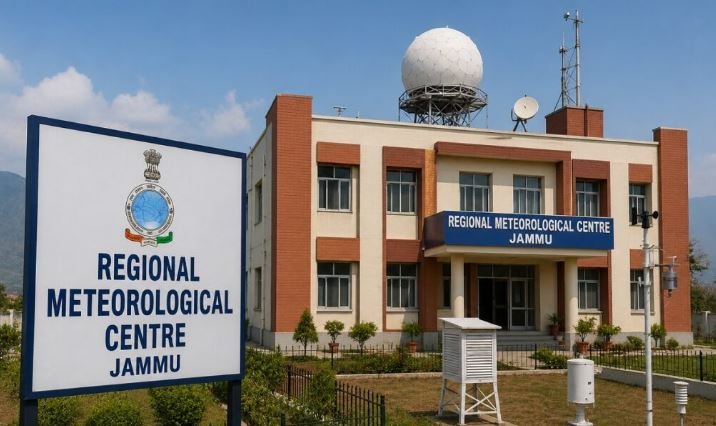
The establishment of the Regional Meteorological Centre at Jammu marks a significant institutional milestone for the north-western Himalayan region. More than the inauguration of a new scientific facility, it represents a shift towards region-specific climate governance, stronger disaster preparedness and more accurate weather services for Jammu and Kashmir, Ladakh and Himachal Pradesh. In a region where weather is not merely a seasonal matter but often a question of safety, livelihood and mobility, the new centre carries both administrative and humanitarian importance.
The Himalayas demand a forecasting system that understands their complexity. From the plains of Jammu to the high-altitude cold deserts of Ladakh, from the mountainous belts of Himachal Pradesh to the pilgrimage routes of Shri Amarnath Ji and Shri Mata Vaishno Devi, weather behaviour changes sharply across small distances. Heavy snowfall, landslides, cloudbursts, flash floods, avalanches, thunderstorms and sudden temperature shifts can disrupt life, damage infrastructure and threaten lives within a short span of time. A dedicated Regional Meteorological Centre at Jammu will help bridge this critical gap by providing localized, timely and specialized forecasts. The importance of decentralizing weather services cannot be overstated. Earlier, weather and climate services for a wide geographical stretch were coordinated from Delhi. With Jammu now emerging as a regional hub, the system will be closer to the terrain, closer to the people and closer to the agencies that must act during emergencies. This is not just administrative restructuring. It is a practical step towards faster response, better coordination and more meaningful weather intelligence for a sensitive region. The new centre is expected to provide district-level forecasts, mountain weather forecasts, tourist advisories, city-specific weather information and early warnings for extreme weather events. These services will directly benefit farmers, pilgrims, tourists, transport operators, hydropower projects, disaster management agencies and security forces working in difficult conditions. For a farmer, accurate rainfall information can influence sowing and harvesting decisions. For a pilgrim, timely alerts can prevent exposure to dangerous conditions. For security forces and rescue teams, reliable forecasts can make operations safer and more effective. The expansion of meteorological infrastructure in Jammu and Kashmir and Ladakh over the past decade also deserves attention. The increase in Doppler Weather Radars, Automatic Weather Stations, Automatic Rain Gauges and rainfall monitoring stations reflects a larger national effort to modernize weather science. Such infrastructure is not ornamental. It is the backbone of early warning systems. Every radar, observatory and automated station adds to the ability of the state to read nature’s signals before they turn into disasters. The proposed addition of more Doppler Weather Radars under Mission Mausam in districts such as Anantnag, Rajouri, Baramulla, Kishtwar and Doda is particularly important. These areas have seen weather-related vulnerabilities and require stronger observational coverage. If implemented effectively, this network can greatly improve forecasting precision and disaster response. The proposed seismological observatory and automatic weather facility in Kishtwar also indicate the need to treat disaster-prone districts with special scientific attention. What makes this development more meaningful is its connection with broader climate resilience. Weather forecasting today is no longer limited to predicting rain or sunshine. It is deeply linked with agriculture, tourism, power generation, transport planning, urban development, disaster management and public health. In the Himalayan region, where climate variability is becoming increasingly visible, scientific institutions must serve as guardians of preparedness. The Jammu centre can become one such institution if it is strengthened with adequate land, manpower, technology and inter-agency coordination. The recognition of the Srinagar Meteorological Observatory as a Centennial Observing Station by the World Meteorological Organization also reminds us that this region has a long scientific legacy. The new centre at Jammu can build upon that legacy by encouraging research, university collaboration, climate studies and capacity building. Partnerships with agricultural universities and scientific institutions can help translate weather data into practical advisories for farmers, planners and communities. However, infrastructure alone will not deliver results unless the information reaches the last mile. Forecasts must be simple, timely and accessible. District administrations, panchayats, schools, tourism departments, pilgrimage boards, transport authorities and local communities must be connected with the warning system. Early warning has value only when it leads to early action.
The inauguration of the country’s seventh Regional Meteorological Centre at Jammu is a welcome step towards scientific governance in the Himalayan region. It strengthens the idea that development in vulnerable geographies must be supported by knowledge, technology and preparedness. If pursued with continuity and seriousness, this centre can transform Jammu into a vital hub of weather science, climate intelligence and disaster resilience, serving not only the present needs of the region but also its safer and more sustainable future.

