


West Indies Beat India by 24 Runs to Level T20I Series 2-2
Shai Hope’s unbeaten century and Keemo Paul’s five-wicket haul powered the visitors to victory in Hyderabad, leaving India’s bowlers and middle order under pressure ahead of the series decider.
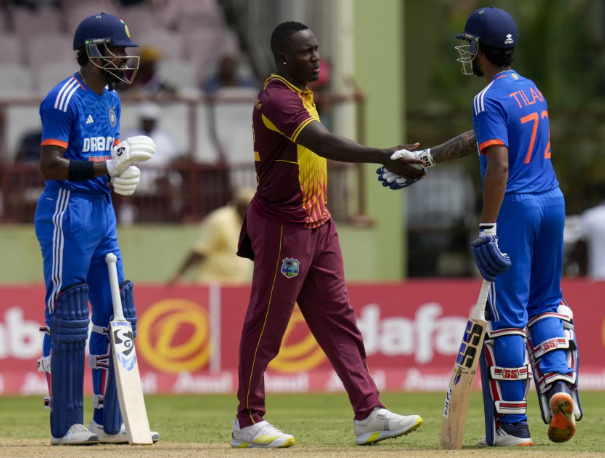
HYDERABAD, October 14: West Indies produced a commanding batting performance before dismantling India’s chase to register a 24-run victory in the fourth T20 International, bringing the five match series level at 2-2.
Captain Shai Hope led the visitors with an unbeaten 102 off just 50 deliveries, while Sherfane Rutherford contributed an explosive 49 not out from 26 balls. Their late partnership helped West Indies post a formidable 247 for three, putting the Indian team under considerable pressure from the outset.
India, in response, managed 223 before being bowled out, falling short despite Sanju Samson’s rapid half-century and a useful partnership between Tilak Varma and Nitish Kumar Reddy. West Indies fast bowler Keemo Paul proved decisive with a five-wicket haul that disrupted India’s recovery and prevented the hosts from completing the chase.
The result was a significant boost for the visitors, who had the opportunity to turn the contest around after India’s efforts earlier in the series. With the teams now level, the final match became crucial for both sides as they looked to secure the series.
Hope and Rutherford power West Indies to 247
West Indies made full use of favourable batting conditions, combining aggressive strokeplay with calculated acceleration during the latter stages of their innings.
Hope anchored the innings while maintaining a remarkable scoring rate. His unbeaten 102 came from 50 balls and included a series of powerful shots that repeatedly put the Indian bowlers on the defensive. The West Indies skipper reached his century on the final delivery of the innings by striking a six, bringing the crowd to life and completing a dominant individual performance.
Rutherford provided equally important support at the other end. His 49 not out from 26 deliveries ensured that the visitors continued to score rapidly during the closing overs rather than allowing India to regain control.
The pair shared an unbeaten 91-run partnership from just 43 balls, giving the West Indies innings a decisive finish. Their combination of timing, power and aggressive running between the wickets left the Indian attack struggling to contain the scoring.
West Indies finished at 247 for three, with the innings featuring 16 sixes and 18 extras. The total reflected the visitors’ ability to capitalise on scoring opportunities and maintain pressure throughout the innings.
The opening six overs were particularly damaging for India. West Indies raced to 79 for one in the powerplay, matching the joint-highest powerplay total recorded against India in men’s T20 internationals. They also reached 100 in just 7.4 overs, demonstrating the speed at which the innings developed.
Hope’s performance was especially notable because of his growing effectiveness in the shortest format. The century was his third in T20 internationals and another major contribution during a productive series. His ability to combine an established batting technique with aggressive scoring made him the central figure in the West Indies innings.
Indian bowling struggles to contain the attack
India’s bowling unit found it difficult to establish control as the West Indies batters attacked both pace and spin.
Mayank Yadav and Arshdeep Singh conceded 52 runs each in their respective four-over spells. The expensive figures underlined the difficulty of defending against a batting line-up that maintained an attacking approach throughout the innings.
India also missed opportunities in the field, allowing the visitors to sustain their momentum. Against a team scoring at such a rapid pace, missed chances and inconsistent execution can quickly turn a competitive total into a daunting target.
The Indian attack needed regular wickets to prevent West Indies from building partnerships, but Hope and Rutherford ensured that the closing stages belonged firmly to the visitors.
The hosts were left with a demanding chase requiring sustained aggression without losing wickets at regular intervals. The scale of the target meant that even a brief slowdown could make the task considerably harder.
Samson gives India an explosive start
India began their reply with urgency, knowing that a strong powerplay would be essential to keep the required run rate within reach.
Sanju Samson delivered an aggressive innings of 56 from just 23 balls, briefly raising hopes of a successful chase. He attacked the West Indies bowlers with confidence and found boundaries at a rate that kept India in contention during the opening phase.
However, his dismissal proved to be an important turning point. Paul removed Samson and followed up by dismissing Ishan Kishan, who managed only six runs. These breakthroughs disrupted India’s momentum and placed additional responsibility on the middle order.
Abhishek Sharma scored 29, while Shreyas Iyer contributed 16, but neither could convert the start into a substantial innings. Naman Dhir was dismissed for a golden duck, adding to India’s difficulties.
The early wickets meant that India had to rebuild while continuing to chase an exceptionally high target. The pressure was particularly severe because the visitors had demonstrated that they could take wickets without allowing the scoring rate to fall significantly.
Varma and Reddy attempt to rebuild the chase
With India losing wickets at regular intervals, Tilak Varma and Nitish Kumar Reddy attempted to restore stability through an attacking partnership.
The pair added 70 runs, offering the hosts a realistic opportunity to return to the contest. Their stand combined controlled batting with timely boundaries, helping India recover from the early setbacks.
Reddy contributed 41 runs and showed the importance of maintaining composure while pursuing a large total. Varma also played an important role before attempting to accelerate further and being caught by Rovman Powell off Romario Shepherd.
Varma’s dismissal ended the partnership at a critical stage. India needed the pair to remain together for longer, as their stand had begun to reduce the pressure created by the early wickets.
Reddy was subsequently dismissed by Paul, who struck again in the same over to remove Prince Yadav for a first-ball duck. Axar Patel also fell to the West Indies bowler, allowing Paul to complete a five-wicket haul and effectively end India’s hopes of reaching the target.
The late collapse demonstrated the difference between the two teams’ ability to sustain partnerships. West Indies had used a long, productive stand to strengthen their innings, whereas India lost their remaining momentum when their key middle-order partnership broke.
Paul delivers the decisive bowling performance
Paul emerged as the principal figure in the West Indies bowling effort. His five wickets came at crucial moments, preventing India from establishing a sustained recovery.
His dismissal of Samson was particularly important because the Indian opener had provided the chase with an aggressive beginning. Removing Kishan soon afterwards compounded the damage and forced India to depend on their middle order earlier than planned.
Paul then broke the Varma-Reddy partnership and took two further wickets in quick succession. The sequence of dismissals ensured that India could not build the finish required to challenge the West Indies total.
The performance also highlighted the value of taking wickets at key stages rather than concentrating exclusively on restricting runs. Against a target of 248, India needed both a high scoring rate and wickets in hand. Paul’s strikes made it increasingly difficult for the hosts to achieve either objective.
Series decider now carries greater significance
The 24-run defeat leaves India with important questions to address before the fifth and final T20I. The team will need to assess its bowling plans, fielding execution and approach to chasing a total built around aggressive batting.
The visitors, meanwhile, can take confidence from their ability to produce a strong all-round performance under pressure. Hope’s century demonstrated the effectiveness of their batting strategy, while Paul’s five-wicket haul showed that the bowling unit could defend a large total by attacking India’s key players.
India’s batting also offered positives, particularly Samson’s rapid half-century and the partnership between Varma and Reddy. However, the inability to convert those contributions into a sustained chase proved costly.
The final match will therefore test both teams’ ability to respond to pressure. India will look to correct the weaknesses exposed in Hyderabad, while West Indies will aim to carry their momentum into the deciding encounter.
With the series tied at 2-2, the contest has developed into a closely fought battle in which individual performances and execution during decisive moments could determine the outcome.

