


Kargil Groundwater under Stress
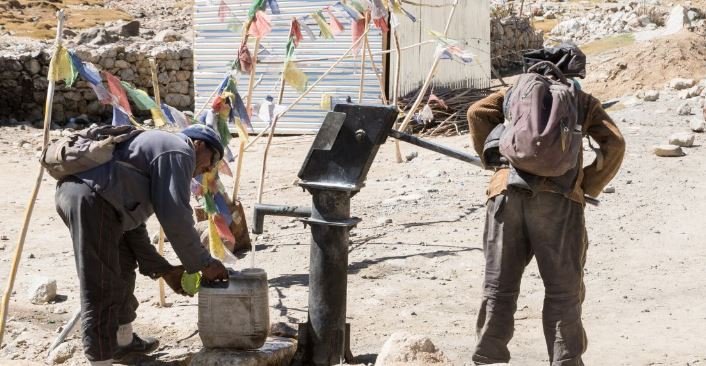
The latest official data on groundwater in Ladakh offers both reassurance and reason for concern. On the one hand, the Union Territory as a whole is still not in a severe extraction zone. On the other hand, the sharp decline in Kargil’s extractable groundwater over a short period suggests that localized stress is emerging and deserves careful policy attention. In a fragile mountain region where water supports households, farming, and ecological balance, such figures should be read with sensitivity and seriousness.
The most striking number is from the Kargil district. Its annual extractable groundwater resource was reported at 24.54 million cubic meters in 2022, rose to 28.49 MCM in 2023, and then fell steeply to about 14.05 MCM in 2025. This means availability has come down by nearly half in about two years when compared with the 2023 level, and it is also far below the 2022 figure. Such a decline does not automatically mean a crisis in every part of the district, but it does indicate a weakening water cushion that should not be overlooked. Leh presents a different picture. The district recorded 48.65 MCM in 2022 and 51.48 MCM in 2023, after which the figure stabilized at 46.63 MCM in both 2024 and 2025. This relative stability suggests that water conditions are not uniform across Ladakh. The contrast between Leh and Kargil underlines the need for district-specific planning rather than a single broad approach for the entire Union Territory. At the overall Ladakh level, the government has informed Parliament that the stage of groundwater extraction stands at 30.93 percent as per the 2025 assessment. Out of 18 groundwater assessment units, 17 have been classified as safe and one as semi-critical. These numbers provide some comfort, as they show that the region overall is not yet facing widespread over-extraction. Still, averages can sometimes hide local vulnerabilities. Kargil’s decline is a reminder that even when the larger picture appears manageable, a specific district may need quicker attention and closer monitoring. The data on drinking water access also adds an important dimension. Under the Jal Jeevan Mission, 201 out of 240 villages in Ladakh have been reported as having achieved Har Ghar Jal status, while work is continuing in the remaining villages to provide functional tap water connections. This is encouraging progress, but long-term water security will depend not only on the reach of pipelines and taps but also on the stability of the underlying water sources that support them. Another important concern is the lack of a deeper scientific assessment of related environmental changes. The government has said that no study has so far been conducted by the Ladakh administration on glacial retreat in the river basins of the region, including year-wise data on glacier area loss, snow cover changes, and spring discharge levels since 2021. In a region like Ladakh, where glaciers, snowmelt, springs, and groundwater are closely linked, such knowledge gaps make long-term planning more difficult. There has, however, been investment in conservation. Since 2022, Rs 2,162.51 lakh has been allocated in Ladakh for water conservation and recharge measures, of which Rs 1,471.36 lakh has been utilized so far. This is a meaningful step, and it should now be accompanied by closer groundwater tracking, spring mapping, local recharge planning, and district-level scientific studies, especially for Kargil. Seen in a balanced light, the figures do not call for alarmism, but they do call for urgency. Kargil’s decline, Leh’s relative stability, the 30.93 percent extraction stage, the 17 safe units, the one semi-critical unit, and the 201 of 240 villages with tap water coverage together tell a nuanced story. Ladakh still has time for careful course correction, but that will require steady monitoring, better research, and a more locally tailored water strategy.
The government must treat the decline in Kargil’s groundwater as a serious policy warning and respond with urgency. It should order district-specific hydrogeological studies, regular spring and aquifer monitoring, glacier-linked water assessments, and time-bound conservation planning. Funds already allocated must be fully utilized with transparent outcomes. A dedicated groundwater management strategy for vulnerable areas, especially Kargil, is now essential. Delayed action in a fragile region like Ladakh could deepen drinking water stress, irrigation pressure, and long-term ecological instability.

