


Trump Flies on Qatar-Gifted Air Force One as Questions Mount Over Cost, Optics and Foreign Influence
US President Donald Trump takes his first trip aboard a Boeing 747 gifted by Qatar’s royal family, reigniting debate in Washington over ethics, taxpayer-funded retrofitting and the symbolism of accepting a foreign state aircraft for presidential use.
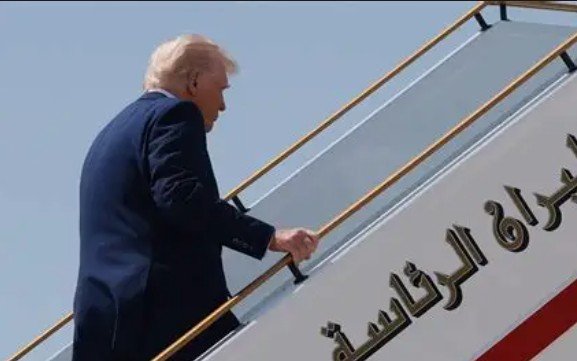
Washington, July 2: US President Donald Trump’s first flight aboard a Boeing 747 gifted by Qatar’s royal family has triggered a fresh political and ethical storm in Washington, with critics questioning the propriety of accepting an aircraft from a foreign government for use as Air Force One and raising concerns over the taxpayer cost of retrofitting the plane for presidential travel. The controversy, which had already simmered since details of the arrangement emerged, intensified this week as Trump prepared to use the aircraft for an official trip to North Dakota, turning what might have been a symbolic showpiece into a flashpoint over presidential ethics, foreign influence and the boundaries of executive discretion.
The aircraft at the centre of the debate is a Boeing 747 previously used by Qatar’s ruling family and later donated for American presidential use. Trump praised the gesture when the plane was unveiled earlier, calling Qatar generous for providing the modified jet. But while the White House has portrayed the development as a practical and welcome enhancement to presidential aviation, the move has provoked scrutiny from legal experts, political opponents and ethics watchdogs who argue that the symbolism of a US president flying on an aircraft gifted by a foreign monarchy is deeply problematic, regardless of the technical legality of the arrangement.
At the heart of the controversy lies a simple but politically explosive question: can the American presidency accept a luxury aircraft from a foreign state without compromising public trust or inviting concerns about influence? The Trump administration’s defenders have framed the matter in transactional terms, emphasising that the aircraft is not a personal present to the president but a state asset incorporated into the government fleet. They argue that if the plane can be used to modernise or supplement presidential air travel, there is no reason to reject it merely because it originated abroad. Critics, however, say the issue is not just legal ownership but public symbolism, institutional dignity and the message sent when the commander-in-chief flies on a jet associated with a foreign royal household.
The debate has been sharpened by the financial details surrounding the aircraft’s conversion. Although the plane was gifted, it has reportedly required extensive retrofitting using taxpayer money before it could safely and securely function as a presidential aircraft. That includes upgrades to communications systems, security infrastructure, defensive features and the wide range of technical modifications required for any aircraft used to transport the US president. Opponents of the move argue that once the public bears the cost of converting and securing the jet, the claim of a “gift” becomes more complicated. In their view, the United States may have accepted not a free aircraft but a politically costly symbol that still demands large public expenditure to make it operational.
Trump’s decision to take the aircraft on his trip to North Dakota, where he was due to attend an event marking the 250th anniversary of US independence, guaranteed maximum visibility for the controversy. The optics of using a Qatar-gifted aircraft on a journey tied to American national celebration were always likely to provoke comment, particularly from those who see the symbolism as awkward or even contradictory. For critics, the image of a US president commemorating the nation’s founding aboard a jet supplied by a Gulf monarchy encapsulates what they view as the Trump era’s disregard for conventional ethical boundaries. For supporters, by contrast, the criticism is overblown and politically motivated, another example of Washington outrage directed at a president who has long embraced unconventional gestures and high-visibility displays of power.
The episode fits a broader pattern in Trump’s political style, where spectacle, personal branding and transactional diplomacy often intersect. Throughout his political career, Trump has shown a willingness to blur lines between formal statecraft and symbolic display, turning state visits, business announcements and even aircraft into extensions of his public persona. The Qatar aircraft saga reflects that instinct. Rather than avoiding a politically sensitive arrangement, Trump has leaned into it, publicly praising the donor state and proceeding with the aircraft’s use in a manner that almost invites debate. That strategy may energise supporters who admire his refusal to bow to conventional criticism, but it also creates repeated openings for opponents to question his judgment and motives.
The controversy also arrives at a time when the United States’ relationship with Gulf states remains strategically significant and politically delicate. Qatar is an important American partner in the region, hosting a major US military base and often acting as a diplomatic intermediary in Middle East crises. Yet Gulf monarchies also occupy a complicated place in Washington politics, where partnerships driven by security and energy interests often collide with concerns about influence, lobbying and the optics of elite state-to-state ties. Accepting a plane from Qatar therefore does not occur in a diplomatic vacuum. It feeds into longstanding anxieties about how wealth, access and geopolitical necessity shape the behaviour of American institutions.
For Trump’s critics, the aircraft raises obvious constitutional and ethical questions. Even if the transfer is structured as a state-to-state arrangement rather than a personal gift, they argue that it brushes dangerously close to the kind of foreign benefit the framers sought to guard against. The US Constitution’s Emoluments Clause has repeatedly surfaced in debates over Trump’s business and foreign relationships, and while the legal facts of the aircraft deal may differ from earlier controversies, the political resonance is similar: can a president maintain unquestioned independence when foreign governments are seen to provide tangible benefits, prestige assets or special accommodations?
Supporters of the administration counter that the criticism ignores both precedent and practical reality. They argue that governments routinely exchange gifts, equipment and diplomatic courtesies, and that presidential aircraft are ultimately tools of statecraft rather than symbols of personal enrichment. In this telling, the plane is simply an asset that can be used by the US government if properly integrated into official systems. To reject it out of fear of appearances, they say, would be an act of political theatre rather than principled governance.
Yet appearances matter profoundly in presidential politics, and that is precisely why the issue has become so combustible. Air Force One is not just a mode of transport; it is one of the most potent symbols of American state power. It functions as a flying White House, a secure command post and a global emblem of the presidency itself. The idea that such a symbol could be linked, however indirectly, to the largesse of a foreign royal family is bound to trigger discomfort across party lines. Even those unconvinced by legal objections may still feel that the arrangement diminishes the aura of independence and self-sufficiency traditionally associated with the office.
The timing of the first flight has added another layer of political sensitivity. Trump’s use of the aircraft comes as his administration is navigating a series of foreign policy challenges, including tensions in the Middle East, renewed debate over alliances and persistent scrutiny of his approach to transactional diplomacy. Against that backdrop, every visible sign of closeness with a foreign power carries added significance. The Qatar aircraft story is therefore not just about a plane. It is about how Trump chooses to represent presidential authority, how his administration manages optics and whether American voters are willing to tolerate ethical ambiguity if it is wrapped in efficiency, spectacle or political defiance.
The taxpayer angle has also resonated strongly. Americans are accustomed to expensive presidential travel and understand that national security requirements come at a cost. But the idea of spending public money to retrofit a gifted foreign aircraft for presidential use creates a different kind of unease. Critics argue that if the plane required such substantial investment to become usable, then the administration should have been more transparent about the full financial burden from the outset. They also ask whether the cost-benefit logic truly justifies the political fallout, or whether the White House embraced the arrangement because it suited Trump’s instinct for grand gestures rather than because it made clear administrative sense.
The administration’s response has so far been to emphasise utility and downplay controversy. Officials have presented the flight as a straightforward operational decision, not a symbolic provocation. But the very fact that the first journey aboard the aircraft attracted so much attention shows how difficult it will be to depoliticise the issue. Every future use of the jet is likely to revive the same questions: Who paid for the upgrades? What exactly did Qatar provide? What does the arrangement say about Trump’s approach to the presidency? And why was this aircraft, of all possible options, worth the reputational cost?
The North Dakota trip itself may be routine in presidential scheduling terms, but in political symbolism it is anything but. A president travelling to commemorate the 250th anniversary of American independence is expected to project national pride, institutional continuity and sovereign confidence. Doing so aboard a plane associated with a foreign royal donor inevitably complicates the message. To some observers, it looks like an avoidable own goal—an unnecessary collision between patriotic theatre and ethically awkward diplomacy. To others, it is simply proof that Trump governs by his own rules and refuses to accept the symbolic constraints that have traditionally shaped presidential conduct.
More broadly, the episode reflects a recurring feature of Trump-era politics: the collapse of boundaries between what is technically permissible, what is institutionally appropriate and what is politically sustainable. Trump has repeatedly shown that he is less interested in respecting inherited norms than in testing how far he can stretch them. Sometimes that approach produces tactical gains, forcing opponents to fight on uncomfortable terrain. But it also creates a constant churn of controversy that can obscure substantive policy questions beneath debates over ethics, optics and personal conduct.
In that sense, the Qatar aircraft controversy is about more than aviation or gift law. It is a window into how power is performed in Trump’s presidency. The plane is a stage, a message and a provocation all at once. It allows Trump to project strength and extravagance while simultaneously daring critics to object. The White House may calculate that the benefits of that posture—media attention, supporter enthusiasm, the image of a president unconstrained by elite disapproval—outweigh the costs. But the risks are real. Public trust in institutions is not eroded only by outright illegality; it can also be weakened by repeated signals that norms are negotiable and symbolism is secondary to spectacle.
Internationally, the story is being watched for what it says about the relationship between personal leadership styles and state institutions in the United States. Allies and adversaries alike understand the symbolic weight of Air Force One. They also understand that when the symbolism surrounding the aircraft changes, it can reveal something about the administration in power. Trump’s willingness to embrace a Qatar-gifted plane signals comfort with a more personalised, less convention-bound style of diplomacy one in which transactional advantage and visual impact may matter more than traditional caution about foreign entanglement.
Whether the controversy has lasting political consequences may depend on how the aircraft is used going forward and whether new details emerge about the costs, conditions or internal deliberations behind the decision. If the plane becomes a regular part of presidential travel, the issue could settle into the background, one more unusual feature of Trump’s presidency that eventually normalises through repetition. But if further scrutiny reveals larger public costs, hidden diplomatic understandings or internal objections that were brushed aside, the aircraft could become a more serious liability.
For now, the first flight has ensured that the debate is no longer hypothetical. Trump has made the choice visible and concrete. The gifted aircraft is not a diplomatic curiosity parked in the background; it is now part of the image of the presidency itself. That image carries power, and in this case it carries questions as well about ethics, symbolism, influence, taxpayer money and the meaning of presidential independence in an era when spectacle often outruns convention.
As Washington absorbs the implications, one thing is clear: the Qatar-gifted Air Force One is more than a plane. It is a political test of how much ambiguity Americans are willing to accept around the symbols of their highest office. And, as with so many Trump-era controversies, the answer may depend less on legal technicalities than on whether the public sees the arrangement as clever statecraft, unnecessary provocation or something more troubling in between.

