


Rajkummar Rao Turns Sourav Ganguly in ‘Dada’ First Look, Setting Up One of Bollywood’s Biggest Sports Biopics
The first glimpse of Dada – The Sourav Ganguly Story has triggered strong buzz online, with Rajkummar Rao recreating Ganguly’s iconic shirt-swinging moment and reviving excitement around cricket based biographical dramas.
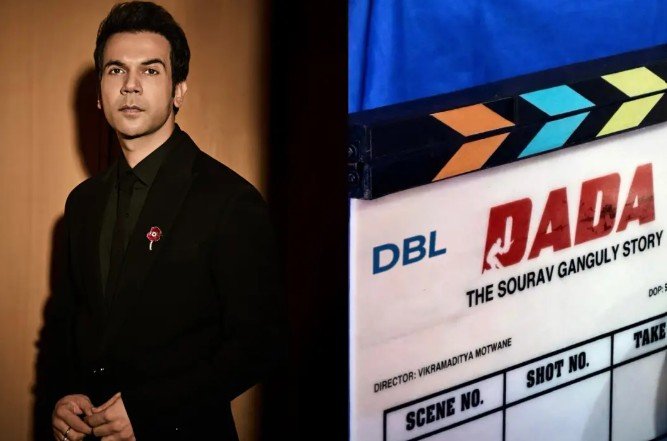
Mumbai, July 09 : Bollywood’s next major sports biopic has officially entered the spotlight with the unveiling of the first look of Dada The Sourav Ganguly Story, featuring Rajkummar Rao as former India captain Sourav Ganguly. The early glimpse from the film has already sparked wide discussion across entertainment and cricket circles, not only because it revisits one of Indian sport’s most unforgettable images, but also because it places one of Bollywood’s most respected performers at the centre of a story loaded with emotion, nostalgia, controversy and national sporting pride.
The first look presents Rajkummar Rao recreating Ganguly’s famous shirt-swinging celebration at Lord’s a moment that has long been etched into Indian cricket folklore. That image, originally associated with India’s dramatic NatWest Trophy triumph in 2002, was far more than a spontaneous outburst. It became a symbol of aggression, confidence and a changing Indian cricket identity under Ganguly’s leadership. By choosing that visual as the first public introduction to the film, the makers have made it clear that Dada intends to tap not just into a biography, but into a larger cultural memory that millions of fans instantly recognise.
The response to the first look has been swift and intense. On social media, viewers have debated everything from Rajkummar Rao’s physical transformation to the likely narrative arc of the film. Some have praised the decision to cast an actor known for his craft rather than relying solely on star glamour, while others have begun speculating about which chapters of Ganguly’s career the biopic will foreground his debut heroics, his captaincy era, his clashes with authority, his role in rebuilding Indian cricket after a crisis period, or his later administrative journey.
The excitement surrounding Dada reflects the enduring fascination with sports biopics in Hindi cinema, especially those linked to cricket. Unlike many fictional sports dramas, a biopic built around Sourav Ganguly comes with a ready-made emotional framework. Ganguly was not merely a successful captain; he represented a turning point in Indian cricket’s personality. His tenure was marked by visible self-belief, a willingness to challenge opponents abroad, and a strong instinct for backing young talent who would later become pillars of the national team. Any film that attempts to tell his story is therefore dealing not only with one man’s career, but with a larger narrative about the transformation of Indian cricket in the early 2000s.
That is precisely what makes the project such an intriguing entertainment proposition. A Sourav Ganguly biopic is not just about runs, matches and trophies. It is also about leadership, image, rivalry, pressure, redemption and reinvention. Ganguly’s career contained all the ingredients that cinema seeks: a stylish debut at Lord’s, a meteoric rise to captaincy, allegations and controversies that shadowed Indian cricket during his era, a fierce public persona, a difficult falling-out with coach Greg Chappell, a dramatic comeback, and eventually a second innings as an administrator. Few cricketing lives lend themselves to narrative adaptation as naturally as his does.
Rajkummar Rao’s casting is a major part of why the first look has generated such interest. He is not the most obvious “mass” sports-biopic choice in the conventional Bollywood sense, which may actually work in the film’s favour. Rao has built his reputation on immersion, detail and emotional control rather than larger-than-life posturing. His best performances have often been driven by restraint and observation qualities that could prove valuable in portraying Ganguly, whose public image combined arrogance, calm, provocation and strategic intelligence in equal measure.
The challenge, of course, lies in translating a towering real-life personality into cinematic form without reducing him to imitation. Ganguly is one of Indian cricket’s most recognisable figures, with a distinctive batting stance, body language, speaking style and emotional rhythm. Audiences will not just be looking for physical resemblance; they will want the actor to capture the psychology of the man the pride, stubbornness, competitiveness and occasional vulnerability that defined him across different phases of his career. The first look does not answer those questions yet, but it does suggest that the film intends to begin from iconography and build outward.
There is also a broader industry reason why the first look matters. Sports biopics in Hindi cinema have gone through several phases. For a time, they were among the safest prestige commercial hybrids available to producers: emotionally uplifting, patriotic in tone, star friendly and rich in built-in audience familiarity. Films based on athletes and sporting milestones could attract both critical attention and mainstream viewership. But in recent years, the genre has faced a tougher environment. Audiences have become more selective, theatrical economics have shifted, and merely adapting a famous name is no longer enough. A project like Dada therefore has to justify itself not just through subject matter, but through storytelling ambition.
That is why the choice of the Lord’s shirt-waving moment is clever from a marketing standpoint. It immediately anchors the film in a scene that carries emotional electricity. For one generation of fans, it evokes a rebellious India taking on the old powers of world cricket without fear. For younger viewers who know Ganguly more as a commentator, former board chief or television personality, it offers a dramatic visual hook into who he was as a player and leader. The first look is essentially a promise: this will not be a dry chronology of statistics, but a cinematic recreation of moments that defined a sporting era.
The biopic’s potential reach extends beyond cricket fans. Sourav Ganguly’s story overlaps with a broader period of Indian social and media change — satellite television expansion, the rise of celebrity athletes, the commercial transformation of cricket, and a growing appetite for assertive national icons. He belonged to a generation that helped turn Indian cricketers into full spectrum public figures, with visibility extending far beyond the boundary rope. A film about him therefore has the chance to function not only as sports storytelling but also as a portrait of an era when Indian cricket was becoming central to mass culture in a new way.
There is also the matter of conflict, which often determines whether a biopic becomes compelling cinema or just a respectful tribute. Ganguly’s life offers no shortage of dramatic material on that front. His relationship with coaches, selectors and cricket administrators often produced headlines. His leadership style inspired loyalty but also criticism. His exclusion from the team and subsequent comeback remains one of the defining comeback arcs in Indian sport. If the film is willing to engage with those difficult chapters rather than simply celebrate triumphs, it could emerge as something richer than a standard sports drama.
From a performance standpoint, that complexity is what could make Dada one of Rajkummar Rao’s most demanding mainstream roles. Portraying a public figure who is admired, debated and deeply familiar to audiences requires a balance between transformation and accessibility. Overplaying the aggression would turn Ganguly into caricature; softening him too much would erase what made him distinctive. The role demands charisma without theatrical excess, confidence without parody, and emotional layering across multiple phases of life. If handled well, it could become one of the actor’s defining commercial performances.
The film also arrives at a time when Bollywood is re-evaluating its relationship with biography-driven storytelling. For years, biopics were among the industry’s most reliable genres, especially when attached to sports stars, military figures or controversial public personalities. But the audience now expects more than a Wikipedia to screen retelling. There is greater scrutiny around narrative authenticity, emotional honesty and cinematic quality. A high-profile cricket biopic today must compete not only with earlier films in the genre but also with documentaries, streaming series and fan-driven digital storytelling that often cover the same subject in greater detail.
That raises the stakes for Dada. To succeed, it will likely need to do more than recreate famous matches and applause lines. It must decide what kind of story it wants to tell about Ganguly. Is it a film about an underdog aristocrat who reshaped Indian cricket’s self-belief? A leadership drama about building a team after institutional crisis? A personal story about ego, exile and return? Or a larger cultural narrative about India’s sporting coming-of-age? The strongest biopics usually work because they choose a clear emotional centre rather than trying to include every event in a public life.
The public fascination with Ganguly’s journey suggests that the film will not struggle for attention. Few cricketers have remained so culturally present long after retirement. He is still remembered not only for achievements but for attitude the raised collar, the direct stare, the refusal to be overawed, the willingness to back players who would later become legends. For many fans, Ganguly’s captaincy era was when Indian cricket stopped merely participating abroad and began believing it could dominate. That emotional association gives the film a powerful starting advantage.
At the same time, that emotional connection also creates pressure. Fans will expect the biopic to honour Ganguly’s significance without sanitising his contradictions. They will want the highs Lord’s, Brisbane, NatWest, the rise of a young Indian team but they may also expect the film to confront the lows, tensions and decisions that made his career so dramatic. A sports biopic that avoids friction risks feeling weightless; one that embraces it has a chance to become memorable.
The early marketing of Dada suggests the makers understand the scale of the opportunity. By leading with one of the most instantly recognisable images in Indian cricket history, they have positioned the film not simply as another biographical release but as an event project with mass recall value. The casting of Rajkummar Rao adds an element of performance credibility, while the subject itself ensures crossover interest from cricket audiences, nostalgia-driven viewers and mainstream Bollywood followers.
In the coming months, much of the conversation will revolve around how far the film goes in capturing the texture of Ganguly’s career and personality. Questions will also arise about casting for other key figures from that era, the recreation of landmark matches, the portrayal of dressing-room politics, and the extent of Ganguly’s own involvement in shaping the narrative. Those details will determine whether Dada becomes a surface-level tribute or a layered portrait of one of Indian sport’s most consequential figures.
For now, though, the first look has done its job. It has reignited memories, triggered debate and placed the film firmly on the entertainment radar. In an industry crowded with announcements, teasers and franchise noise, that is no small achievement. A single image Rajkummar Rao, shirt in hand, channelling Sourav Ganguly at Lord’s has been enough to reopen an entire chapter of Indian sporting nostalgia.
That nostalgia, however, is only the entry point. The real test for Dada The Sourav Ganguly Story will be whether it can turn a familiar legend into a compelling cinematic experience for audiences who already know the headlines. If it can capture the swagger, the conflict, the reinvention and the emotional force of Ganguly’s journey, it may not just become another sports biopic. It could become one of Bollywood’s most significant cricket films in recent years.

