


Information Superiority, Faster Decisions Crucial to Winning Future Wars: Air Marshal Tejpal Singh
Air Marshal Tejpal Singh calls for integrated surveillance, communications, intelligence and electro-optical systems to strengthen multi-domain military operations.
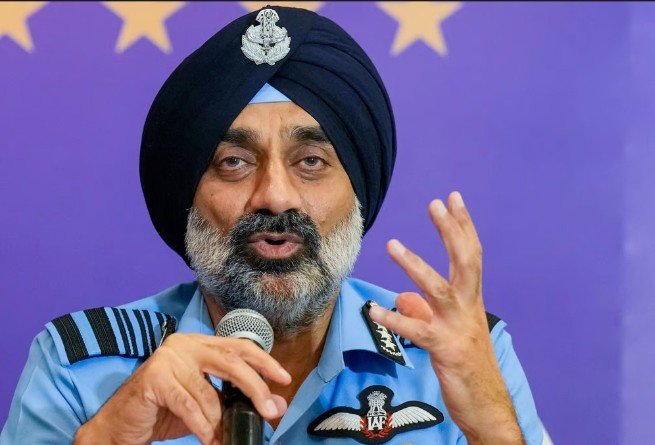
NEW DELHI, Aug 18: Information superiority and the ability to make faster decisions will play a decisive role in determining the outcome of future conflicts, Deputy Chief of the Air Staff Air Marshal Tejpal Singh said on Tuesday.
Addressing a joint seminar on “Surveillance, C4I2 & Electro Optics”, organised in collaboration with Indian Military Review (IMR), Singh stressed the need for deeper integration of surveillance, communications, intelligence and electro-optical technologies across the armed forces.
He said conventional combat platforms and weapon systems would continue to remain important, but modern warfare was increasingly being shaped by the ability to collect, process and act upon information faster than an adversary.
Singh highlighted the importance of the OODA cycle Observe, Orient, Decide and Act saying the objective should be to complete the cycle faster than the opponent.
“The intention is to make our OODA loop shorter than that of the adversary so that we can decide and act before he can,” he said.
According to Singh, surveillance, C4I2 and electro-optical capabilities would play a central role in the first three stages of this decision-making cycle. Their effective integration, he said, would help commanders obtain a common and real time picture of the battlefield.
He emphasised that these capabilities should not be developed as independent technologies. Instead, they need to operate as an interconnected “system of systems” capable of bringing together information from multiple sources.
Surveillance systems provide persistent awareness across land, sea, air, space and cyber domains, while electro-optical technologies improve detection, identification and precision through tools such as thermal imaging and multi-spectral sensing.
C4I2 systems, meanwhile, connect sensors, communications and intelligence networks, allowing raw information to be converted into actionable inputs for commanders.
Singh described the integration of these capabilities as a combat multiplier, particularly as military operations increasingly span several domains simultaneously.
He pointed to the Integrated Air Command and Control System (IACCS) as an example of how sensors, communication networks and weapon systems can be brought together through a network-centric architecture.
Push for Common Digital Standards
The Air Marshal also stressed the importance of interoperability and common digital standards among the armed forces.
He called for standardised protocols and greater self-reliance in communication technologies to ensure that sensors, platforms and intelligence, surveillance and reconnaissance assets can exchange information without technological barriers.
“To achieve seamless jointness, it is very, very important that we have standardised protocols,” he said.
Singh maintained that interoperability should be incorporated into the design of military systems from the beginning rather than being addressed after deployment.
At the same time, he warned that increased dependence on interconnected networks could create new vulnerabilities. Cyberattacks, electronic warfare and spoofing could disrupt military communications and command systems, particularly in contested electromagnetic environments.
He said network resilience would therefore be essential to maintaining command and control capabilities during high-intensity operations.
Focus on Operational Problems
Singh further called for a shift in the way military technology requirements are identified.
Rather than beginning with a demand for a particular piece of equipment, he said planners should first identify the operational challenge that needs to be addressed.
“We should not be asking, ‘What is the system?’ but ‘What is the operational problem that I’m trying to address?’” he said.
He advocated closer collaboration between the armed forces, industry and academia to develop technologies tailored to actual battlefield requirements.
Such cooperation, he said, could help accelerate innovation, improve technological self-reliance and strengthen India’s military capabilities.
Warfare Undergoing Rapid Transformation
Deputy Chief of Army Staff Lieutenant General Rahul R Singh also spoke about the rapid evolution of warfare and the need for military forces to continuously adapt to emerging technologies.
He noted that developments since 2020 had accelerated the adoption of digital communications, electronic warfare, cyber operations and network and cloud-enabled systems for improving situational awareness.
Modern surveillance, he said, has developed into a multi-layered architecture drawing information from space based assets, airborne platforms, unmanned aerial vehicles, signals intelligence, human intelligence and maritime systems.
Lieutenant General Rahul R Singh also highlighted the growing importance of drone warfare, describing its rapid expansion as one of the most significant changes in today’s battlespace.
The challenge, he said, extends beyond acquiring or operating unmanned platforms. The armed forces must also integrate large numbers of drones into wider operational networks while effectively processing and managing the vast amount of information they generate.
The discussions at the seminar underscored a broader shift in military strategy, where technological integration, resilient networks and rapid decision-making are becoming increasingly important alongside traditional weapons and platforms.
For future conflicts, the ability to detect developments early, understand the operational environment, make informed decisions and respond rapidly could provide a critical battlefield advantage.

