


J&K Handicrafts, Global Future
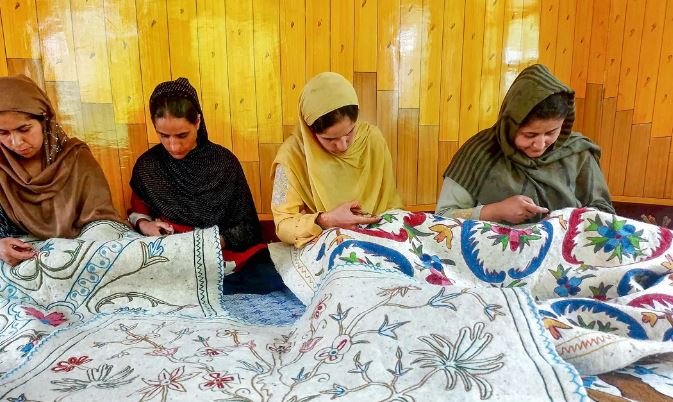
Jammu and Kashmir’s handicrafts are not merely products for export; they are the memory, skill and cultural identity of generations. The new Action Plan for Promotion of Export of Handicrafts and Handloom Products, reviewed by Chief Secretary Atal Dulloo, comes at a crucial moment when traditional craft sectors must move beyond admiration and enter a stronger phase of organized global competitiveness. The goal of raising textile and apparel exports from the present ₹800 crore to ₹2,000 crore by 2030 is ambitious, but it is not beyond reach if planning, execution and market strategy move together with discipline.
The central argument is clear. Jammu and Kashmir already has world-renowned craft strength, but strength alone does not create export growth. Carpets, shawls, papier-mâché, wood carving, handloom products and other traditional crafts carry immense cultural and commercial value, yet many artisans remain trapped between low returns, weak market access, limited branding and dependence on intermediaries. If the export strategy is to succeed, it must connect the artisan’s hand with the international buyer through authenticity, technology, quality assurance and institutional support. The Chief Secretary’s emphasis on analyzing strengths, competitive advantages and challenges before finalising the implementation framework is important. Too often, public plans fail because they begin with targets and end with paperwork. This plan must begin with ground realities. Which products have high-value export potential? Which districts have specific craft advantages? Where are artisans facing raw material shortages? What prevents exporters from using Free Trade Agreements? Why is the active registered exporter base still limited when the artisan base is so large? These questions must guide policy, not remain hidden inside reports. The figures placed before the meeting show both possibility and challenge. The plan seeks to expand the active registered exporter base to 15,000 by 2030, against the present 269 active RCMC exporters and a potential pipeline of around 1,000 users. It also aims at 100 percent GI-QR tagging of exports, ₹100 crore in e-commerce exports and Free Trade Agreement utilization above 50 percent from the current level below 20 percent. These are not minor targets. They require a major shift in training, certification, digital onboarding, compliance support and exporter facilitation. GI-QR tagging can be a game changer if implemented properly. Jammu and Kashmir’s crafts suffer when imitation products enter markets in the name of authenticity. Traceability can protect the reputation of genuine products and give buyers confidence. But tagging should not become another difficult procedure for artisans. It must be simple, affordable and linked with real market advantage. The artisan should feel that authenticity brings better income, not just another official requirement. The proposed “Soulful J&K” GI branding campaign is also significant. A unified brand can help international buyers recognize the emotional, cultural and geographical identity behind the product. But branding must be backed by quality, timely delivery and professional export support. A beautiful slogan cannot compensate for weak packaging, delayed consignments, lack of digital visibility or poor compliance readiness. The global market rewards consistency as much as craftsmanship. The plan’s focus on Artisan Credit Card expansion, Export Textile Planning Cells under Tex-RAMPS, ESG and EUDR compliance certification for more than 100 manufacturing units, and raw material banks shows a wider understanding of the sector’s needs. Central schemes such as RoSCTL and SAMARTH, along with the J&K Export Subsidy Scheme, 2021, can strengthen competitiveness if they are made accessible to real beneficiaries. Convergence of Central and UT schemes should not remain a policy phrase; it must become a working system where exporters and artisans know what support is available, how to apply and whom to approach. The independent concern is that export growth must not leave artisans behind. If profits rise only for traders while wages remain low for craftsmen, the strategy will fail morally and socially. The success of this plan must be judged not only by export value, but also by artisan income, youth participation, women’s involvement, district-level enterprise growth and preservation of traditional skills.
Finally, Jammu and Kashmir should create district-wise craft export cells, simplify exporter registration, provide digital training to artisans, ensure raw material support, promote GI-based branding, build e-commerce capacity and monitor every target year by year. Banks, departments, NIFT, IICT, exporters and artisan groups must work as one ecosystem. The ₹2,000 crore export goal should become more than a number; it should become a movement to give dignity to artisans, strength to local enterprise and global recognition to the cultural wealth of Jammu and Kashmir.

