


Millets Ancient Grain, Modern Need
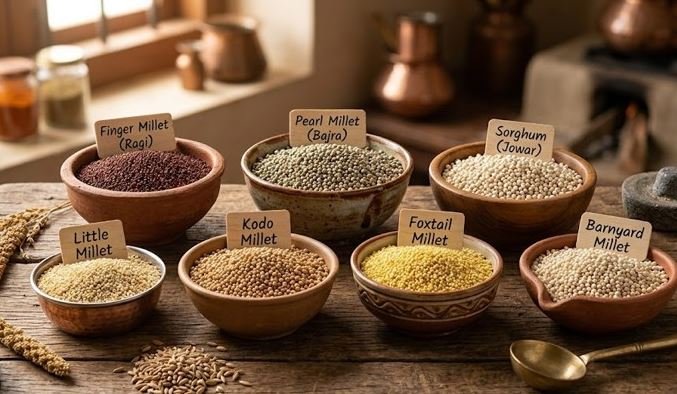
In an age when hospitals are crowded by lifestyle diseases and fields are increasingly exposed to uncertain weather, Jammu and Kashmir cannot afford to treat food merely as a matter of taste or tradition. What people eat, what farmers grow and what the environment can sustain are now deeply connected public questions. The renewed call to bring millets, or Shree Anna, back to the plate is therefore not a nostalgic appeal to the past. It is a timely reminder that some of the answers to modern health, farming and ecological challenges may lie in the food wisdom that society gradually pushed aside.
Millets have long been part of India’s civilizational food culture. Bajra, jowar, ragi, kodo, kutki, kangni and sanwa sustained generations in villages where irrigation was limited, chemical inputs were minimal and farming was closer to nature. Their strength lies in their simplicity. They require comparatively less water, can withstand difficult climatic conditions and are known for nutritional value. In a region like Jammu and Kashmir, where a large number of farmers are small and marginal, this is not a minor agricultural detail. It is a question of risk reduction, income security and confidence for families that depend on land, weather and labour. The public health argument is equally important. Lifestyle diseases are no longer confined to urban elites. Diabetes, obesity, high blood pressure and heart-related concerns are entering ordinary households with alarming regularity. Processed food, sedentary habits and unbalanced diets have changed the health profile of society. Millets are rich in fibre and contain important nutrients such as iron, calcium and other micronutrients. Their relatively low glycaemic value makes them relevant in discussions on balanced diets and preventive health. This does not mean that millets are a magic cure, nor should they be promoted through exaggerated claims. Their real value lies in restoring dietary diversity and encouraging people to move away from excessive dependence on refined, heavily processed food. Jammu and Kashmir needs to see millets through a wider lens. This is not only about putting millet rotis or ragi dishes on the table. It is about reconnecting food, farming, health, women’s empowerment and rural economy. If millet cultivation is supported seriously, it can create opportunities for farmers, self-help groups, young entrepreneurs and small food enterprises. Value-added products, proper branding, packaging, school nutrition linkages and local market support can turn traditional grains into a modern livelihood chain. Women’s self-help groups can play a particularly important role in processing and popularising millet-based products if training, credit and market access are made available. However, the success of such a movement will depend on honesty of implementation. Seminars and speeches can create awareness, but they cannot change food habits or farming patterns on their own. Farmers will not shift crops unless they see assured demand, fair prices, quality seeds, technical guidance and procurement support. Consumers will not adopt millets unless products are affordable, tasty, accessible and explained properly. Doctors and nutrition experts will not support the movement effectively unless awareness is based on evidence and not on fashionable slogans. Schools, hospitals, Anganwadi centres, hostels and public institutions can become early platforms for introducing millet-based meals in a practical and acceptable manner. The independent lesson is clear. Jammu and Kashmir should not reduce millets to a ceremonial campaign. The region needs a structured millet mission that links agriculture universities, medical colleges, farmer groups, women’s collectives, food technologists, local entrepreneurs and government departments. District-wise crop suitability, seed banks, farmer training, recipe innovation, nutrition counselling and market linkages must move together. Public awareness should be simple, scientific and culturally rooted. People must know why millets matter, how to cook them and how to include them in daily diets without feeling that healthy food is a burden.
Finally, Jammu and Kashmir should create millet clusters in suitable districts, include millet products in public nutrition programmes, support women-led processing units, introduce millet awareness through hospitals and schools, and ensure that farmers receive market confidence before being asked to diversify. A healthier society cannot be built only in hospitals, and a resilient farming future cannot be secured only through policy files. It must begin in the field, enter the kitchen and become a habit on the plate. Millets offer Jammu and Kashmir a rare opportunity to protect health, strengthen farmers and respect nature at the same time. That opportunity must now be converted into a sustained public movement.

