


India–New Zealand Free Trade Agreement Takes Effect
The trade pact removes import duties on Indian exports to New Zealand, expands opportunities for service providers and targets stronger bilateral commerce by 2030.
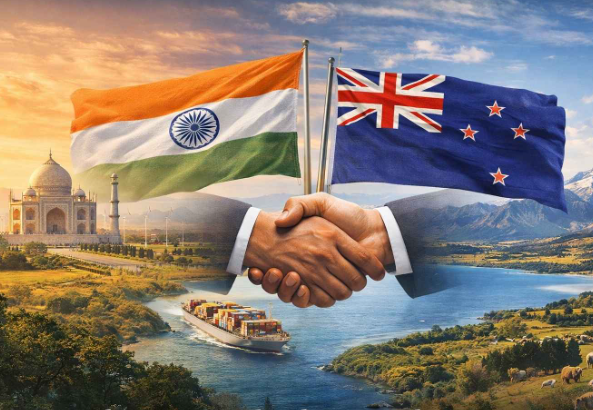
NEW DELHI, Oct 20: India’s free trade agreement with New Zealand came into force on Tuesday, opening the door to duty free access for Indian goods across the Pacific nation’s market and creating fresh opportunities for exporters seeking to expand beyond traditional trading destinations.
The agreement, which became operational at 12.01 am, covers a wide range of Indian products, including textiles, garments, leather goods, footwear, pharmaceuticals, engineering equipment, processed food and marine products. The removal of import duties is expected to improve the competitiveness of Indian manufacturers and make their products more attractive to New Zealand buyers. Commerce and Industry Minister Piyush Goyal said the agreement was intended to strengthen commercial relations and increase trade in goods and services between the two countries. The stated objective is to raise bilateral trade from around $2.4 billion to approximately seven billion New Zealand dollars, equivalent to nearly Rs 35,000 crore, by 2030. The implementation was marked by the dispatch of a mini excavator manufactured by JCB India for export to New Zealand. The shipment highlighted the potential for Indian engineering companies to use the agreement to expand overseas sales and diversify their customer base.
Goyal said JCB India currently exports around a quarter of its production to international markets and encouraged the company to increase that share. New Zealand has become another destination for Indian-made construction equipment, demonstrating how the trade arrangement could support manufacturers with established export capabilities.
Exporters gain wider market access
A key feature of the agreement is New Zealand’s commitment to provide 100 per cent duty-free access across its tariff lines for Indian exports. Previously, some Indian products faced import duties of up to 10 per cent, creating an additional cost disadvantage for suppliers competing with businesses from countries enjoying preferential access.
The removal of these tariffs could help Indian companies improve pricing, protect profit margins or offer more competitive rates to importers. The actual benefit, however, will depend on production costs, exchange-rate movements, freight charges and the ability of businesses to meet overseas quality requirements.
Textile and apparel manufacturers are among the sectors that could benefit from the new arrangement. India’s established manufacturing base, combined with lower tariff barriers, may help suppliers seek additional orders from retailers and distributors in New Zealand.
Leather and footwear businesses could also find opportunities to increase shipments. Engineering goods, pharmaceuticals, rubber products, plastics and agricultural commodities are other areas with potential for expansion.
For smaller exporters, the agreement may provide an incentive to explore a market that previously appeared less attractive because of duties and other compliance expenses. Industry participants will nevertheless need to invest in product standards, packaging, distribution networks and buyer relationships to convert preferential access into sustained business.
Services and skilled professionals included
The agreement extends beyond merchandise trade. New Zealand has agreed to open 118 services sectors and sub-sectors to Indian service providers, covering areas such as information technology, telecommunications, construction, education, tourism, financial services and professional consultancy. These provisions could help Indian companies seek contracts in overseas markets without relying exclusively on physical exports. Technology firms, engineering consultants, educational service providers and tourism businesses may be able to develop partnerships with New Zealand organisations.
The pact also establishes pathways for certain Indian professionals and business visitors to enter New Zealand for defined periods. Intra-company transferees may stay for up to three years, while business visitors and workers installing or servicing equipment may qualify for stays of up to 90 days within a 12-month period. Contractual service providers and independent professionals may be eligible for stays of up to 12 months, subject to the applicable conditions.
A temporary employment entry route provides for a quota of 5,000 skilled Indian workers at any given time, with eligible stays of up to three years. The covered occupations include fields such as information technology, engineering, construction, education and healthcare, alongside specified traditional and cultural professions. These arrangements could make it easier for eligible Indian businesses to deploy personnel for projects, technical assignments and professional engagements. Applicants will still need to satisfy the relevant visa and eligibility requirements.
Safeguards for domestic industries
While New Zealand has opened its market to Indian goods, India has adopted a selective approach to tariff concessions to protect sensitive domestic sectors.
Dairy products, including milk, cream, whey, yoghurt and cheese, are among the categories excluded from concessions. Several agricultural products, including onions, chickpeas, peas, corn and almonds, have also been kept outside the main tariff-benefit framework.
Other exclusions include sugar, certain fats and oils, precious metals, finished jewellery, arms and ammunition, and specified copper and aluminium products.For products such as apples, kiwifruit and Manuka honey, India has provided calibrated concessions through measures that include quotas, minimum import price provisions and other safeguards. The approach is intended to expand trade while limiting sudden pressure on vulnerable domestic producers.
New Zealand, meanwhile, will receive tariff concessions on 70 per cent of India’s tariff lines, covering around 95 per cent of the current value of bilateral trade. Its exporters are expected to gain from improved access to India’s large consumer market, particularly in sectors where the two economies have complementary commercial interests. Faster customs procedures
The agreement also seeks to reduce delays at the border. It provides for customs clearance within 48 hours for cargo and 24 hours for express and perishable consignments, alongside provisions for digital certification and self-certification of rules of origin for eligible businesses. Quicker processing could be particularly valuable for companies handling time-sensitive shipments, including perishable goods and urgent commercial consignments. More predictable procedures may also help businesses manage inventory, improve delivery schedules and reduce costs associated with goods remaining in transit or at ports.
However, exporters will need to maintain accurate documentation and comply with the agreement’s rules of origin to qualify for the applicable benefits.
Trade recovery remains a challenge
The new framework comes at a time when bilateral merchandise trade has faced a setback. Trade between India and New Zealand declined by about 11 per cent to $1.15 billion in the 2025-26 financial year, compared with $1.3 billion in the preceding year.
India’s exports during the period stood at $566.51 million, while imports were valued at $589.1 million, resulting in a trade deficit of $22.59 million. Reversing that trend will require companies to identify new buyers, improve product competitiveness and build reliable supply chains. The agreement provides favourable conditions, but stronger trade flows will depend on how effectively businesses use them.
The proposed investment commitment of $20 billion from New Zealand into India over 15 years could also support the broader economic relationship, subject to investment decisions and implementation. Cooperation in agriculture, including productivity initiatives for kiwifruit, apples and honey, is another area expected to receive attention.
With the agreement now in force, the focus shifts from negotiations to execution. Exporters, service providers and investors will need to translate the improved trading framework into actual orders, commercial partnerships and long-term market expansion.

