


Bavuma’s Magnificent 179 Puts South Africa in Command Against Australia
The South African captain rescues his side from 97 for five with crucial partnerships alongside Marco Jansen and Simon Harmer, helping the hosts declare at 425 for nine in the second Test.
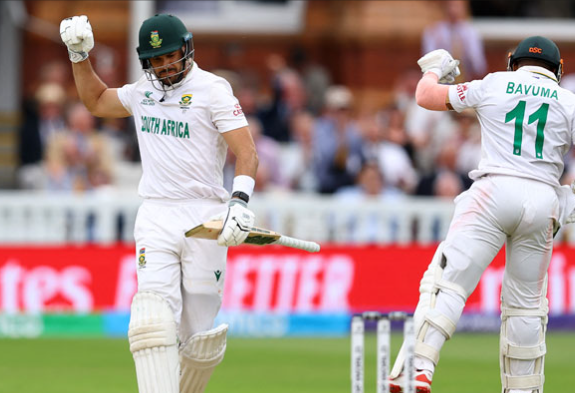
Gqeberha, Oct 20: South Africa captain Temba Bavuma produced a career best innings of 179 to lead a remarkable recovery against Australia in the second Test at St George’s Park, steering the hosts from a precarious position to a commanding total of 425 for nine declared.
Bavuma’s outstanding knock, supported by substantial contributions from Marco Jansen and Simon Harmer, transformed the match after South Africa had struggled at 97 for five. The hosts recovered through a series of determined partnerships, putting Australia under pressure following their dominant victory in the opening Test in Durban.
Jansen scored 85, while Harmer contributed a career-best 82 as South Africa’s lower order frustrated the Australian bowling attack. Their efforts enabled the home side to establish a substantial first-innings total and regain control of the contest.
Australia fast bowler Scott Boland claimed five wickets for 81 runs, recording his first five-wicket haul outside Australia. However, his efforts were overshadowed by South Africa’s late-order resistance.
The visitors endured a difficult start to their reply after Kagiso Rabada, returning from a hamstring injury, dismissed Nic Maddinson for a duck in the first over. Australia reached stumps at three for one, still trailing by 422 runs.
The recovery placed South Africa in a strong position heading into the fourth day, although weather interruptions earlier in the match meant the teams still faced the challenge of making up for lost playing time.
Bavuma anchors South Africa’s recovery
South Africa began the third day in a vulnerable position, having lost five wickets for 97 runs. Australia appeared well placed to restrict the hosts to a modest total, with Boland and the other visiting bowlers applying pressure through disciplined lines and lengths.
Bavuma, however, remained composed and focused on rebuilding the innings. Rather than allowing the situation to deteriorate, the captain prioritised preserving his wicket, rotating the strike and punishing deliveries that offered scoring opportunities.
His approach provided the stability South Africa needed. As the innings progressed, Bavuma began to find greater freedom at the crease, turning a difficult situation into an opportunity to put the Australian attack under sustained pressure.
The captain’s 179 was his highest score in Test cricket and represented a major individual achievement in a match that carried considerable importance for the hosts.
Bavuma’s innings was particularly significant because it came after South Africa had been forced onto the defensive. With wickets falling early, the team required a batter capable of absorbing pressure while giving the lower order time to settle.
His partnership with Jansen provided the first major breakthrough in the recovery. Jansen contributed 85, using his height and reach to negotiate the Australian attack while supporting the captain’s effort.
The pair added 132 runs for the seventh wicket, giving South Africa a platform from which to challenge the visitors’ advantage.
Their stand changed the complexion of the innings and ensured that Australia’s early success did not translate into complete control.
Jansen and Harmer extend the resistance
Jansen’s contribution was crucial in extending South Africa’s recovery beyond the initial partnership. The all-rounder showed patience against the new ball and capitalised when the bowlers missed their lengths.
His 85 helped South Africa move beyond the danger zone and placed greater demands on Australia’s bowling resources.
After Jansen’s dismissal, Harmer continued the fight alongside Bavuma. The pair produced an even more substantial stand, adding 183 runs for the eighth wicket and setting a South African record for that partnership.
Harmer’s career-best 82 was a valuable contribution from a lower-order batter who helped ensure that Bavuma’s innings was not left unsupported.
The partnership demonstrated the importance of tail-end contributions in Test cricket. When a side loses several early wickets, the lower order can determine whether the innings ends quickly or develops into a competitive total.
Harmer remained alongside Bavuma as South Africa steadily increased its score, forcing Australia to continue bowling for long periods and preventing the visitors from wrapping up the innings.
The record partnership also provided a psychological boost for the home team. After being reduced to 97 for five, South Africa had moved into a position from which it could apply pressure with both bat and ball.
Bavuma eventually completed his career-best innings before South Africa declared at 425 for nine, bringing an end to a remarkable recovery.
Boland stands out despite Australia’s difficulties
Boland was Australia’s most successful bowler, finishing with figures of five for 81. His performance represented his first five-wicket haul in a Test match played outside his home country.
The right-arm fast bowler had helped Australia establish their advantage during the earlier stages of South Africa’s innings, exploiting opportunities to remove batters and keep the hosts under pressure.
However, the prolonged partnerships prevented him and his teammates from completing the job quickly.
Test cricket often rewards bowlers who can sustain pressure over long spells, but it also requires patience when batters settle and begin building substantial partnerships.
South Africa’s recovery meant Australia had to spend additional time in the field, while the home side gained confidence from the way its lower order resisted the attack.
Boland’s five-wicket return remained a significant personal achievement, but the match situation had shifted considerably by the time South Africa declared.
The Australian bowlers now faced the challenge of restricting South Africa’s attack while also preparing for a demanding run chase or prolonged defensive effort in the remainder of the match.
Rabada strikes immediately after the declaration
South Africa’s decision to declare at 425 for nine gave its bowlers an opportunity to attack before the close of play.
Rabada made an immediate impact on his return from a hamstring injury, removing Maddinson for a duck with his fourth delivery of the innings.
The early breakthrough was important for South Africa because it prevented Australia from building momentum after the declaration. Rabada’s return also provided encouragement to the hosts, who had spent much of the match recovering from a difficult start with the bat.
Australia finished the day at three for one, with Travis Head and nightwatchman Boland at the crease.
The visitors faced a substantial deficit of 422 runs, making their immediate priority to avoid further wickets and establish a stable partnership.
Head’s presence at the crease gave Australia an experienced batter capable of helping to rebuild the innings. However, the team still had a considerable amount of work ahead, particularly after losing an opener so early.
South Africa, meanwhile, had the advantage of a large first-innings total and renewed confidence in its bowling attack.
The fourth day’s opening session was expected to be important in determining whether Australia could mount a recovery or whether the hosts would continue to strengthen their position.
A response to the opening Test defeat
South Africa’s performance carried added significance because Australia had won the first Test in Durban by a substantial margin.
The hosts needed a stronger response in the second match, and Bavuma’s innings provided the type of leadership required to prevent another difficult result.
The captain’s ability to remain at the crease while partnerships developed showed the value of patience in the longest format. Rather than attempting to force the pace too early, he built the innings around stability and allowed the supporting batters to contribute.
Jansen’s 85 and Harmer’s 82 further underlined the importance of contributions from different positions in the batting order.
For Australia, the day served as a reminder that early wickets do not guarantee control of a Test innings. Despite reducing South Africa to 97 for five, the visitors were unable to maintain their advantage as the home side’s lower order produced a determined response.
The contest also highlighted the different pressures facing teams in a multi-match series. South Africa needed to recover from the opening defeat, while Australia sought to maintain the advantage established in Durban.
Weather remains a factor
Weather interruptions had affected the earlier stages of the match, reducing playing time and increasing the importance of every available session.
With South Africa having declared at 425 for nine and Australia beginning its reply at three for one, the match remained finely balanced in terms of the time available to produce a result.
The home side had established a strong position, but it still needed to take wickets and manage the remaining overs effectively.
Australia’s immediate objective was to build a substantial partnership and reduce the deficit, while avoiding the collapse that had undermined South Africa earlier in the innings.
The third day’s events had given the hosts a clear boost, with Bavuma’s career-best score and the record eighth-wicket partnership providing the defining moments.
South Africa’s recovery from 97 for five to 425 for nine illustrated the resilience required in Test cricket, where matches can change direction through sustained partnerships and disciplined bowling.
Bavuma’s innings ultimately gave the home side renewed hope of levelling the series, while Australia’s response on the following day would determine whether the visitors could regain control.
The second Test had become a contest of endurance, with South Africa carrying the momentum after an exceptional batting recovery and Australia facing a substantial task to keep the match within reach.

