


India Face Testing New Zealand Challenge as Five Match T20I Series Begins
Shreyas Iyer led India head to Christchurch following a 2-2 series draw against the West Indies, with unfamiliar conditions, a demanding travel schedule and New Zealand's pace attack presenting early challenges.
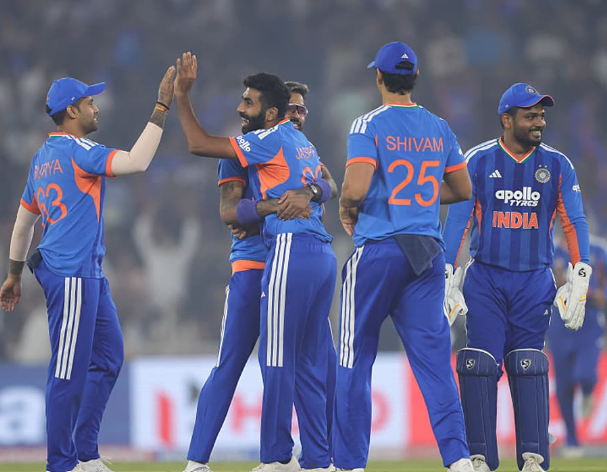
Christchurch, October 22: India will begin their five match T20 International series against New Zealand at Hagley Oval on Thursday, with the visitors looking to adapt quickly to conditions that could favour the home side. The opening contest is scheduled for 12.30 pm Indian Standard Time and marks the start of an important overseas assignment for Shreyas Iyer’s team.
The Indian squad arrives in New Zealand after a closely fought home series against the West Indies ended 2-2. The deciding match in Bengaluru was washed out by rain on October 17, leaving India with little time to recover before travelling overseas.
The packed schedule has created a demanding transition for the players. India’s campaign at the Asian Games in Japan concluded on October 3, after which the team returned home for the West Indies series. The short gap between assignments has left the squad with limited preparation time in Christchurch.
India will need to balance their established attacking approach with the patience required on New Zealand pitches, where movement off the surface and additional bounce can challenge batters accustomed to flatter conditions.
Captain Iyer has stressed the importance of assessing the surface before deciding how aggressively to approach the contest. The Indian team will be expected to make quick adjustments rather than rely on assumptions about how the pitch will behave.
New Zealand captain Mitchell Santner has also highlighted adaptability as a decisive factor. With conditions expected to vary across the five-match series, both teams will need to modify their bowling plans and batting strategies according to the venue.
New Zealand look to exploit home conditions
The hosts enter the series with confidence and will be keen to use their familiarity with local pitches to put India under pressure. New Zealand possess several fast-bowling options capable of exploiting movement with the new ball, making the opening overs particularly important for the visitors.
Finn Allen, Tim Seifert and Devon Conway provide the hosts with attacking options at the top of the order. Their ability to score quickly during the powerplay could determine how effectively New Zealand establish control over the innings.
The home side also has a strong selection of seam bowlers, including Matt Henry, Lockie Ferguson, Adam Milne, Jacob Duffy and Kyle Jamieson. Their pace, bounce and ability to vary their lengths could create problems for India’s top order.
Santner has indicated that bowlers will need to be intelligent rather than rely exclusively on speed or aggressive variations. At Hagley Oval, the ground’s larger boundaries could reward accurate bowling and make it harder for batters to clear the ropes consistently.
New Zealand will also have to adjust their approach as the series moves to other venues. Wellington, Auckland and Hamilton offer different ground dimensions and playing conditions, meaning the opening match will provide only a partial indication of what lies ahead.
The hosts will be without injured players Mark Chapman and Rachin Ravindra, which could influence their batting combinations. Nevertheless, their available resources offer sufficient flexibility to construct a competitive playing XI.
India face selection and workload questions
India’s immediate challenge is to settle on a balanced combination capable of handling the conditions. The absence of Jasprit Bumrah and Hardik Pandya leaves the team without two important players, requiring other members of the squad to take on additional responsibilities.
Bumrah has been rested with the Test series in mind, while Pandya has not returned to international action since the T20 World Cup final in Ahmedabad in March. Their absence affects India’s options in both the pace department and the all-rounder combination.
Experienced fast bowler Bhuvneshwar Kumar could prove valuable in New Zealand. His ability to swing the new ball and control the opening overs makes him a potentially important part of India’s plans.
New Zealand’s captain has also acknowledged the threat posed by Bhuvneshwar, particularly if the surface offers assistance to seamers. The Indian bowler’s experience could help the visitors restrict the hosts during the powerplay and create opportunities for the middle overs.
Varun Chakaravarthy’s return provides another option for India’s bowling attack, although the team management must decide whether the conditions justify selecting an additional seamer instead.
The batting order presents a separate question. Abhishek Sharma, Sanju Samson, Ishan Kishan and Tilak Varma provide attacking possibilities, while Shivam Dube and Nitish Kumar Reddy offer flexibility in the middle order.
The final combination will depend on how India assess the pitch and the need to maintain depth in both batting and bowling. A surface offering movement could encourage the selection of additional pace, whereas a more batting-friendly wicket might allow India to retain greater flexibility in the middle order.
Iyer stresses importance of adapting quickly
Iyer’s leadership will be closely watched as India attempt to establish consistency away from home. The captain has emphasised that players must evaluate conditions on arrival and remain flexible throughout the series.
The challenge is not limited to technical adjustments. Travel fatigue, limited training time and changes in climate can also affect performance, particularly when matches follow one another at short intervals.
India’s recent experience against the West Indies offered opportunities to test combinations, but New Zealand’s bowling attack and local conditions are expected to provide a different examination.
The visitors will need to manage the opening overs carefully, rotate the strike during difficult periods and identify opportunities to accelerate without taking unnecessary risks. Their bowling unit must similarly find ways to prevent New Zealand’s aggressive batters from establishing momentum.
The series will also offer valuable exposure to younger members of the squad. Iyer has indicated that developing players should be given time to understand overseas conditions, rather than being judged solely on immediate selection opportunities.
Young batter Vaibhav Sooryavanshi is among the players attracting attention, but his inclusion in the playing XI is not assured. India’s established opening options have continued to perform, and the team management may prefer to maintain continuity while allowing younger players to learn from the tour.
Five matches offer a wider test
The opening T20I is the first of five contests scheduled across New Zealand. The second match will also take place in Christchurch on October 24, followed by the third in Wellington on October 27.
The series will then move to Auckland for the fourth match on October 30 before concluding in Hamilton on November 1.
The itinerary will test the teams’ ability to adjust to different conditions and maintain consistency over a demanding period. For India, success will depend on how effectively the players adapt their methods while retaining the aggressive style that has become central to their T20 approach.
New Zealand, meanwhile, will aim to make home advantage count by applying pressure through their seam attack and using local knowledge to exploit changes in the pitch and weather.
India have enjoyed success in recent bilateral T20I meetings with New Zealand, but past results will offer limited protection if the visitors fail to adjust quickly. The hosts have the resources to challenge India’s batting depth, while the tourists possess enough experience and attacking quality to counter the threat.
The opening match is therefore likely to be an important early indicator of each team’s readiness for the series. India will seek a positive start despite their demanding schedule, while New Zealand will attempt to establish control on familiar ground.
With several tactical questions still to be answered, the Christchurch contest promises a competitive beginning to a series that could hinge on adaptability, disciplined bowling and the ability to perform under pressure.

