


India, Germany Target Major Trade Expansion as Businesses Explore New Investment Opportunities
Commerce Minister Piyush Goyal pushes for deeper industrial cooperation, technology partnerships and stronger supply chains as New Delhi advances its economic engagement with Europe.
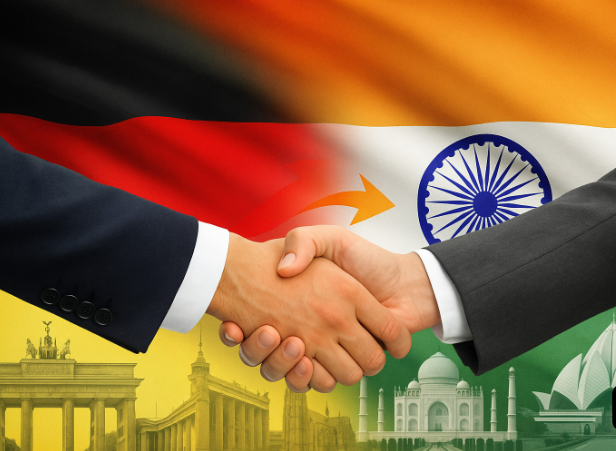
BERLIN, October 24: India and Germany are looking to expand their economic partnership through greater trade, investment and industrial cooperation, with Commerce and Industry Minister Piyush Goyal calling on businesses in both countries to combine their strengths and unlock new commercial opportunities.
During engagements in Berlin on October 22 and 23, Goyal held discussions with German Economic Affairs and Energy Minister Katherina Reiche, business leaders and industry representatives on ways to deepen commercial relations. The discussions covered advanced manufacturing, engineering, energy, digital technologies, infrastructure and opportunities emerging from the proposed India-European Union Free Trade Agreement (FTA).
Speaking at the India-Germany Business Roundtable, Goyal said bilateral trade could potentially rise tenfold, from around USD 31 billion to USD 310 billion, if businesses in both countries concentrated on developing complementary capabilities and creating new opportunities. The minister did not specify a deadline for achieving the proposed expansion.
The ambitious target highlights India’s interest in strengthening its economic engagement with Europe’s largest economy at a time when companies are reassessing international supply chains, manufacturing locations and access to major consumer markets. Germany, meanwhile, offers expertise in precision engineering, industrial technology and advanced manufacturing, while India provides a growing domestic market, a large workforce and expanding digital capabilities.
The two countries are seeking to turn these advantages into practical business partnerships rather than relying exclusively on conventional trade in finished products.
Trade agreement seen as an important catalyst
The proposed India-EU FTA featured prominently in the discussions. Goyal indicated that the agreement could be signed before the end of 2026 and become operational within four to five months of signing, subject to the necessary processes.
If implemented on that schedule, the agreement could begin creating new commercial opportunities in early 2027. However, its actual implementation timeline will depend on the completion of negotiations, formal approvals and applicable procedures.
A trade agreement can influence business decisions by reducing certain trade barriers, improving market access and establishing clearer rules for commercial engagement. Companies may be more willing to establish partnerships, invest in production facilities or expand distribution networks when they have greater certainty about future trading conditions.
For Indian exporters, improved access to European markets could create opportunities in engineering goods, pharmaceuticals, textiles, information technology services, chemicals and other manufactured products. German companies could also find additional opportunities in India’s expanding industrial and consumer markets.
The scale of the potential benefits will depend on the final terms of the agreement, including tariff schedules, regulatory requirements, rules of origin and provisions affecting services and investment.
Businesses will also need to assess whether they can meet European quality, environmental and product-compliance standards. Better market access can open doors, but companies must still demonstrate competitive pricing, reliable delivery and consistent product quality.
Industrial cooperation takes centre stage
The India-Germany relationship already includes established commercial links, with more than 2,000 German companies operating in India, according to Goyal’s remarks reported by The Economic Times on October 23.
The presence of these companies provides an existing base for expanding cooperation. German businesses have experience in machinery, automotive technology, industrial equipment and specialised manufacturing, while Indian firms are strengthening their capabilities in digital services, engineering, pharmaceuticals and technology-enabled production.
Greater cooperation could allow companies to develop products jointly, establish supplier networks and expand manufacturing capacity for domestic and international markets.
The two governments have also highlighted the importance of resilient supply chains. Disruptions to shipping, geopolitical tensions and changing trade policies have encouraged companies to reconsider the concentration of production in particular countries or regions.
India could benefit if German companies diversify their manufacturing and sourcing arrangements, particularly in sectors where Indian suppliers can meet international standards and offer dependable delivery.
For German manufacturers, partnerships with Indian businesses could provide access to a growing market and additional production capabilities. For Indian companies, collaboration could improve technical expertise, quality control and access to advanced industrial processes.
However, deeper industrial integration will require sustained investment in infrastructure, workforce training, research and development, and reliable logistics.
Technology and clean energy offer new opportunities
Technology was another important area of discussion during the Berlin engagements. The Indian delegation explored opportunities spanning artificial intelligence, information technology, advanced engineering and industrial innovation.
Companies in both countries could benefit from partnerships that combine German industrial expertise with India’s software development capabilities and growing technology ecosystem. Potential areas include factory automation, data analytics, digital manufacturing, engineering software and technology-driven supply-chain management.
Such partnerships may also help manufacturers improve productivity and reduce operating costs. Businesses increasingly rely on digital systems to monitor production, predict equipment failures, manage inventories and respond more quickly to changing customer demand.
Energy transition and clean technology also featured among the broader areas identified for cooperation. India is expanding its renewable energy capacity and looking for technologies that can support cleaner industrial processes, energy efficiency and sustainable mobility.
German companies could contribute engineering expertise and equipment, while Indian firms could provide manufacturing capabilities and opportunities for deployment at scale.
Collaboration in these areas may become increasingly important as businesses face pressure to reduce emissions and improve resource efficiency. However, the commercial success of clean-energy projects will depend on financing, technology costs, regulatory certainty and the availability of supporting infrastructure.
Indian business delegation seeks concrete partnerships
Goyal’s visit to Germany and the Netherlands from October 22 to 27 includes a delegation of around 100 Indian businesses and startups. The programme is designed to connect companies with prospective partners, investors and institutions across Europe.
In Berlin, business discussions covered automobiles, advanced manufacturing, infrastructure, energy, information technology, artificial intelligence, agri-food, consumer goods, textiles, healthcare and pharmaceuticals.
An India-Germany Investment Roundtable, organised with Germany Trade and Invest, was intended to help Indian companies understand opportunities to establish operations in Germany and engage with the country’s industrial ecosystem.
These interactions are important because trade growth does not depend only on government-level agreements. Businesses must identify specific projects, negotiate commercial terms, secure financing and establish the infrastructure required to serve customers.
Smaller companies and startups may particularly benefit from introductions to international investors, technology providers and established manufacturers. At the same time, entering European markets can involve substantial compliance costs, competition and the need to adapt products to local requirements.
The delegation’s work therefore represents an opportunity to explore potential projects rather than evidence that all discussions will immediately result in investment commitments.
Reducing barriers remains essential
German officials have emphasised the importance of reducing bureaucratic hurdles and pursuing joint projects to expand bilateral commerce. Simplifying administrative processes can make it easier for companies to establish operations, secure approvals and move goods across borders.
For India, attracting greater German investment will also depend on the ease of doing business, the reliability of infrastructure and the availability of skilled workers. German companies evaluating long-term projects will look at production costs, market access, policy stability and the ability to integrate Indian operations with global networks.
Indian businesses seeking to enter Germany will face their own challenges, including competition from established European suppliers, regulatory requirements and the need to build local distribution and service networks.
These practical issues could determine whether the proposed expansion in trade becomes achievable. Large trade targets provide direction, but they require measurable progress through new contracts, higher exports, investment commitments and productive partnerships.
Outlook
The latest engagements indicate that India and Germany want to move beyond traditional commercial exchanges towards a broader economic partnership built around technology, manufacturing, investment and supply-chain resilience.
The proposed India-EU FTA could provide an additional framework for expanding market access, although its eventual impact will depend on the agreement’s final provisions and implementation.
For Indian companies, closer ties with Germany could create opportunities to improve manufacturing capabilities, diversify exports and access new technologies. German businesses could gain a stronger presence in India’s expanding economy while diversifying production and sourcing arrangements.
The proposed tenfold increase in bilateral trade remains an ambitious objective rather than a guaranteed outcome. Achieving it would require sustained cooperation between governments and businesses, improved market access and a steady pipeline of commercially viable projects.
The next stage will be to convert diplomatic discussions into investments, supply agreements and long-term business relationships capable of delivering measurable economic benefits to both countries.

