


Air Chief Marshal AP Singh: Operation Sindoor Proved IAF Can Strike Any Target, Air Power Key to India’s Response
Air Chief Marshal AP Singh says the operation validated India’s capability driven military strategy, highlighting precision strikes, indigenous weapons, integrated air defence and the need to strengthen future combat readiness.
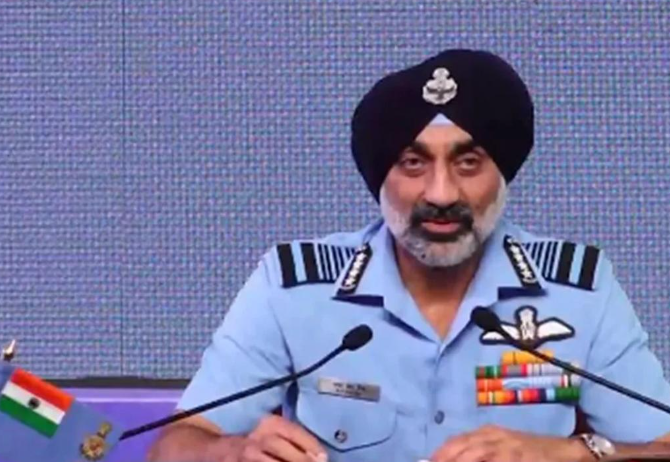
NEW DELHI, Oct 25: Operation Sindoor demonstrated the Indian Air Force’s ability to strike targets across a vast area of the Western front, with precision attacks extending 1,200 km in breadth and 200 km in depth, Chief of Air Staff Air Chief Marshal AP Singh said on Sunday, underscoring the importance of air power in India’s military strategy.
In an interview with a news agency, Singh described the operation as a major validation of the IAF’s capability centric approach, which integrates aircraft, sensors, weapons and communication networks to achieve greater operational effectiveness. He said air power had reaffirmed its position as India’s primary responder and a crucial element of strategic deterrence.
The Air Chief stressed that the experience gained during the operation should encourage further modernisation rather than complacency. According to him, the force must continue expanding its capabilities to respond more quickly, accurately and decisively to emerging security challenges.
“Operationally, one lesson stands out: we must always retain multiple options and the ability to adapt rapidly as the adversary changes tactics,” Singh said, emphasising the importance of flexibility in modern warfare.
He explained that a capability driven force can draw upon a range of operational tools instead of depending on individual platforms or weapons. This approach, he said, helped the IAF calibrate its response while maintaining control over the escalation of hostilities.
Launched in response to the Pahalgam terror attack, Operation Sindoor involved precision strikes against terror infrastructure in Pakistan and Pakistan-occupied territories in May 2025. The military action marked a significant phase in India’s cross-border response to terrorism.
Singh said the operation had strengthened the IAF’s confidence in its strategic direction and reinforced its determination to develop an increasingly integrated and technologically advanced force.
“Operation Sindoor proved that the path we have chosen is the right one,” he said, adding that the service would continue working towards responding more swiftly and precisely whenever the nation required its capabilities.
The Air Chief highlighted the performance of several indigenously developed weapons systems, saying they had delivered significant blows against targets deep inside enemy territory. He also said the IAF had maintained its commitment to avoiding civilian casualties during the operation.
According to Singh, the operation’s effectiveness did not depend on a single aircraft or weapon. Instead, it resulted from the combined application of intelligence, networked operations, precision and stand-off weapons, electronic warfare, layered air defence and counter-unmanned aerial system capabilities.
He said the integration of these elements enabled the IAF to conduct coordinated offensive and defensive operations across a broad geographical area.
The Air Chief also credited India’s indigenous networked air-defence systems with countering the large number of drones and stand-off weapons launched by the Pakistani military. He said the defensive capability allowed India to operate with confidence while offensive operations were being conducted.
“Offence and defence reinforced each other, which is precisely what a capability-centric force is designed to achieve,” Singh said.
He added that the operation highlighted the significance of joint planning and coordination among different military domains. Integrating air, land, maritime, space, cyber and electromagnetic capabilities helped improve decision-making and increased the overall operational impact.
Despite the operation’s achievements, Singh said the IAF must continue addressing areas requiring improvement. Priorities include increasing combat strength, enhancing intelligence, surveillance and reconnaissance capabilities, strengthening electronic warfare and counter-drone systems, improving network resilience and expanding the use of artificial intelligence in decision-making.
He also stressed the need to sustain high-intensity operations over extended periods. This would require reliable logistics, maintenance facilities, infrastructure and a stronger domestic defence manufacturing base.
The Air Chief said work was already underway across these areas, reflecting the force’s intention to convert operational lessons into long-term improvements.
Singh linked the IAF’s modernisation plans to the national objective of achieving a developed India by 2047. He said economic progress and national security were closely connected, with a secure environment supporting growth and a stronger economy providing the resources needed to enhance strategic capabilities.
He noted that the broader Defence Forces Vision 2047 envisages an integrated, multi-domain and technologically advanced military capable of supporting India’s long-term national ambitions.
For the Air Force, this means evolving into a multi-domain aerospace service capable of protecting the country’s expanding economic, technological and strategic interests across the full spectrum of conflict.
Singh said the IAF’s Capability Perspective Plan-2047 provides a structured framework for long-term development, identifying priorities based on emerging technologies and future operational requirements. The plan is supported by ten-year programmes that are periodically reviewed and updated.
Space capabilities will also form an important part of the force’s future development. Singh said the IAF Space Vision 2047 reflects the growing importance of space-based assets in modern military operations.
He identified self-reliance, advanced aerospace technologies, artificial intelligence, autonomous systems, cyber capabilities, precision weapons and resilient communication networks as key areas of focus. Building a domestic industrial ecosystem capable of developing and maintaining these technologies will be equally important, he added.
The Air Chief said achieving these objectives would require cooperation across government, industry, research institutions and the wider national ecosystem. Indigenous production, in particular, would help reduce external dependencies and improve the ability to maintain operational readiness during prolonged periods of tension.
He reiterated that national security and economic development must advance together, arguing that technological strength and industrial capacity are essential components of strategic power.
Singh said the IAF was committed to contributing to the country’s broader development ambitions by building a force that combines operational effectiveness with innovation and technological self-reliance.
By 2047, he said, the objective is to establish the IAF among the world’s most capable and technologically advanced aerospace forces, capable of protecting India’s interests while supporting its emergence as a developed nation.
The lessons of Operation Sindoor, he indicated, will remain central to this transformation, particularly the need for precision, integrated capabilities, rapid decision-making and the ability to adapt to changing battlefield conditions.

