


India’s Fiscal Deficit Rises to 42.1% of FY27 Target in First Half Amid Higher Spending
Government accounts show a 25 per cent year on year increase in the first-half deficit, with higher capital expenditure and subsidy commitments putting pressure on public finances.
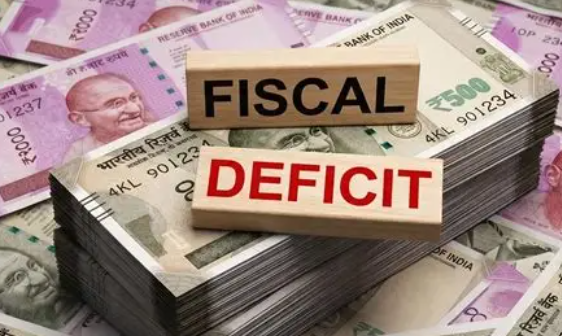
New Delhi, Oct 30: India’s central government fiscal deficit widened to Rs 7.14 lakh crore during the first six months of the financial year 2026-27, reaching 42.1 per cent of the annual Budget Estimate, as increased expenditure and higher subsidy commitments put pressure on public finances.
According to data released by the Controller General of Accounts (CGA) on Friday, the fiscal deficit during April-September was significantly higher than the Rs 5.7 lakh crore recorded in the corresponding period of the previous financial year. The latest figures highlight the challenge of maintaining fiscal discipline while continuing investments in infrastructure and meeting expenditure commitments.
The government has set the fiscal deficit target for FY27 at Rs 16.96 lakh crore, equivalent to 4.3 per cent of the country’s gross domestic product (GDP).
The deficit had accounted for approximately 36.5 per cent of the full-year target during the corresponding period last year. Its increase to 42.1 per cent this year indicates that government spending has outpaced the growth in receipts during the first half.
The fiscal deficit represents the difference between the government’s total expenditure and its receipts, excluding borrowings. It is an important indicator of the government’s financial position and its ability to manage public spending without excessive borrowing.
Government expenditure increases
Total government expenditure during April-September stood at approximately Rs 25.50 lakh crore, representing 47.7 per cent of the annual Budget Estimate.
This marked an increase from around Rs 23 lakh crore spent during the same period a year earlier, reflecting higher spending on infrastructure, subsidies, interest payments and other government programmes.
Revenue expenditure, which includes routine administrative costs, salaries, pensions, interest payments and subsidies, reached Rs 18.95 lakh crore during the six-month period.
Capital expenditure, which covers investments in infrastructure and the creation of long-term public assets, stood at Rs 6.55 lakh crore.
Capital spending accounted for 53.6 per cent of the annual Budget Estimate, compared with 51.8 per cent during the corresponding period last year.
The relatively faster pace of capital expenditure reflects the government’s continued emphasis on infrastructure development as an important driver of economic growth.
Investments in roads, railways, logistics, urban infrastructure and other public assets are intended to improve productivity, support industrial activity and encourage private sector investment.
However, higher spending also increases the pressure on government finances, particularly when revenue growth does not keep pace with expenditure.
Revenue collections show moderate growth
The Centre’s total receipts during the first half of FY27 amounted to Rs 18.35 lakh crore, equivalent to 50.3 per cent of the annual Budget Estimate.
Net tax revenue stood at Rs 12.76 lakh crore, accounting for 44.5 per cent of the full-year target. The figure was higher than the Rs 12.3 lakh crore collected during the corresponding period of the previous financial year.
Non-tax revenue reached Rs 4.81 lakh crore, representing 72.2 per cent of the annual estimate.
The government’s non-tax receipts include dividends, interest income, fees and other revenue sources. These collections provide an additional source of funding beyond direct and indirect taxation.
The pace of tax collection remains an important factor in determining whether the government can meet its fiscal consolidation commitments.
Although receipts have increased in absolute terms, their growth has not been sufficient to prevent the fiscal deficit from rising during the first half.
The government will therefore need to maintain a balance between revenue mobilisation and expenditure management during the remaining months of the financial year.
Subsidies contribute to expenditure pressure
Subsidy commitments continued to account for a substantial portion of government spending.
Major subsidies, including those for food, fertilisers and petroleum, amounted to approximately Rs 2.23 lakh crore during April-September.
Food and fertiliser subsidies are particularly important because they support agricultural production and help provide essential commodities at affordable prices.
Food subsidy expenditure stood at around Rs 1.02 lakh crore, while spending on urea subsidies reached Rs 85,585 crore. Nutrient-based fertiliser subsidy expenditure amounted to Rs 33,664 crore.
Petroleum subsidies remained comparatively limited at approximately Rs 1,149 crore.
Higher subsidy spending can increase pressure on the government’s revenue position, particularly when international commodity prices fluctuate or domestic support requirements rise.
The government must also account for interest payments on existing public debt, which reached Rs 6.46 lakh crore during the first six months.
Interest obligations represent a significant recurring expenditure and reduce the amount of financial resources available for other development programmes.
Fiscal consolidation remains a priority
Despite the increase in the deficit, the government has maintained its commitment to fiscal consolidation, with the FY27 target fixed at 4.3 per cent of GDP.
Fiscal consolidation involves gradually reducing the deficit and controlling public borrowing while ensuring that essential expenditure and investments are not disrupted.
Maintaining a credible fiscal position is important for investor confidence, macroeconomic stability and the government’s ability to finance future development requirements.
A lower fiscal deficit can also help moderate borrowing requirements and reduce pressure on interest rates over the longer term.
However, achieving the annual target will require careful management of expenditure during the second half of FY27.
The government will need to monitor the pace of capital investment, subsidy requirements and revenue collections to ensure that the deficit remains within the budgeted limit.
The timing of tax receipts and government expenditure can also influence monthly fiscal figures. Consequently, the first-half deficit does not necessarily determine the final position at the end of the financial year.
Infrastructure spending and economic growth
The government’s relatively strong capital expenditure reflects its strategy of using public investment to support economic activity.
Infrastructure development can generate employment, improve connectivity and reduce logistics costs for businesses.
Higher public investment can also encourage private companies to expand manufacturing capacity, establish new facilities and participate in infrastructure-related projects.
However, maintaining infrastructure spending while reducing the deficit requires consistent growth in government revenues.
Economists generally consider productive capital expenditure important because it can create assets that support economic activity over an extended period.
At the same time, the government must ensure that expenditure is directed towards projects capable of delivering long-term economic benefits.
Second-half performance will be crucial
The fiscal accounts for the first half of FY27 present a mixed picture. Government receipts have continued to increase, and capital expenditure remains strong, but the faster growth in overall spending has widened the deficit compared with the previous year.
The remaining six months will be important in determining whether the government can meet its annual fiscal target.
Higher tax collections, improved non-tax revenue and disciplined expenditure management could help narrow the gap.
However, unexpected spending requirements, fluctuations in commodity prices and changes in economic activity could influence the final outcome.
The latest figures underline the importance of balancing development priorities with fiscal responsibility as India seeks to sustain economic growth while maintaining macroeconomic stability.

