


India Targets Indigenous AI Processor Development Within Two Years, Accelerates Semiconductor Mission
The Ministry of Electronics and Information Technology is working towards developing an Indian GPU within 24 months while expanding domestic chip manufacturing, AI research and semiconductor infrastructure to reduce dependence on foreign technology.
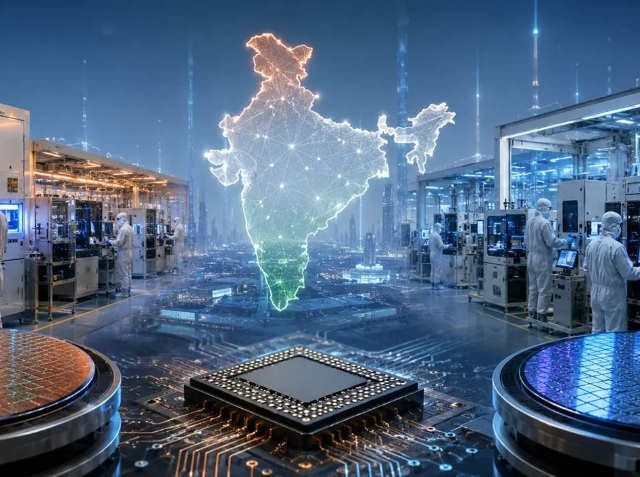
NEW DELHI, Nov. 4: India is stepping up efforts to strengthen its domestic semiconductor and artificial intelligence capabilities, with the government targeting the development of an indigenous Graphics Processing Unit (GPU) within the next 24 months as part of its broader strategy to establish technological self reliance.
The Ministry of Electronics and Information Technology (MeitY) is working on an integrated approach covering semiconductor manufacturing, chip design, computing infrastructure, artificial intelligence models and digital applications.
MeitY Secretary S. Krishnan outlined the government’s priorities in an interaction published on Wednesday, highlighting the importance of reducing dependence on imported technologies and developing a complete domestic ecosystem to support India’s growing digital economy.
The proposed indigenous GPU is expected to become an important component of India’s artificial intelligence ambitions. GPUs are specialised processors widely used for complex computing activities, particularly training and running advanced AI models.
At present, the global market for high-performance AI processors is dominated by international technology companies. Developing domestic alternatives could help India strengthen its computing capabilities and reduce vulnerabilities arising from dependence on overseas suppliers.
The government is also expanding the scope of the India Semiconductor Mission through its second phase, known as Semicon 2.0. With an approved outlay of Rs 1,27,500 crore, the programme aims to develop capabilities across the semiconductor value chain rather than concentrating only on chip fabrication and packaging.
Under the expanded initiative, greater attention will be given to chip design, manufacturing equipment, specialised materials, chemicals, advanced packaging and research and development.
Krishnan said the objective was to create an integrated semiconductor ecosystem capable of supporting domestic industries and competing in international markets.
India has already made progress in attracting semiconductor investments and establishing manufacturing facilities. However, developing a sustainable industry requires a wider network of suppliers, research institutions, technology companies and skilled professionals.
The government is therefore seeking to encourage domestic manufacturers to produce essential components and materials required by semiconductor fabrication facilities.
Chip design has also emerged as a major priority. Under the first phase of the Design Linked Incentive scheme, more than 100 companies were identified, with 24 receiving financial assistance. Of these, 15 subsequently attracted venture capital or other private investments.
The programme has supported companies working on different semiconductor applications, including microcontrollers, drone flight controllers, smart meter components and surveillance-related chips.
The government intends to strengthen this support under Semicon 2.0, particularly for strategically important processors and AI accelerators. Assistance for electronic design automation tools, which are essential for developing complex semiconductor designs, will also continue.
Another focus area is the commercialisation of indigenous processors developed using the RISC-V architecture.
Indian-developed processors such as SHAKTI and VEGA demonstrate the country’s growing capabilities in semiconductor design. Authorities are looking to expand their practical applications across telecommunications, industrial equipment, defence-related systems and other sectors.
The government believes that encouraging domestic chip adoption in security-sensitive applications could create a stronger market for Indian semiconductor companies.
Devices such as CCTV cameras, industrial sensors, smart meters and drone controllers can involve sensitive information. Using trusted and verified components in these systems could help address security concerns while creating commercial opportunities for domestic manufacturers.
India’s semiconductor market is currently valued at slightly more than USD 50 billion and is projected to approach USD 100 billion by 2030, according to estimates discussed by the MeitY Secretary.
Despite the expected expansion, domestic production will initially account for only a portion of the country’s total semiconductor requirements. Building manufacturing capacity, improving technological expertise and developing reliable supply chains will therefore remain important priorities.
Artificial intelligence is another major area receiving government attention. Under the IndiaAI Mission, support has been extended to more than 20 indigenous AI models.
The government expects some of these models to develop advanced capabilities, while also encouraging smaller, specialised systems designed for sectors such as agriculture, healthcare, education and manufacturing.
Such applications could help businesses and public institutions use artificial intelligence without necessarily depending on expensive, large-scale general-purpose models.
Krishnan emphasised that developing AI models alone would not be sufficient to establish technological independence. India must also strengthen its capabilities in computing hardware, servers, data infrastructure and practical applications.
The government is encouraging the production of AI-capable servers within the country. The Centre for Development of Advanced Computing has developed its Rudra series of servers, including systems designed to support artificial intelligence workloads.
Technology transfer to Indian companies is expected to help expand domestic manufacturing and improve the availability of computing infrastructure.
The government is also encouraging international companies establishing data centres in India to consider developing local manufacturing facilities.
Data availability and privacy protection form another important part of the country’s AI strategy.
On October 31, MeitY launched the DEPA for AI Training Handbook, outlining a framework for secure data sharing to support artificial intelligence research and development while protecting personal information.
The Data Empowerment and Protection Architecture is intended to create mechanisms through which organisations can share information for legitimate purposes without compromising individual privacy or institutional control.
The government has also developed AIKosh, a platform providing access to datasets that can support AI development.
However, officials have acknowledged that anonymised information can sometimes be re-identified, creating additional challenges for organisations handling sensitive data. Establishing reliable safeguards will therefore be essential as AI development expands.
India is simultaneously preparing for the implementation of the Digital Personal Data Protection Act. The framework is expected to become operational by May 2027, following an 18-month preparation period.
Awareness programmes are being conducted to familiarise government departments, private companies and other organisations with their responsibilities under the legislation.
The National Informatics Centre has also developed a product to assist government departments and organisations handling substantial quantities of personal information in preparing for compliance.
Beyond infrastructure and regulation, the government sees artificial intelligence as a major opportunity for India’s information technology services industry.
Krishnan said the expansion of enterprise-level AI adoption could create opportunities comparable to those generated by the Y2K transition, which played an important role in the growth of India’s IT industry.
Although automation could change existing job requirements, the government believes that demand for professionals involved in AI integration, software development, data management and enterprise technology transformation will increase.
India’s IT companies could help international businesses introduce AI systems into their operations, address security requirements and integrate emerging technologies with existing software infrastructure.
The challenge will be to ensure that employees receive the necessary training and develop skills suited to the changing requirements of the industry.
The government’s strategy reflects a broader effort to move India from being primarily a consumer of advanced digital technologies towards becoming a developer and manufacturer of critical technological solutions.
Developing indigenous GPUs, expanding semiconductor manufacturing, supporting domestic AI models and improving data protection could collectively strengthen the country’s technological position.
However, achieving these objectives will require sustained investment, research collaboration, private-sector participation and the development of specialised talent.
With the semiconductor industry becoming increasingly important to global economic and strategic competition, India’s ability to establish a reliable domestic ecosystem will play a significant role in determining its future position in the international technology market.

