


Bangladesh Deploys More Paramilitary Forces Amid Ongoing Garment Workers’ Protests
Authorities step up security across Dhaka’s industrial zones as wage protests enter their fifth day, forcing factory closures and triggering clashes between demonstrators and security personnel.
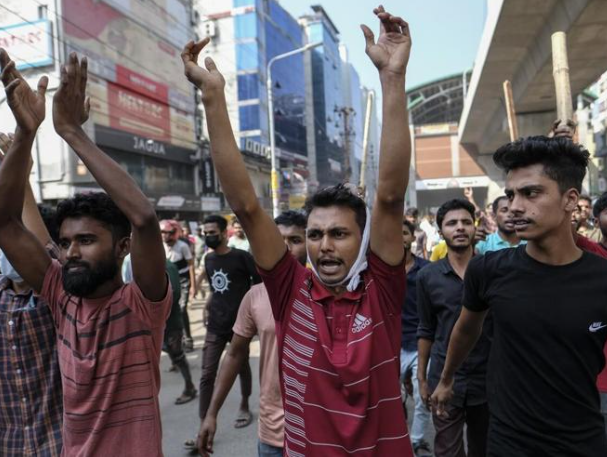
DHAKA, Nov 4: Bangladesh stepped up security across key industrial areas on Wednesday as protests by garment workers demanding higher wages continued for a fifth consecutive day, prompting authorities to deploy additional paramilitary forces and ruling Bangladesh Nationalist Party (BNP) activists to prevent further unrest.
The Bangladesh Garment Manufacturers and Exporters Association (BGMEA) said around 50 factories in Gazipur remained closed due to fears of retaliatory violence following the death of a worker who had sustained injuries during the ongoing demonstrations.
Tensions escalated in the Savar industrial area, where protesters reportedly set a police vehicle on fire during clashes that disrupted traffic on the busy Dhaka-Aricha highway.
Meanwhile, BNP activists carrying bamboo sticks organised counter-demonstrations, claiming they were attempting to maintain public order and prevent outsiders from provoking violence. The ruling party has alleged that supporters of former prime minister Sheikh Hasina’s disbanded Awami League had infiltrated the workers’ movement.
The political controversy intensified after Zahedur Rahman, Information Affairs Adviser to Prime Minister Tarique Rahman, accused Hasina of encouraging unrest in the country. Speaking at a media briefing on Tuesday, he alleged that the former prime minister was behind attempts to destabilise the government.
Rahman’s remarks represented a departure from his earlier position that Hasina and the Awami League no longer held political relevance in Bangladesh.
Hasina fled to India after her government was removed from power on August 5, 2024, following a student-led uprising. Subsequently, a special tribunal established under the interim administration led by Muhammad Yunus sentenced her to death in absentia.
Amid the escalating demonstrations, the government constituted a six-member Wage Board on Sunday under the leadership of a senior district judge to address workers’ demands. At its first meeting on Wednesday, the panel agreed to complete its recommendations within one month.
The government had previously announced that the revised wage structure would come into effect in January. However, following the intensification of protests, authorities reportedly advanced the implementation date to December 1, state-run Bangladesh Sangbad Sangstha (BSS) reported.
The unrest also spread to several industrial centres, including Uttara and Mirpur in Dhaka, as well as Savar, Gazipur and Narayanganj. Clashes between demonstrators and law enforcement personnel were reported from multiple locations.
According to BSS, approximately 10,000 police personnel were deployed in Mirpur alone to prevent further violence. Special Response Battalion personnel, Armed Police Battalion units, Counter Terrorism and Transnational Crime officials, detectives and intelligence agencies were also involved in security operations.
Additionally, 24 platoons of Border Guard Bangladesh (BGB) were stationed across industrial zones in Savar, Ashulia, Gazipur and Narayanganj. The paramilitary force also established a monitoring centre at its Pilkhana headquarters, equipped with drones and body-worn cameras to oversee developments.
Bangladesh’s garment industry, one of the country’s most important economic sectors, is facing mounting challenges due to increasing manufacturing expenses, inflation and stiff competition in international markets.
Workers have maintained that their existing salaries are insufficient to meet everyday expenses, particularly as inflation remains close to eight per cent. Their demand for improved wages has fuelled demonstrations across major manufacturing centres, creating fresh challenges for the government and the country’s export-oriented textile industry.

