


US Chip Restrictions Threaten China’s AI Expansion as Alibaba and Tencent Assess Impact
New American export controls targeting access to advanced AI processors through overseas data centres could disrupt China's computing capacity, forcing major technology companies to reconsider infrastructure investments and accelerate domestic chip development.
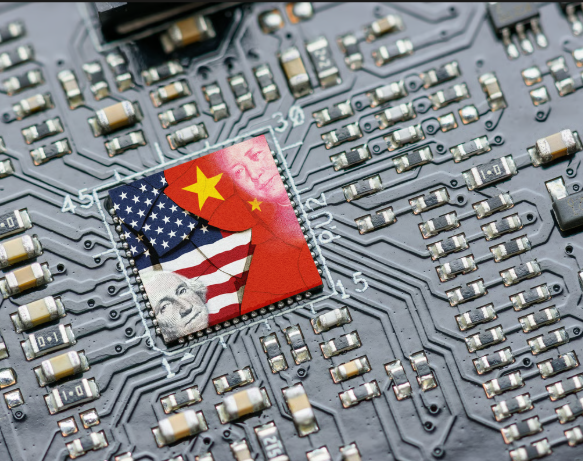
HONG KONG: China’s leading technology companies are assessing the potential consequences of tighter US restrictions on advanced artificial intelligence chips, as Washington moves to close overseas computing routes that Chinese businesses have used to access powerful processors.
The new restrictions could create additional challenges for companies developing sophisticated AI models, particularly Alibaba and Tencent, which have been investing heavily in cloud computing, semiconductor technology and artificial intelligence infrastructure.
The measures target remote access to advanced computing resources through data centres located in third countries. They are intended to prevent Chinese companies from obtaining access to powerful American-designed processors through overseas facilities, even when the equipment is not physically shipped to China.
The development marks another escalation in the technology competition between Washington and Beijing, with access to advanced semiconductors emerging as a major strategic issue.
For Chinese technology companies, the restrictions could affect the speed of AI development, infrastructure expansion and the ability to compete with international rivals.
The latest measures also come as China attempts to strengthen its domestic semiconductor industry and reduce dependence on foreign technology.
Washington tightens control over overseas computing access
The United States has already imposed restrictions on exports of its most advanced artificial intelligence processors to China.
However, Chinese businesses have continued to access some powerful computing resources by renting processing capacity from data centres located in countries permitted to import such equipment.
This arrangement allowed companies to train AI models and perform demanding computing operations without directly importing restricted processors into China.
American policymakers have increasingly viewed this practice as a loophole in existing export controls.
The latest restrictions seek to address that issue by extending scrutiny to overseas data centres offering remote computing access to companies in restricted countries.
The move could affect international technology operators, cloud service providers and businesses supplying specialised equipment to data centres.
It also introduces additional compliance responsibilities for companies involved in the international distribution and use of advanced computing technology.
The restrictions are part of Washington’s broader effort to control the movement of strategically important semiconductor technology and limit China’s access to computing resources that could support advanced AI development.
Alibaba warns of possible impact on expansion plans
Chinese technology giant Alibaba has acknowledged that the new American restrictions could affect certain aspects of its international data centre expansion strategy.
The company said it was evaluating the potential consequences of the measures, indicating that the full impact on its operations and investment plans was not yet clear.
Alibaba has been expanding its presence in artificial intelligence through investments in computing infrastructure, cloud services and proprietary AI models.
Its cloud division has become an increasingly important part of its business as companies seek computing capacity to develop and deploy AI applications.
During the July-September quarter, Alibaba reported a 53 per cent year-on-year increase in revenue from AI-related cloud and computing services, taking the figure to nearly 61 billion yuan, equivalent to approximately $9 billion.
The company’s overall revenue increased 10 per cent to almost 272 billion yuan during the same period.
However, the expansion has required substantial investment in infrastructure.
Alibaba’s capital expenditure rose 60 per cent during the quarter to 50.5 billion yuan, reflecting its efforts to increase computing capacity and strengthen its artificial intelligence business.
The company has also been developing its own semiconductor technology and AI models as part of a wider strategy to compete in the global technology market.
Its latest investments highlight the growing importance of computing infrastructure in the commercial development of artificial intelligence.
Restrictions on overseas computing access could complicate these plans, particularly if the company faces difficulties securing sufficient access to advanced processors.
Tencent raises concerns over computing limitations
Tencent has also expressed concerns about the consequences of the new American policy.
The company’s president, Martin Lau, said the restrictions would reduce the availability of advanced computing resources for Chinese technology businesses.
He indicated that the measures could affect the development schedules of future AI models because companies would have fewer options for obtaining access to powerful processors.
Tencent has been investing in artificial intelligence across several business areas, including cloud computing, digital services and enterprise applications.
The company requires substantial computing capacity to train and operate increasingly sophisticated AI systems.
The restrictions could therefore create additional pressure on its technology development plans.
Industry analysts have also highlighted the importance of advanced Nvidia processors to Chinese AI companies.
Despite efforts to develop domestic alternatives, powerful foreign-designed chips have remained an important component of the computing infrastructure used by several Chinese technology businesses.
The latest American measures could make access to such processors more difficult, particularly through international cloud platforms.
Nvidia’s position adds to uncertainty
The restrictions have also brought renewed attention to Nvidia, whose processors are widely used in artificial intelligence development.
The company has played a central role in supplying the semiconductor technology required for large-scale AI training and inference.
Its advanced processors are used by technology companies, research institutions and cloud service providers around the world.
Nvidia has indicated that it is no longer shipping certain processors, including the H200, to China.
The development adds another layer of uncertainty for Chinese companies seeking access to high-performance computing equipment.
Although the H200 is not Nvidia’s most advanced processor, it remains a powerful component for AI workloads.
The restrictions and changes in the company’s supply arrangements could affect the availability of advanced computing resources for Chinese customers.
For Nvidia, the situation also highlights the commercial difficulties created by increasingly complex export regulations.
Technology companies must navigate restrictions imposed by governments while attempting to maintain relationships with customers across international markets.
The semiconductor industry has consequently become closely connected to diplomatic relations and national security considerations.
China faces pressure to strengthen domestic semiconductor production
The latest American measures are expected to reinforce China’s efforts to develop a more independent semiconductor industry.
Beijing has been encouraging domestic companies to invest in chip manufacturing, processor design and advanced computing technologies.
The objective is to reduce dependence on foreign suppliers and establish a domestic technology ecosystem capable of supporting the country’s growing AI requirements.
Chinese technology companies have already increased their investments in alternative processors and artificial intelligence infrastructure.
Alibaba has been developing its own chip technology, while other domestic semiconductor companies are working to improve the performance and production capacity of locally designed processors.
However, building a competitive semiconductor industry requires substantial financial resources, specialised manufacturing equipment, technical expertise and time.
Advanced processors depend on sophisticated production processes that remain difficult to replicate at scale.
China’s efforts to strengthen domestic manufacturing could therefore receive additional momentum from the latest restrictions, although the transition will not necessarily be immediate.
Tencent’s Lau has suggested that Chinese technology companies will increasingly need to depend on domestic supply chains and locally developed semiconductor products over the longer term.
The comments reflect an industry-wide recognition that access to computing resources has become a critical factor in determining the future of artificial intelligence.
International data centres face additional compliance requirements
The new restrictions could also affect companies operating data centres outside China.
International cloud providers and infrastructure operators may have to review their customer relationships, access arrangements and compliance procedures to ensure that restricted entities do not obtain prohibited computing resources.
This could increase the administrative and operational costs associated with international data centre operations.
Companies may also need to introduce stronger verification systems to identify the ultimate users of computing capacity.
The challenge is particularly significant because data centres often provide services to customers through complex international arrangements.
A facility located in one country may provide computing services to businesses operating in several other markets.
Under tighter export controls, operators could face additional scrutiny over the identity of customers, the purpose of computing activities and the organisations ultimately benefiting from the services.
These requirements could affect the commercial flexibility of international cloud businesses.
The new policy also raises questions about how governments will coordinate enforcement when computing resources are accessed remotely across national borders.
Global technology competition intensifies
The growing restrictions reflect a wider shift in the relationship between international trade and technology development.
Semiconductors, artificial intelligence and cloud computing are increasingly being treated as strategic assets rather than ordinary commercial products.
The United States argues that controlling access to advanced computing technology is necessary to protect national security and maintain its technological advantage.
China, meanwhile, has criticised American restrictions and described efforts to limit its access to overseas computing resources as economic coercion.
Beijing has maintained that domestic innovation and investment will help the country overcome external restrictions.
The latest developments could encourage further investment in alternative semiconductor technologies and domestic cloud infrastructure.
They may also lead technology companies to reconsider their international partnerships and supply chain arrangements.
For other countries, the growing competition creates both opportunities and challenges.
Markets seeking to attract semiconductor manufacturing and data centre investments could benefit from companies diversifying their infrastructure.
However, businesses operating internationally may face greater uncertainty as export regulations become more complicated.
AI development could face higher costs
Access to computing power is one of the biggest expenses involved in developing advanced artificial intelligence systems.
Training large models requires thousands of processors working together, supported by high-speed networking, energy supplies and specialised cooling infrastructure.
If access to advanced chips becomes more restricted, companies may need to rely on alternative processors, optimise their models or invest additional resources in domestic computing facilities.
These adjustments could increase development costs and potentially affect the pace at which new AI products reach the market.
Chinese technology companies may also have to improve software efficiency to achieve comparable results with fewer advanced processors.
Developers are likely to explore different approaches to model training, inference optimisation and computing resource management.
The situation could accelerate innovation in domestic chip design, but it also presents immediate operational challenges.
For Alibaba and Tencent, maintaining competitive AI services will depend on their ability to secure reliable computing capacity while adapting to changing international regulations.
A defining moment for the semiconductor industry
The latest restrictions underline how access to advanced processors has become central to the global artificial intelligence race.
For China, the immediate challenge is to maintain the momentum of AI development despite tighter access to foreign computing resources.
For the United States, the priority is to strengthen export controls and prevent restricted technologies from reaching organisations it considers strategically sensitive.
The coming months will be important in determining how effectively Chinese companies can adjust their infrastructure strategies and whether domestic semiconductor manufacturers can fill the gaps created by restricted imports.
The developments also demonstrate that the future of artificial intelligence will depend not only on software innovation but also on semiconductor manufacturing, international trade policies and access to large-scale computing infrastructure.
As Washington and Beijing continue to compete for technological leadership, the semiconductor industry is likely to remain at the centre of their economic and strategic rivalry.

