India and Nepal Sign Healthcare MoU to Expand Medical Infrastructure, Research and Affordable Medicines
The agreement aims to upgrade Nepal's hospitals and National Medical Laboratory, establish Jan Aushadhi Kendras and strengthen medical education, workforce training and pharmaceutical regulation.
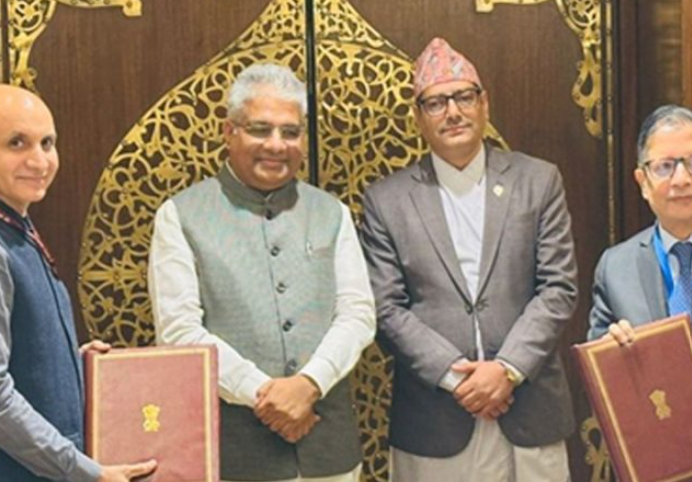
NEW DELHI, Nov 27: India and Nepal have agreed to expand cooperation in the healthcare sector through a new Memorandum of Understanding (MoU) covering medical infrastructure, research, healthcare workforce development and access to affordable medicines.
The agreement is part of a broader effort by the two neighbouring countries to deepen bilateral relations and strengthen cooperation across several strategic sectors, including healthcare, traditional medicine, forensic science, satellite communications and sustainable urban development.
The healthcare agreement was signed between India’s Ministry of Health and Family Welfare and Nepal’s Ministry of Health and Food Safety. It forms part of eight memoranda of understanding exchanged following bilateral discussions between Prime Minister Narendra Modi and Nepalese Prime Minister Balendra Shah.
The two leaders also adopted a Joint Vision for a ‘Viksit Bharat and Samunnat Nepal’, outlining their commitment to building a future-oriented partnership based on economic development, institutional cooperation and regional progress.
Healthcare has emerged as an important component of the proposed partnership, with both countries recognising the importance of improving medical infrastructure, strengthening healthcare institutions and expanding access to essential services.
Under the agreement, India will support Nepal’s efforts to improve healthcare facilities, including health posts, birthing centres and hospitals. The collaboration is expected to help strengthen medical services, particularly in areas where access to specialised treatment and adequate infrastructure remains a challenge.
Focus on upgrading healthcare infrastructure
One of the key components of the agreement is the proposed strengthening of Nepal’s existing healthcare infrastructure.
The partnership envisages cooperation in developing and improving health posts, maternity facilities and hospitals to enhance the availability of medical services.
Healthcare infrastructure plays an important role in ensuring timely diagnosis, treatment and emergency medical assistance. Strengthening facilities at different levels can help improve access for people living in remote and underserved communities.
The proposed cooperation could also support Nepal in improving the operational capacity of its healthcare institutions through technical assistance, institutional partnerships and knowledge-sharing initiatives.
The emphasis on birthing centres is particularly relevant to maternal and child healthcare. Accessible maternity services can help women receive appropriate medical attention during pregnancy, childbirth and the postnatal period.
Improved hospital infrastructure can also strengthen referral systems and provide patients with better access to specialised medical services.
National Medical Laboratory to receive support
Another important feature of the agreement is the proposed upgrading of Nepal’s National Medical Laboratory.
Laboratory facilities are essential to the healthcare system because they support disease detection, medical diagnosis, clinical investigations and public health surveillance.
Modern laboratory infrastructure can improve the accuracy and reliability of diagnostic services while strengthening the ability of health authorities to identify and respond to emerging disease threats.
The proposed collaboration is expected to support Nepal’s efforts to enhance laboratory capacity and improve technical capabilities.
Better laboratory services can also strengthen medical research and provide healthcare professionals with more reliable diagnostic information.
The initiative reflects the importance of investing not only in hospitals but also in supporting institutions that contribute to disease prevention, diagnosis and treatment.
Jan Aushadhi Kendras to improve access to affordable medicines
Access to affordable medicines is another major area covered by the India-Nepal healthcare partnership.
The agreement includes plans to establish India-Nepal Jan Aushadhi Kendras in Nepal to improve the availability of reasonably priced medicines.
India’s Jan Aushadhi initiative focuses on making quality generic medicines available at affordable prices through dedicated outlets.
Extending a similar model to Nepal could help patients access essential medicines at lower costs and reduce some of the financial pressure associated with medical treatment.
Medicine affordability remains an important concern for households, particularly those requiring long-term treatment for chronic conditions.
The proposed centres could provide an additional channel for patients to obtain essential medicines while encouraging greater awareness about generic pharmaceutical products.
The initiative also reflects India’s intention to share its experience in pharmaceutical distribution and affordable medicine delivery with its neighbouring country.
However, the success of the proposed outlets will depend on effective supply-chain management, regulatory compliance and consistent availability of medicines.
Training programmes for healthcare professionals
The agreement also places emphasis on developing Nepal’s healthcare workforce through specialised training programmes.
India will facilitate customised capacity-building opportunities under its Indian Technical and Economic Cooperation (ITEC) Programme.
The initiative is expected to provide Nepalese healthcare professionals with opportunities to improve their technical knowledge, professional skills and institutional capabilities.
Training and professional development are important for strengthening healthcare delivery, particularly as medical technologies and treatment methods continue to evolve.
Doctors, nurses, laboratory professionals and other healthcare personnel require continuous training to keep pace with developments in diagnosis, patient management and clinical practices.
The proposed cooperation could help strengthen professional expertise and improve the quality of services available through Nepal’s healthcare institutions.
Medical education and research partnerships
The MoU also encourages institutional partnerships between leading medical institutions in India and Nepal.
These collaborations are expected to include student and faculty exchanges, research partnerships and opportunities for academic cooperation.
Medical institutions play an important role in developing skilled professionals and advancing scientific knowledge.
Closer academic engagement can allow institutions to exchange experiences, share research findings and collaborate on healthcare challenges affecting both countries.
Student and faculty exchange programmes could also provide opportunities for medical professionals and researchers to gain exposure to different healthcare systems and clinical practices.
Research cooperation is another significant component of the partnership.
India’s Indian Council of Medical Research (ICMR) and Nepal’s Nepal Health Research Council (NHRC) are expected to strengthen their collaboration to promote joint research activities.
Such partnerships could support scientific studies, improve research capabilities and encourage greater cooperation in public health.
The agreement also provides for regulatory coordination between India’s Central Drugs Standard Control Organisation (CDSCO) and Nepal’s Department of Drug Administration.
Closer cooperation between the two regulatory authorities could improve information-sharing and coordination concerning pharmaceutical standards and drug regulation.
Traditional medicine also included in broader cooperation
The healthcare agreement is part of a wider bilateral framework that also includes traditional medicine.
India and Nepal have longstanding cultural and historical connections, including shared traditions concerning traditional healthcare practices.
Cooperation in this area could provide opportunities for institutional exchanges, knowledge-sharing and further engagement between relevant organisations.
The broader agreements also cover forensic science and other sectors, reflecting the two governments’ intention to expand cooperation beyond conventional diplomatic and economic relations.
A broader partnership between neighbouring countries
The Joint Vision adopted by Modi and Shah outlines a roadmap for expanding bilateral engagement across ten sectors, including healthcare, economic development, sports, technology and agriculture.
The two countries have also discussed wider development cooperation, including cross-border connectivity, energy projects and educational partnerships.
India has announced a development assistance package worth Rs 15,000 crore, comprising grants and a line of credit for reconstruction, infrastructure and energy-related projects.
An offshore Indian Institute of Technology campus in Nepal is also among the broader proposals outlined during the discussions.
To ensure that the agreements move towards implementation, the two countries have agreed to activate a High-Level Monitoring Group led by Nepal’s Foreign Secretary and India’s Ambassador to Nepal.
The group is expected to meet at least once every six months to review progress, address implementation-related difficulties and facilitate necessary approvals.
Healthcare cooperation expected to strengthen regional ties
The new healthcare agreement represents an important step towards expanding cooperation between India and Nepal in a sector that directly affects the well-being of their populations.
By focusing on infrastructure, affordable medicines, laboratory services, medical education and research, the partnership seeks to address several important aspects of healthcare delivery.
For Nepal, collaboration with Indian medical institutions and regulatory agencies could provide access to technical expertise and institutional support.
For India, the agreement offers an opportunity to strengthen regional healthcare partnerships and share experience in areas such as generic medicines, medical education and public health infrastructure.
The effectiveness of the initiative will ultimately depend on the timely implementation of the proposed projects and sustained coordination between the two governments.
With healthcare identified as a priority under their broader Joint Vision, the agreement provides a framework for deeper medical cooperation and stronger institutional links between the neighbouring countries.