


J&K MLAs Swear Oaths in Kashmiri, Dogri, Sanskrit, and Regional Dialects; Omar Abdullah Opts for Kashmiri Amid Cultural Unity
Legislative Comeback: J&K MLAs Swear Oaths in Kashmiri, Dogri, Sanskrit, and Regional Dialects; Omar Retains Ganderbal Seat in J&K Assembly
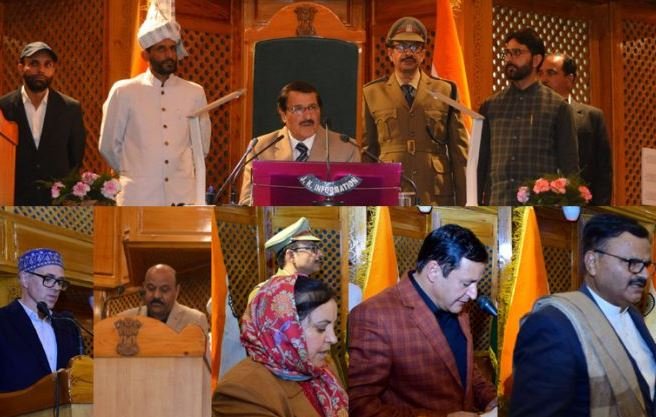
SRINAGAR, Oct 21: The Jammu and Kashmir Assembly witnessed a historic moment today as Chief Minister Omar Abdullah and several other newly elected members took their oaths in various regional languages, marking the revival of the legislative process after a six-year hiatus. The oath-taking ceremony, administered by Pro-tem Speaker Mubarak Gul, saw a unique linguistic diversity as MLAs chose to pledge in languages like Kashmiri, Dogri, Sanskrit, Gojri, Pahari, Shena, Hindi, Urdu, and English.
Chief Minister Omar Abdullah surprised many by taking his oath in Kashmiri, a language he had been criticized for not being proficient in during his early political career. His gesture was seen as a testament to his efforts to connect with the people of the Valley. Omar, whose mother is British, had worked to improve his fluency in Kashmiri during his tenure as Chief Minister from 2009 to 2014.
Around a dozen MLAs took their oaths in Kashmiri, while another dozen chose Dogri, reflecting the cultural and linguistic diversity of the Union Territory. Three MLAs—Sunil Sharma, Dilip Singh Parihar, and Ranbir Singh Pathania—opted for Sanskrit, a rare occurrence in legislative proceedings. National Conference (NC) leader Nazir Gurezi, a former Deputy Speaker, took his oath in Shena, the native language of his region in the Gurez Valley.
Deputy Chief Minister Surinder Kumar Choudhary, who had previously taken his oath as Deputy CM in Hindi, switched to English for his MLA oath today, while several other legislators took their oaths in Hindi and Urdu.
In a significant political development, the Pro-tem Speaker announced that Omar Abdullah had vacated the Budgam Assembly seat, which he had also won in the recent elections, choosing instead to retain the Ganderbal constituency, a traditional stronghold of the Abdullah family. With this decision, the strength of the National Conference (NC) in the 95-member Assembly was reduced to 41 seats. However, the party continues to hold a majority with the support of six Congress MLAs, five Independents, and one MLA each from the Aam Aadmi Party (AAP) and the Communist Party of India (Marxist) (CPI-M). The Bharatiya Janata Party (BJP), with 29 seats, achieved its best-ever performance in the region and emerged as the second-largest party in the Assembly.
The oath-taking ceremony also marked the induction of 51 first-time legislators, including Shagun Parihar, the 29-year-old BJP MLA from Kishtwar, who is now the youngest member of the Assembly. At the other end of the spectrum, NC veteran Abdul Rahim Rather, the 80-year-old MLA from Chrar-e-Sharief, holds the distinction of being the oldest member. Rather, along with party colleague Ali Mohammad Sagar, MLA from Khanyar, set a record by being elected to the Assembly for the seventh time. Rather began his legislative career in 1977, while Sagar has been a member since 1983.
During the ceremony, Pro-tem Speaker Mubarak Gul congratulated the newly elected MLAs and expressed hope that they would raise public welfare issues with professionalism and dedication. He called for collective efforts from all legislators to ensure a smooth and progressive journey for the state. Gul praised the Omar Abdullah-led government’s vision of steering Jammu and Kashmir towards peace, progress, and prosperity, emphasizing the need for unity in addressing the region’s challenges.
The Pro-tem Speaker also thanked the various government departments involved for ensuring the smooth conduct of the oath ceremony, which marked a new chapter in the state’s legislative history, closing the chapter of a long, six-year absence of legislative proceedings.

