


Bhagwat Warns of Attempts to Divide India Through Separatist Activities
RSS chief alleges that separatist sentiments and narrow identities are being promoted to create social divisions, urges citizens to remain united and organised to safeguard the country's strength.
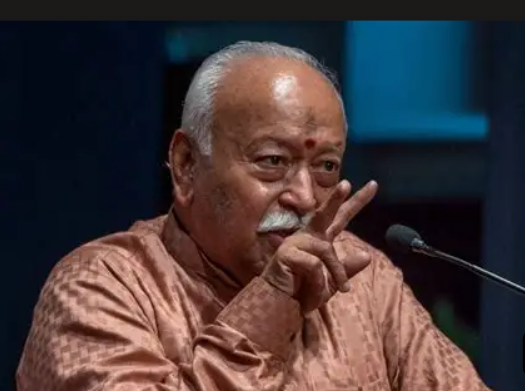
Jaipur, Nov 16: Rashtriya Swayamsevak Sangh (RSS) chief Mohan Bhagwat has expressed concern over what he described as coordinated efforts to weaken India by promoting separatist tendencies and encouraging divisions within society. He urged people to rise above narrow identities, strengthen their common bonds and work collectively to protect the nation’s unity.
Addressing the concluding ceremony of the four-day RSS musical band camp, ‘Maru Ninad 2026’, at Shri Rajaram Ashram in Shikarpura near Jodhpur on Sunday, Bhagwat said India’s progress was significant not only for its citizens but also for the larger welfare of the world.
He observed that while several countries and communities looked towards India with expectations, certain forces were uncomfortable with its growing strength because of their own interests.
“India is the answer to everyone’s hopes, but the situation in the world is strange. Some do not want India to become strong because of their own interests. They cannot do without India, yet they cannot get along with India. Both things are happening at the same time,” he said.
Highlighting the challenges facing the country, the RSS chief alleged that attempts were being made to create mistrust and confrontation among different sections of society.
He said smaller social identities were being given disproportionate importance to weaken the broader sense of national belonging. According to him, encouraging separatism and creating internal disagreements were part of efforts aimed at obstructing India’s development.
Drawing a comparison with the British colonial period, Bhagwat claimed that similar divisive strategies were being employed through the activities of forces operating across different parts of the world.
He stressed that people must recognise their common cultural and national identity instead of allowing differences to become sources of confrontation.
“The situation demands that we remember our unity. We need to remain organised so that our strength is maintained and dharma is protected,” he said.
Describing the prevailing circumstances as delicate, Bhagwat maintained that collective determination and social harmony would help the country overcome difficulties.
He said a united and powerful India would not only secure its own future but also contribute positively to global peace and prosperity.
“The times are very delicate, but if we stand together, we will overcome the challenges. It will benefit us, our country will become stronger, and a stronger India will mean the welfare of the entire world,” he said.
Historical Lessons and Cultural Identity
Referring to India’s historical experiences, Bhagwat said people had repeatedly come together to defend the country against foreign invasions.
He recalled that whenever external forces attempted to establish control, communities united to resist them. He argued that invaders understood the importance of weakening this collective consciousness and therefore attempted to undermine India’s traditional institutions and social structures.
“Whenever a foreign invader came, people united and drove him away. They knew that as long as Indians remained conscious and alert, they could not be defeated. So they tried to make people lose that awareness,” he said.
Bhagwat further alleged that foreign rulers systematically dismantled indigenous systems and introduced their own institutions, particularly in education.
“They destroyed our systems and imposed their own. They replaced our education system with theirs. As a result, people who were once prosperous became poor,” he said.
He emphasised the importance of understanding India’s historical and cultural foundations, adding that awareness of the country’s traditions could strengthen people’s connection with their heritage.
Bhagwat Raises Concern Over Social Media Addiction
During his address, the RSS chief also spoke about the growing influence of addiction in modern society, pointing out that the problem extended beyond alcohol and other intoxicating substances.
He cautioned that excessive dependence on social media platforms could also develop into an unhealthy habit.
“There is also an addiction to Instagram and Facebook. People do different things, become famous, and then become addicted to fame itself,” he said.
Bhagwat suggested that the pursuit of popularity and constant public attention could become another form of dependency, particularly when individuals began measuring their worth through online recognition.
His remarks highlighted the need for responsible use of digital platforms and greater awareness of their influence on individual behaviour.
Music as a Source of Discipline and Courage
Speaking about the significance of the RSS musical tradition, Bhagwat said music served purposes beyond recreation and entertainment. He described it as an important medium for developing courage, discipline, collective responsibility and self-respect.
He observed that music had historically played an important role in motivating people during difficult circumstances, including on battlefields.
“Music is not necessary only at gatherings. It also plays an important role on the battlefield. We should have our own martial music because music awakens a sense of self-respect,” he said.
Referring to India’s traditional musical heritage, Bhagwat mentioned the conch instruments described in the Bhagavad Gita, highlighting their symbolic and inspirational significance.
He said the RSS had gradually developed its own musical tradition through group songs, instrumental performances and specially composed band arrangements.
According to him, these musical activities reflected the organisation’s emphasis on discipline, teamwork and cultural values.
He also pointed out that the musicians associated with the RSS were not professional performers. Their participation, he said, represented dedication to collective activities and a shared commitment to the organisation’s values.
Collective Participation at the Core of RSS Tradition
Explaining the philosophy behind the RSS musical performances, Bhagwat emphasised that the focus was on coordinated participation rather than individual recognition.
He said every participant contributed to the overall performance, with discipline and cooperation bringing individuals together for a common purpose.
“In the Sangh, there are no individual performances. Everyone plays together, and through this collective performance, their minds also come together. Gathering at one place, living together and doing something worthwhile collectively is the Sangh’s way of working,” he said.
The four-day ‘Maru Ninad 2026’ camp concluded with Bhagwat highlighting the relationship between cultural expression, social organisation and national consciousness.
His address brought together concerns over social divisions, historical awareness, digital addiction and the role of traditional music, with a broader appeal for unity and collective responsibility in strengthening India.

