


Dharma and Rashtra Are Inseparable, India Has Role in Troubled World: Bhagwat
RSS chief says India's spiritual and philosophical traditions can offer perspectives on conflicts and contradictions facing the modern world.
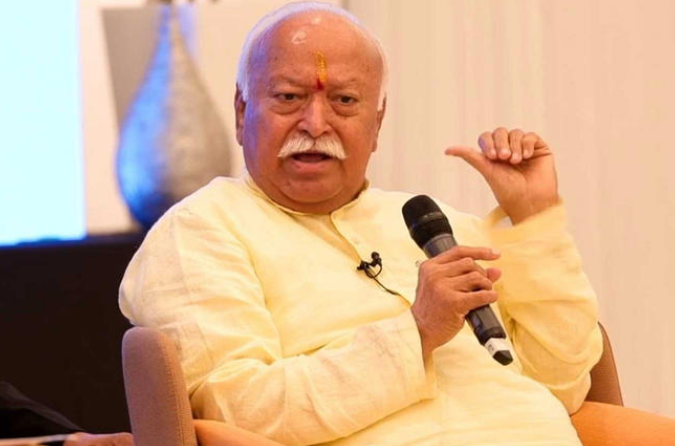
Mumbai, Oct 2: Rashtriya Swayamsevak Sangh (RSS) chief Mohan Bhagwat on Friday said dharma and the nation are closely connected in the Indian context, while asserting that the country’s longstanding spiritual and intellectual traditions could contribute to addressing challenges faced by the world.
Speaking at the 14th conference of the All India Vihar Seva group in Mumbai, Bhagwat said the concept of dharma was linked to the purpose of the nation and its ability to sustain society.
He said the two should not be viewed as independent of each other, arguing that the existence and continuity of one were connected with the other.
Bhagwat also spoke about several competing priorities confronting societies around the world. He cited tensions between economic and social development and environmental protection, individual liberty and family responsibilities, as well as religious belief and conflict.
“The world is troubled,” he said, describing a situation in which aspirations and sources of happiness can involve competing interests and where different forms of loyalty may come into conflict.
According to Bhagwat, the absence of balance has contributed to increasingly extreme positions on various issues.
He said India could offer a perspective on resolving some of these contradictions because of its historical approach to sharing knowledge and spiritual traditions.
Bhagwat referred to India’s past interactions with other societies and said the country had traditionally shared its knowledge without pursuing territorial conquest or seeking to convert people to its beliefs.
He said this tradition was relevant at a time when the international community was searching for ways to deal with complex social, environmental and ideological challenges.
“The world knows that the path will come from India,” Bhagwat said.
Elaborating on India’s intellectual heritage, the RSS chief referred to a broad range of texts and traditions. These included the Vedas, Upanishads, Ramayana, Mahabharata and Bhagavad Gita, along with Jain Agamas, the Tripitaka, Guru Granth Sahib and teachings associated with various saints.
He described this body of knowledge as an important repository of ideas that could be relevant to contemporary society.
Bhagwat also emphasised the role of devotion in spiritual life, saying that people could move closer to the Almighty through faith and devotion.
He linked the preservation of religious teachers and communities carrying these traditions with a wider responsibility towards humanity.
According to Bhagwat, safeguarding individuals who preserve and transmit such knowledge is not limited to protecting a particular religious tradition. He argued that their work also helps maintain intellectual and spiritual resources that could have wider relevance.
“You are not protecting just one life. You are protecting the safe future of the entire human race,” he said.
His remarks came during the conference organised by the All India Vihar Seva group, where discussions centred on service and the preservation of spiritual traditions.
Bhagwat’s address placed particular emphasis on the relationship between India’s civilisational traditions and its understanding of social responsibility. He presented dharma not simply as a matter of personal belief but as a principle connected with the functioning and continuity of society.
He also suggested that India’s contribution to the wider world could extend beyond economic or technological development. In his view, the country’s philosophical traditions contain ideas that may help societies examine conflicts between competing values and search for greater balance.
The RSS chief’s comments highlighted the role he sees for India’s spiritual heritage at a time of international uncertainty and social change.
He argued that the country’s diverse traditions provide a broad intellectual framework through which questions concerning faith, family, freedom, development and the environment can be considered.
Bhagwat said preserving these traditions and the people who carry them forward therefore has significance beyond individual communities.
His address ultimately connected cultural preservation with what he described as a broader service to humanity, while reiterating his view that India has a role in offering ideas to a world facing multiple and interconnected challenges.

