


Ex-CJI Chandrachud Defends Article 370 Verdict, Calls It a ‘Transitional Provision’
Judiciary Under No Political Influence, Former CJI Chandrachud Rejects Allegations
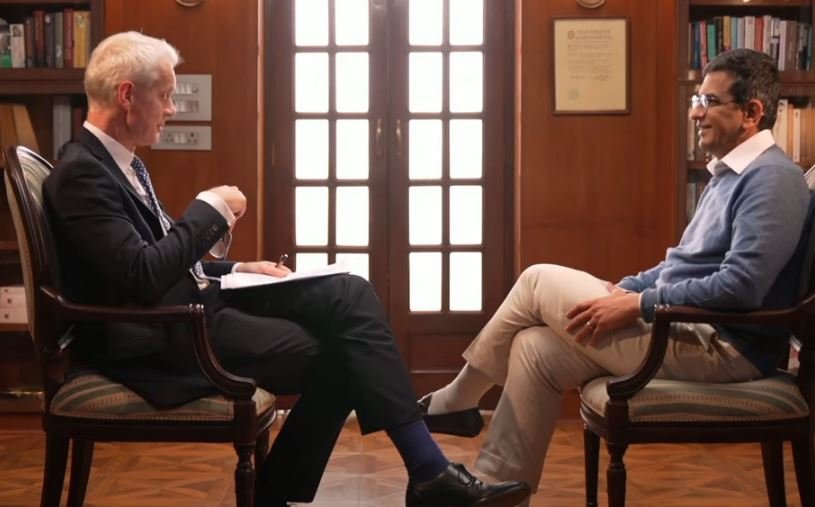
New Delhi, February 13: Former Chief Justice of India DY Chandrachud has strongly defended the Supreme Court’s decision to uphold the revocation of Article 370, reaffirming that its inclusion in the Constitution was always intended as a temporary and transitional measure. Speaking to journalist Stephen Sackur on BBC’s Hard Talk, Justice (Retd) Chandrachud dismissed criticism of the verdict, asserting that the provision was never meant to be permanent.
Citing constitutional history, he noted that Article 370 was originally part of the “Transitional Arrangements” chapter, later renamed “Temporary and Transitional Arrangements,” reinforcing the intent behind its gradual phase-out. “The Constitution’s framers envisaged a seamless integration of Jammu and Kashmir into the Indian Union. Can a transitional provision be extended indefinitely? Is 75 years too short a period to conclude such a transition?” he remarked.
Justice (Retd) Chandrachud underscored the importance of democratic governance in Jammu and Kashmir, highlighting the region’s recent elections. He pointed out that a peaceful transition of power had taken place, with an elected government assuming office. “A new administration, led by a political party different from the ruling party at the Centre, is now in place. This signifies that democracy is not only functional but thriving in Jammu and Kashmir,” he stated.
On the matter of Jammu and Kashmir’s full statehood, which remains a contentious issue despite political promises, he acknowledged the public demand for reinstating statehood, a key electoral commitment of the region’s leadership.
Responding to allegations that the Supreme Court failed in its constitutional duties by upholding the abrogation of Article 370, Justice (Retd) Chandrachud rejected such claims, asserting that the judiciary ensured democratic accountability. “The assertion that the Court did not uphold constitutional principles is unfounded. The existence of a democratically elected government in Jammu and Kashmir today is itself a testament to the judiciary’s role in preserving democratic values,” he argued.
Addressing concerns over diversity within the Indian judiciary, particularly regarding gender and caste representation, Justice (Retd) Chandrachud emphasized the increasing inclusion of women in the legal profession. “At the district judiciary level, which forms the backbone of the judicial system, women constitute over 50% of new recruits in several states, reaching as high as 60–70% in some regions,” he noted.
He explained that the composition of the higher judiciary reflects past trends in legal education and practice, but with greater accessibility to legal education for women, the gender balance is steadily improving. “Today, law schools have nearly equal representation of men and women. This shift is translating into increased female representation in the judiciary,” he added.
Justice (Retd) Chandrachud also dismissed allegations of political interference in judicial decisions, particularly claims that the ruling Bharatiya Janata Party (BJP) exerted influence over the judiciary. Pointing to the 2024 general election results, he emphasized the continued dominance of regional parties, reinforcing India’s vibrant multiparty democracy. “The federal structure remains robust, and regional parties continue to flourish, reflecting the strength of India’s democratic institutions,” he stated.
On the controversial conviction of Rahul Gandhi in a defamation case, which was later suspended by the Supreme Court, he cited multiple instances where political figures across party lines were granted bail, affirming the judiciary’s commitment to upholding personal liberties. “While opinions on specific judgments may vary, the judiciary’s consistent record in protecting individual freedoms is beyond question,” he asserted.
When questioned about the delay in hearing the Citizenship Amendment Act (CAA) case, Justice (Retd) Chandrachud defended the Supreme Court’s prioritization of cases, drawing comparisons with the United Kingdom’s legal system. “Unlike the UK, where courts lack the authority to strike down legislation, the Indian judiciary has that power. During my tenure, I authored 62 Constitution Bench judgments, resolving cases that had been pending for over two decades,” he explained.
Sackur raised reports suggesting that Justice (Retd) Chandrachud sought divine guidance before ruling on the Ayodhya Ram Temple case, prompting him to categorically dismiss any link between personal faith and judicial decisions. “The Indian Constitution does not require judges to be atheists. My personal faith does not interfere with my judicial duties. If anything, meditation and prayer reinforce my commitment to impartial justice,” he said.
Another contentious issue discussed was Prime Minister Narendra Modi’s visit to Justice (Retd) Chandrachud’s residence for Ganesh Chaturthi, which sparked accusations of judicial bias. The former CJI rejected the controversy, emphasizing that such interactions are merely constitutional courtesies. “The Supreme Court has, both before and after that visit, delivered rulings that have gone against the government, including the verdict on electoral bonds. The judiciary’s independence remains sacrosanct,” he affirmed.
Concluding the interview, Justice (Retd) Chandrachud reaffirmed the judiciary’s primary duty to uphold the Constitution rather than act as an opposition force. “The judiciary is not a political entity. Our duty is to interpret and apply the law without fear or favor. The rule of law remains the guiding principle of our courts,” he asserted.
By defending the Supreme Court’s verdict on Article 370, addressing concerns over judicial independence, and clarifying his stance on high-profile legal controversies, Justice (Retd) Chandrachud provided a strong reaffirmation of the judiciary’s role as the guardian of constitutional democracy in India.

