


Government Defends Inviting Rebel TMC MPs to All Party Meeting
Government says NCPI members cannot be excluded after seeking Lok Sabha recognition, while opposition protests their participation before Parliament's Monsoon Session begins.
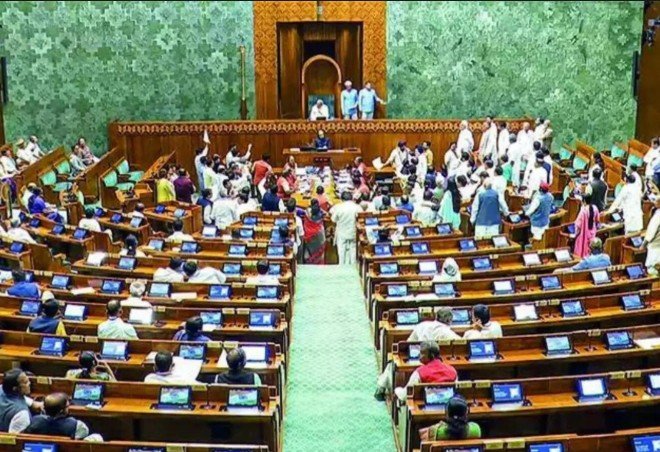
NEW DELHI, July 19: A day before the Monsoon Session of Parliament commenced, the Centre defended its decision to invite rebel Trinamool Congress (TMC) Members of Parliament to the customary all party meeting, asserting that lawmakers who have formally sought recognition as a separate parliamentary group cannot be ignored.
The issue sparked a brief confrontation between the government and opposition parties after two rebel TMC MPs attended the meeting under the banner of the Nationalist Citizens Party of India (NCPI). Opposition leaders objected to their presence and staged a symbolic walkout before returning to continue discussions.
Parliamentary Affairs Minister Kiren Rijiju maintained that the government had acted according to parliamentary conventions, stressing that the invitation was extended because the rebel legislators had already petitioned the Lok Sabha Speaker for official recognition.
Government Explains Decision
Addressing reporters after the meeting, Rijiju said the Centre had a responsibility to ensure that every parliamentary group seeking recognition was included in discussions related to the functioning of Parliament.
He explained that once the NCPI formally approached the Lok Sabha Speaker for recognition and requested separate seating arrangements in the House, the government could not arbitrarily exclude its representatives from the all-party meeting.
According to the minister, the government’s role is to facilitate dialogue with all recognised or recognition-seeking parliamentary entities to ensure effective coordination before the commencement of each parliamentary session.
Opposition Registers Protest
The participation of rebel MPs Sudip Bandyopadhyay and Kakoli Ghosh Dastidar became the focal point of the meeting.
Several opposition parties questioned the legitimacy of inviting legislators who had recently broken away from the Trinamool Congress and joined the NCPI. Their objections resulted in a symbolic walkout during the proceedings.
However, the opposition leaders later returned to the meeting, signalling their willingness to continue discussions on the legislative agenda despite the disagreement over the invitations.
The incident highlighted the growing political tensions following the recent developments within the Trinamool Congress after the West Bengal Assembly elections.
Split Within the Trinamool Congress
The controversy comes in the backdrop of a significant political split within the TMC.
Following the party’s defeat in the West Bengal Assembly elections, 20 of its 28 Members of Parliament reportedly distanced themselves from the party leadership and joined the newly formed Nationalist Citizens Party of India.
The rebel lawmakers have since approached the Lok Sabha Speaker seeking official recognition as a separate parliamentary group, a move that has generated political and procedural debates.
Until a final decision is taken by the Speaker, questions regarding their parliamentary status continue to remain a matter of political discussion.
Centre Calls for Smooth Parliament Functioning
While responding to the controversy, Rijiju urged political parties to prioritise parliamentary business over political confrontation.
He said citizens expect Parliament to function efficiently and productively rather than witnessing repeated disruptions and protests.
According to the minister, legislative debates should focus on issues affecting the country, and every political party has a responsibility to participate constructively in parliamentary proceedings.
He appealed to all members to contribute positively during discussions and support legislative work in the national interest.
Legislative Agenda for the Session
The Parliamentary Affairs Minister informed that the government has initially listed eight Bills for consideration during the Monsoon Session.
He added that additional legislative business could be introduced later if required, following established parliamentary procedures.
The Centre hopes that cooperation among political parties will ensure meaningful debates on pending legislation and national issues during the session.
Government Criticises Frequent Disruptions
Rijiju also referred to repeated disruptions witnessed in previous sessions of Parliament, arguing that prolonged protests ultimately affect governance and delay important legislative work.
He observed that political demonstrations inside Parliament do not necessarily benefit any party and instead reduce the time available for discussions on public welfare measures.
The minister reiterated that Parliament remains the country’s highest democratic institution where differences should be resolved through debate rather than disruption.
Assurance on Opposition Participation
The Centre acknowledged that opposition parties play an essential role in parliamentary democracy.
Rijiju said the government had taken note of suggestions put forward by opposition leaders during the meeting and assured that every party would receive an opportunity to present its views during the session.
He added that constructive criticism strengthens democratic institutions and contributes to better law-making when conducted through parliamentary debate.
Senior Leaders Attend Meeting
The all-party meeting was chaired by Defence Minister Rajnath Singh and attended by Union Health Minister J.P. Nadda, Parliamentary Affairs Minister Kiren Rijiju and leaders representing various political parties.
Such meetings are traditionally organised before every parliamentary session to discuss legislative priorities, scheduling of business and cooperation among parties.
Monsoon Session Begins Monday
The Monsoon Session of Parliament is scheduled to begin on Monday and will continue until August 13.
The government expects discussions on several important Bills along with debates on national issues likely to be raised by both the treasury benches and the opposition.
With political disagreements already surfacing before the session’s commencement, attention will now shift to whether Parliament can maintain smooth functioning while addressing contentious issues through debate and consensus.

