


Harmeet Desai and Yashaswini Ghorpade End India’s 72-Year Wait for Asian Table Tennis Medal
The Indian mixed doubles pair secures bronze at the continental championships in Tashkent after a thrilling comeback against South Korea, before losing to Japan in the semi-finals.
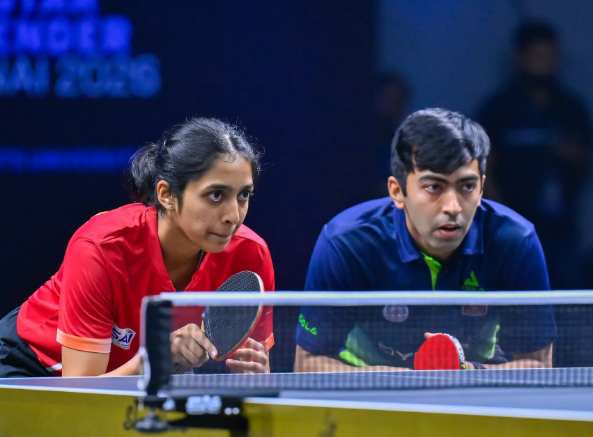
TASHKENT, October 24: India’s Harmeet Desai and Yashaswini Ghorpade created a significant milestone in the country’s table tennis history by winning the mixed doubles bronze medal at the 2026 Asian Table Tennis Championships in Uzbekistan, ending a 72 year wait for a podium finish in the event.
The Indian combination secured the medal after defeating South Korea’s Park Ganghyeon and Lee Daeun 3-2 in a closely fought quarter final on Friday. The victory took them into the semi-finals, guaranteeing India at least a bronze medal in the continental competition for the first time since 1954. The achievement provided a major boost to India’s campaign at the championships, which are being held in Tashkent from October 19 to 25. It also highlighted the growing competitiveness of Indian players in international doubles events.
Desai and Ghorpade, ranked 26th in the world in mixed doubles, demonstrated determination and tactical awareness to overcome their South Korean opponents after falling behind in the match.
Although their campaign ended in the semi-finals against Japan, the assured bronze represented a historic result for Indian table tennis.
Dramatic comeback seals historic medal
The quarter-final against South Korea proved to be the defining match of the Indian pair’s campaign.
Desai and Ghorpade began confidently, taking the opening game 11-6. However, the South Korean combination responded strongly, winning the next two games 11-8 and 11-8 to move within one game of victory.
Facing elimination, the Indian duo regrouped and raised their level of play. They won the fourth game 11-9 to force a decider, demonstrating composure at a crucial stage of the contest.
The deciding game remained closely contested, with both pairs attempting to seize control through aggressive attacking strokes and precise returns.
Desai and Ghorpade eventually prevailed 11-9, completing a 3-2 victory and booking their place in the last four.
The comeback underlined the importance of mental strength in table tennis, where momentum can shift rapidly and a small number of points can determine the outcome of an entire match.
For India, the victory was especially meaningful because it guaranteed a medal in a discipline in which the country had not reached the podium at the Asian Championships for more than seven decades.
Japan end India’s run in the semi-finals
The Indian pair faced Japan’s Sora Matsushima and Miwa Harimoto in the semi-finals, with a place in the final at stake.
The Japanese combination, ranked ninth in the world, proved too strong on the day, winning 11-9, 11-9, 11-8 to secure a straight-games victory.
Desai and Ghorpade remained competitive during the opening two games but were unable to convert their opportunities into victories. Japan maintained its advantage through the closing stages and completed the match in three games.
Despite the defeat, India’s medal had already been secured through qualification for the semi-finals. At the Asian Championships, both losing semi-finalists receive bronze medals, meaning no additional third-place match was required.
The result therefore brought the Indian pair’s campaign to a close with a historic achievement rather than a missed opportunity.
Their performance against Japan also offered valuable experience against a highly ranked international combination. Competing against top-level opponents can help players identify areas for improvement ahead of future tournaments.
A medal after decades of waiting
India’s previous mixed doubles medal at the Asian Table Tennis Championships came in 1954, when Yatin Vyas and Meena Parande won silver.
The country had also enjoyed success in the discipline at the 1952 edition, when Gool Nasikwala and Kalyan Jayant claimed gold.
The long gap between those achievements and the latest result illustrates the difficulty Indian players have faced in reaching the podium in mixed doubles at the continental championships.
Desai and Ghorpade’s success brings renewed attention to the discipline and offers encouragement to other Indian combinations seeking to compete against Asia’s strongest table tennis nations.
Mixed doubles requires players to coordinate their attacking patterns, positioning and service returns while adapting quickly to their opponents. A successful partnership depends on individual ability as well as an understanding of each player’s strengths.
The Indian pair’s recovery against South Korea demonstrated the value of that coordination, particularly when the match entered its decisive stages.
Strong opening rounds build the foundation
Before their quarter-final success, Desai and Ghorpade had progressed through the earlier rounds with a series of convincing performances.
After receiving a bye in the opening round, they defeated Indonesia’s Muhammad Negara and Citra Rasmi 3-0, winning the games 14-12, 12-10 and 11-7.
They subsequently overcame Chinese Taipei’s Hsu Hsien-chia and Wu Ying Syuan 3-1. The Indian duo won the first two games 11-6 and 12-10 before their opponents took the third 13-11. Desai and Ghorpade then closed out the match by winning the fourth game 11-7.
These results established the platform for their dramatic quarter-final victory and eventual medal.
Another Indian combination, Payas Jain and Syndrela Das, also reached the mixed doubles quarter-finals. However, they were defeated 3-0 by China’s Huang Youzheng and Chen Yi, ending their challenge in the event.
The contrasting outcomes highlighted the depth of competition at the championships, where established table tennis nations continue to field highly competitive combinations.
A boost for Indian table tennis
The medal represents an important achievement for Desai and Ghorpade, both of whom have been working to strengthen India’s presence in international table tennis.
Desai has represented India in major team and individual competitions, while Ghorpade has established herself as a promising player in the women’s circuit. Their partnership in Tashkent produced a result that will be remembered for its historical significance.
The achievement also reinforces the importance of developing doubles combinations alongside singles specialists. International success requires players to gain experience against a range of styles, particularly in a region where table tennis has a strong competitive tradition.
For India’s table tennis programme, the result offers encouragement as the team continues its campaign across other events at the championships.
The focus will now turn towards building on the breakthrough, improving consistency against higher-ranked opponents and using the experience gained in Tashkent to prepare for future international assignments.
Looking ahead
Desai and Ghorpade’s bronze medal ends a lengthy wait for India in Asian Championships mixed doubles and provides a positive moment for the country’s table tennis community.
Their comeback against South Korea demonstrated resilience under pressure, while the semi-final against Japan exposed the challenges that remain against the continent’s leading combinations.
The result is nevertheless an important step forward. A historic medal can help raise the profile of mixed doubles, encourage emerging players and strengthen confidence in India’s ability to compete at major international events.
As the Asian Championships conclude on October 25, the Indian pair’s performance will stand out as one of the country’s key achievements in Tashkent. Their bronze medal offers both a milestone to celebrate and a foundation on which Indian table tennis can aim for further success.

