


India Assess Asian Games Campaign After Finishing Fourth With 85 Medals
India collected 21 gold, 27 silver and 37 bronze medals in Aichi-Nagoya, recording strong performances in several disciplines while falling short of the 100-medal target.
New Delhi, Oct 5: India’s campaign at the 2026 Asian Games ended with 85 medals, including 21 gold, 27 silver and 37 bronze, leaving the country fourth in the overall standings while providing both encouragement and areas requiring attention ahead of the next Olympic cycle.
The Aichi-Nagoya Games produced several notable performances for India, with athletes and teams making a strong impact in disciplines including archery, hockey, cricket and boxing. The overall haul demonstrated the depth that has developed across a number of sports, although India finished below the target of 100 medals that had been discussed before the competition.
The final tally also fell short of India’s record performance at the 2022 Asian Games in Hangzhou, where the country won 107 medals. India nevertheless retained fourth place in the continental standings, underlining its position among Asia’s leading sporting nations.
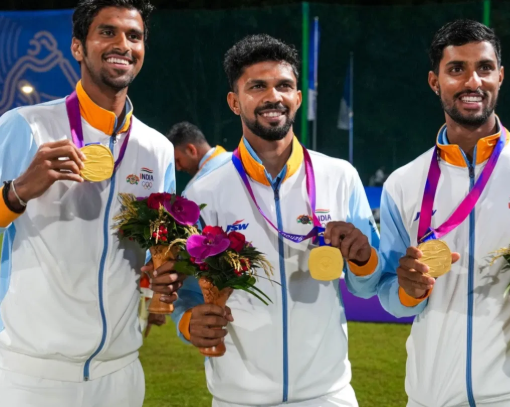
Cricket was among the major highlights of the campaign. India completed a historic double by winning gold in both the women’s and men’s competitions. The men’s team defeated Pakistan by 19 runs in the final, while the women’s side secured a commanding victory over Sri Lanka.
The men’s final produced one of the tournament’s most closely followed contests. India posted 211 for six, the highest total recorded in the men’s competition, before restricting Pakistan to 192 for six. Abhishek Sharma contributed 61 runs, while Tilak Varma remained unbeaten on 51 from only 22 deliveries.
The cricket results added another layer to India’s growing success in the sport beyond traditional bilateral and world-level competitions. The victories also provided significant exposure for younger players who were given opportunities on the Asian Games stage.
Archery was another area where India produced important results. The discipline continued to demonstrate the country’s growing strength, with athletes contributing to the medal tally in team and individual events.
Hockey also remained a major contributor. India’s men’s and women’s teams entered the competition carrying high expectations, reflecting the country’s long-standing connection with the sport and its importance within the national sporting programme.
Boxing produced individual success as well, with Lovlina Borgohain winning an Asian Games gold medal. The achievement was particularly significant for the boxer, who had previously won an Olympic bronze medal. She described the Asian Games title as the best medal of her career.
The success in several established disciplines was accompanied by progress from athletes who have emerged through India’s expanding sporting ecosystem. Government-backed programmes, professional leagues, improved training systems and greater access to sports science have contributed to a broader pool of competitive athletes.
Golf also provided one of the standout individual performances. Pranavi Urs won Asian Games gold after using psychological preparation to manage different scenarios during the final round. Her performance demonstrated the increasing importance of sports psychology alongside technical preparation.
However, the competition also exposed areas where India still has room to improve. Tennis and badminton were among the sports that did not produce the kind of medal returns expected from a country that has traditionally performed well in those disciplines. India’s performance therefore presented a mixed picture rather than a uniform upward trend.
The absence of medals in some established sports is particularly relevant because the Asian Games provide an important indicator of competitive depth before the next Olympic cycle. Results at the continental level can reveal whether a country’s investment is translating into consistent performances across different disciplines.
India’s fourth-place finish means the country remained behind the leading Asian sporting powers. The final tally of 85 medals was substantial, but the gap between the actual result and the 100-medal target has prompted discussion about where additional investment and athlete development may be required.
The Games also offered an opportunity to assess India’s bench strength. Several younger competitors gained experience against established Asian athletes, which could prove valuable as the country prepares for future international competitions.
For India’s sports administrators, the next challenge will be converting individual breakthroughs into sustained programmes. A strong performance at one continental event is important, but maintaining competitiveness across successive championships requires long-term planning, quality coaching, injury management, international exposure and access to advanced training facilities.
The results from Aichi-Nagoya provide several encouraging signs. India won medals in a wider range of events and produced championship performances in cricket, boxing, archery and other disciplines. At the same time, the results show that medal prospects remain uneven across sports.
The performance of the younger generation will be closely watched in the coming years. Athletes who gained major-event experience in Japan could form an important part of India’s squads for future Asian and Olympic competitions.
The cricket double was particularly significant because India’s men’s and women’s teams both delivered gold medals under pressure. Their victories over Pakistan and Sri Lanka respectively added high-profile moments to the country’s campaign.
India’s overall fourth-place finish ultimately presents a combination of achievement and unfinished work. The 85-medal haul represents substantial success, but the missed 100-medal target and weaker performances in some traditional disciplines provide clear areas for review.
As the focus shifts from Aichi-Nagoya to the next cycle of international competitions, India’s sporting authorities will have to assess which programmes are producing sustained results and where additional support is needed.
For the athletes, however, the Games provided valuable competition, international exposure and opportunities to establish themselves. The strongest performers leave Japan with medals and greater recognition, while younger competitors return with experience that could shape India’s future sporting campaigns.

