


India Clinch Record Ninth U-19 Asia Cup Title After Thrilling Last Ball Victory Over Pakistan
India defeated defending champions Pakistan by one wicket in a dramatic final in Oman, extending their record in the tournament and ending a five-year wait for the championship.
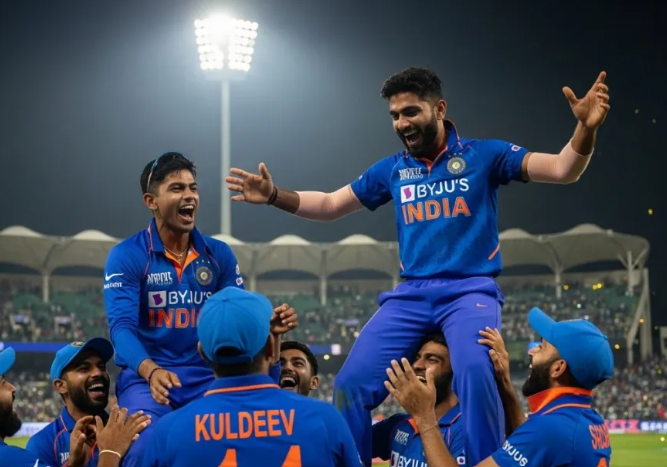
AL AMERAT, Nov 14: India produced a remarkable comeback to defeat arch-rivals Pakistan by one wicket in a thrilling final of the ACC Men’s Under-19 Asia Cup 2026, securing their ninth championship title at the Al Amerat Cricket Ground in Oman on Saturday.
The young Indian side completed a challenging chase of 338 runs on the final delivery of the match, finishing at 339 for nine in 50 overs. The victory marked India’s return to the top of the continental Under-19 competition for the first time since 2021 and extended their record as the tournament’s most successful team.
The final turned into an extraordinary contest, with both sides producing impressive batting performances before India’s lower-order players dramatically changed the outcome in the closing overs.
Pakistan, the defending champions, had entered the title decider with an impressive record, having won all three of their group stage matches. They had also defeated India earlier in the competition before overcoming Bangladesh in the semi-final to secure their place in the final.
After winning the toss, Pakistan elected to bat first and posted an imposing 337 for nine in their allotted 50 overs. Their innings was built around a superb century from Usman Khan, supported by aggressive contributions from Abdul Qadir and captain Farhan Yousaf.
Pakistan began positively, with Usman and opening partner Hayam Khan putting together 62 runs for the first wicket. Hayam contributed 21 off 23 deliveries, including four boundaries, before being dismissed in the ninth over.
Usman subsequently joined Abdul Qadir, and the pair established control through an impressive 135-run partnership for the second wicket. Their association provided Pakistan with the platform to build a substantial total and put India’s bowling attack under considerable pressure.
Qadir was particularly aggressive, scoring 80 runs from only 54 deliveries. His innings included three fours and eight sixes, as he repeatedly attacked the Indian bowlers and accelerated the scoring rate.
Usman, meanwhile, maintained his composure at the other end and converted his promising start into a century. The left-handed batter scored 107 from 111 balls, striking 11 boundaries and three sixes. It was his second century of the tournament and a major contribution to Pakistan’s competitive total.
After Qadir’s dismissal, captain Farhan Yousaf ensured that the scoring momentum continued. He registered 63 runs from 60 deliveries, including four fours and three sixes, and added 59 runs for the fourth wicket with Ahmed Hussain.
India’s bowlers managed to prevent Pakistan from finishing even more strongly in the closing stages. Kavya Paresh Patel delivered an important performance, claiming four wickets for 68 runs, while Chigurupati Venkata picked up three wickets for 40 runs.
Pakistan lost six wickets during the final 10 overs and managed 63 runs in that period, eventually finishing at 337 for nine. Nevertheless, their total presented India with a difficult target of 338 in a high-pressure final.
India’s response began with a cautious approach as captain Lakshya Raichandani and opener Aaryavir Sehwag concentrated on establishing a solid partnership.
The opening pair added 95 runs for the first wicket, giving India a useful foundation despite the demanding target. Sehwag scored 58 from 61 deliveries, demonstrating determination after sustaining an injury to his forearm during the early stages of the innings.
Raichandani provided stability at the other end and continued to build the chase. The Indian captain eventually produced the innings of the match from his side, scoring 80 runs off 101 balls with five boundaries.
Sehwag’s dismissal, however, provided Pakistan with an opportunity to regain control. Their bowlers began applying pressure through disciplined spells and regular breakthroughs, making India’s task increasingly difficult.
Pakistan’s Rizwanullah emerged as one of the most effective performers with the ball, taking three wickets for 53 runs. Niqab Shafiq also contributed two wickets, further weakening India’s batting lineup.
The pressure intensified as India continued losing wickets during the middle overs. The team slipped to 252 for eight in the 42nd over, leaving Pakistan in a strong position to defend their title.
With the required run rate climbing and only two wickets remaining, India’s chances appeared increasingly uncertain.
However, Manal Chauhan and Mohit Ulva produced a remarkable counterattack that transformed the contest.
The two lower-order batters refused to surrender and began scoring more aggressively, putting the Pakistani bowling attack under renewed pressure. Their partnership added 57 runs in just 5.5 overs, bringing India back into contention.
Chauhan played an important role in the recovery, scoring 47 from only 32 deliveries. His attacking approach helped reduce the required runs and restored belief within the Indian camp.
Ulva, meanwhile, displayed impressive composure and attacking ability. Batting lower down the order, he struck the ball cleanly and kept India within reach of the target.
Chauhan’s dismissal briefly threatened to shift the momentum again, but Ulva found valuable support from Chigurupati Venkata, who contributed 11 runs from eight deliveries.
India entered the final over needing eight runs to secure the championship. The situation remained tense as Pakistan attempted to defend their advantage through Ahmed Hussain.
The first five deliveries produced five runs, including a wide, leaving India needing three runs from the final ball.
Ulva then struck a powerful boundary towards long-off, completing an extraordinary victory and triggering celebrations among the Indian players.
He remained unbeaten on 49 from just 26 deliveries, finishing one run short of a half-century but delivering the most decisive contribution of the match.
India completed the chase at 339 for nine, winning by one wicket on the final ball and ending Pakistan’s hopes of retaining the trophy.
The result was particularly significant because Pakistan had defeated India in the previous edition’s final and entered the 2026 tournament as defending champions.
India’s victory also highlighted the importance of contributions from across the batting order. While Raichandani and Sehwag established the foundation, the lower-order partnership between Chauhan and Ulva ultimately proved decisive.
Aaryavir Sehwag’s performance throughout the competition was another major highlight. The young opener finished as the tournament’s leading run-scorer with 361 runs in five innings, including a century and three half-centuries. He was also named Player of the Tournament.
The final attracted considerable attention because of the traditional cricketing rivalry between India and Pakistan. Both teams demonstrated their batting strength, while the dramatic finish provided an exciting conclusion to the continental championship.
For India, the triumph represented more than another trophy. It was a successful return to the top of the Under-19 Asia Cup after missing out on the title in recent editions.
The victory also offered encouragement for India’s emerging generation of cricketers, with several players demonstrating their ability to perform under pressure in a major international tournament.
Pakistan, despite losing the final, produced an impressive campaign and came close to defending their championship. Their batting performance, particularly the contributions of Usman Khan, Abdul Qadir and Farhan Yousaf, ensured that the contest remained competitive until the closing stages.
Ultimately, it was India’s resilience and the fearless batting of its lower order that separated the two sides. Ulva’s final-ball boundary completed one of the most dramatic finishes in the competition’s history and delivered a record-extending ninth Under-19 Asia Cup crown to India.

