


Maharashtra Signs Rs 8.57 Lakh Crore Investment MoUs Across Key Sectors
The proposed projects span semiconductors, data centres, renewable energy, defence, healthcare and infrastructure, with the state estimating nearly 2.91 lakh direct and indirect employment opportunities.
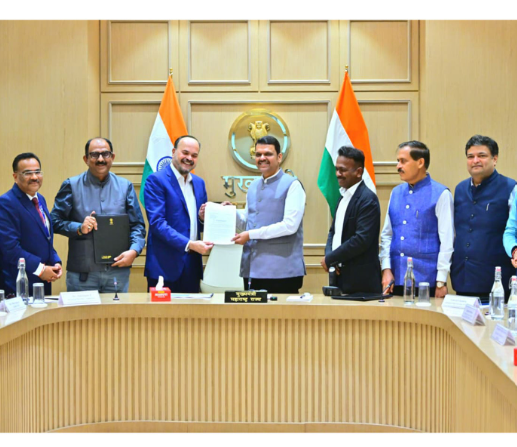
Mumbai, Oct 3: Maharashtra has signed 67 Memorandums of Understanding involving proposed investments of around Rs 8.57 lakh crore under its new Invest Maharashtra initiative, marking a major push to attract capital into technology, manufacturing, infrastructure and emerging industries.
The investment proposals cover sectors including semiconductors, data centres, information technology, renewable energy, aerospace and defence, healthcare, infrastructure, metals and mining and agro-processing. The state government estimates that the projects could create about 2.91 lakh direct and indirect jobs once they move from proposals to implementation.
The initiative is part of Maharashtra’s broader strategy to strengthen its position as an investment destination and support its ambition of becoming a $1 trillion economy by 2030.
The scale of the announced commitments is significant, but the MoUs should be viewed as an investment pipeline rather than completed projects. Actual investment will depend on factors such as regulatory approvals, land availability, financing, project feasibility, infrastructure and execution.
Data centres and semiconductor projects dominate
A major portion of the proposed investment is directed towards data centres, IT infrastructure and semiconductor-related activities.
Akshat Greentech has proposed an investment of Rs 1 lakh crore for data centre, IT/ITeS and semiconductor projects in Navi Mumbai and Pune. The proposal is expected to generate around 5,000 direct and indirect jobs.
Sterlite Group has outlined a Rs 84,500 crore investment in Shahpur and Khalapur for projects linked to data centres, information technology and semiconductors, with an estimated 15,000 employment opportunities.
ReNew has proposed Rs 70,000 crore for data centre and related activities in Khalapur, with the project expected to generate around 7,000 jobs.
Cortex Data Centres has proposed Rs 60,990 crore for a facility in Navi Mumbai, with an estimated 10,000 jobs. Pi-Semicon has earmarked Rs 40,000 crore for a semiconductor project in Nashik and expects to create around 12,750 employment opportunities.
The concentration of investment in digital infrastructure reflects the rapidly increasing demand for computing capacity, cloud services and artificial intelligence applications.
Maharashtra seeks to strengthen technology ecosystem
The proposed investments could also help Maharashtra develop a broader technology ecosystem instead of limiting growth to traditional IT services.
Semiconductor manufacturing requires an extensive network of suppliers, equipment providers, logistics companies, skilled workers and specialised infrastructure. Similarly, data centres require reliable electricity, telecommunications networks, cooling systems, land and high-quality connectivity.
The government hopes that large projects can therefore create opportunities for smaller businesses and local suppliers.
Navi Mumbai, Pune and Nashik are among the locations expected to benefit from the latest investment proposals. Expanding projects beyond Mumbai could also help distribute industrial activity across different parts of the state.
The state’s strategy includes improving coordination around land, electricity, approvals and skill development, all of which are critical for converting investment announcements into operating facilities.
Renewable energy and advanced manufacturing
The investment package is not limited to technology.
Renewable energy, metals and mining, aerospace and defence, healthcare, infrastructure and agro-processing are also included in the proposals. This diversification could help Maharashtra attract investment across both established and emerging industries.
Renewable energy projects can support the power requirements of new industrial facilities, while advanced manufacturing can create demand for engineering, logistics and industrial services.
The aerospace and defence sector also offers opportunities for specialised manufacturing and supply-chain development. Healthcare and agro-processing, meanwhile, can connect investment with domestic consumption and regional economic activity.
Such diversification is important because large technology investments alone cannot meet the employment and development requirements of a state with a large and varied economy.
Jobs and regional development
Employment creation is one of the central objectives behind the investment drive.
The government estimates nearly 2.91 lakh direct and indirect jobs from the proposed projects. While the exact number will depend on implementation, large investments in data centres, manufacturing and infrastructure can generate employment both within project facilities and across supporting industries.
MSMEs could benefit from contracts linked to construction, equipment supply, transportation, maintenance, security, catering and other services.
The government has also indicated that the investment strategy is intended to benefit young people, farmers, local enterprises and smaller businesses beyond the major urban centres.
If successfully implemented, the projects could therefore have a multiplier effect on regional economies.
Infrastructure remains crucial
The size of the proposals also highlights the importance of infrastructure.
Large data centres and semiconductor facilities require uninterrupted power, substantial water and cooling infrastructure, advanced telecommunications and efficient transportation links. Manufacturing projects similarly need dependable logistics and access to markets.
Maharashtra’s ability to provide these requirements will influence whether proposed investments progress on schedule.
Land acquisition and environmental clearances can also determine project timelines. Investors typically assess not only incentives but also the predictability and speed of regulatory processes before committing substantial capital.
The state government’s emphasis on coordination among departments is therefore significant. Faster clearances and better infrastructure can reduce delays and improve investor confidence.
Investment pipeline versus actual capital
The Rs 8.57 lakh crore figure represents commitments contained in MoUs rather than money already invested.
This distinction is important because investment agreements can change after detailed feasibility studies, financing arrangements and regulatory assessments. Some proposals may be scaled down, delayed or modified before construction begins.
The immediate significance of the announcement is therefore the size and diversity of the potential investment pipeline.
For Maharashtra, the next stage will be translating the agreements into projects that reach financial closure, obtain approvals and begin construction.
Push towards $1 trillion economy
The investment drive is closely linked to Maharashtra’s ambition of reaching a $1 trillion economy by 2030.
The state is attempting to combine traditional strengths in finance, manufacturing and services with newer areas such as semiconductors, artificial intelligence infrastructure, clean energy and advanced manufacturing.
The strategy also comes as companies around the world seek to diversify supply chains and establish additional manufacturing and technology bases.
India’s expanding domestic market and growing digital economy provide an additional attraction for investors. Maharashtra, with its established industrial base, financial ecosystem and large consumer market, is seeking to use these advantages to attract more capital.
Implementation will determine outcome
The latest MoUs provide Maharashtra with a substantial investment pipeline, but implementation will be the key measure of success.
The government will need to ensure that proposed projects receive timely approvals, suitable infrastructure and access to skilled manpower. Companies, meanwhile, will need to complete feasibility assessments and arrange the capital required to move ahead.
If a significant share of the proposals materialises, the projects could strengthen Maharashtra’s position in semiconductor manufacturing, digital infrastructure, renewable energy and advanced industries.
For now, the Rs 8.57 lakh crore announcement signals an aggressive investment push. The coming years will determine how much of that proposed capital becomes operational capacity, new businesses and sustained employment across the state.

