


West Indies Chase Down 352 to Shock India in Third ODI
Shai Hope's unbeaten 162 and a fearless chase help West Indies overcome KL Rahul's 129 as India suffer a five wicket defeat in New Chandigarh.
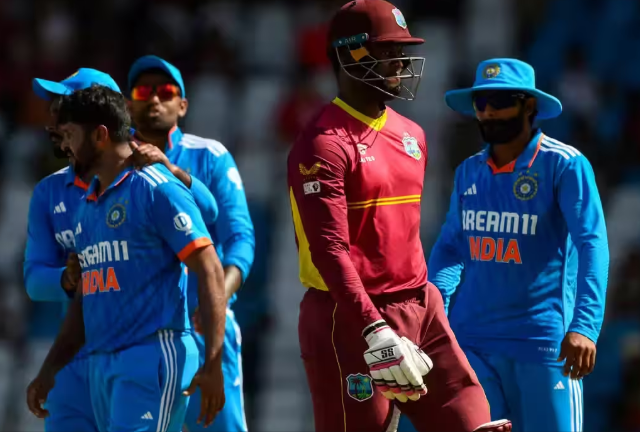
New Chandigarh, Oct 3: West Indies produced a remarkable run chase to defeat India by five wickets in the third ODI on Saturday, successfully overhauling a target of 352 despite a superb unbeaten century from KL Rahul.
India posted 351 for seven after being asked to bat, with Rahul producing an outstanding 129 not out from 87 balls. However, the hosts’ bowling attack struggled to defend the total as West Indies reached 352 for five in 48.2 overs.
Shai Hope was the architect of the victory, remaining unbeaten on 162 and combining patience with controlled aggression throughout the chase. His innings overshadowed Rahul’s counter-attacking effort and exposed concerns in India’s death bowling and fielding ahead of next year’s World Cup.
The result came in a dead rubber but nevertheless carried considerable significance for India because the team had hoped to finish the series with another convincing performance.
Instead, the West Indies demonstrated that India’s bowling unit still has areas that require attention.
India’s innings began with the team looking to establish a competitive total. KL Rahul took responsibility in the middle order and played one of the most impressive ODI innings of the series.
Rahul reached his ninth ODI century with an emphatic six and continued attacking during the closing stages. He finished unbeaten on 129 from 87 deliveries, giving India the foundation for a total that appeared difficult to chase.
The Indian innings also received support from Rohit Sharma, who scored 92. Their contributions ensured that India maintained a high scoring rate and entered the final phase of the innings with a strong platform.
India eventually reached 351 for seven in 50 overs, setting West Indies a target of 352.
On paper, the target appeared demanding. West Indies, however, approached the chase with confidence rather than allowing the required run rate to dictate their strategy.
Shai Hope quickly established himself as the central figure of the innings. The experienced batter combined defensive judgment with attacking strokes, ensuring that West Indies did not lose control of the chase even when India managed to create occasional pressure.
Hope’s unbeaten 162 became the defining performance of the match.
The West Indies captain showed excellent awareness of the situation and adjusted his approach as the innings progressed. Rather than attempting to score boundaries from every delivery, he kept the scoreboard moving and capitalised whenever India’s bowlers missed their lengths.
India’s attack found it increasingly difficult to contain the chase during the middle and final overs.
The pitch and conditions also appeared to work against the defending side as the innings progressed. Dew was reported to have played a role, making the task more difficult for India’s bowlers and fielders.
The West Indies batting unit used those conditions effectively.
As the required rate remained manageable, Hope continued to build the innings around himself. His ability to bat deep into the chase prevented India from creating sustained pressure through wickets.
The West Indies eventually crossed the finish line at 352 for five in 48.2 overs, completing one of their most impressive ODI chases against India.
The five-wicket victory also underlined the importance of finishing matches strongly. India had enough runs on the board to expect victory, but the bowling performance did not match the standard set by the batting unit.
Indian captain Shubman Gill later acknowledged that death bowling and fielding were areas that needed improvement. His assessment was particularly relevant because India’s inability to close out the innings allowed West Indies to maintain control during the final stages.
The match therefore offered contrasting messages for India.
With the bat, Rahul’s performance was a major positive. His unbeaten 129 came at a rapid pace and demonstrated his ability to combine stability with aggression. His innings was particularly valuable because India had already lost wickets during the innings and required someone to bat through the closing overs.
Rohit’s 92 also provided crucial support and helped India establish a substantial total.
Yet those efforts were ultimately overshadowed by the bowling collapse.
The defeat is likely to prompt greater scrutiny of India’s options for the latter stages of ODI innings. With the 2027 World Cup approaching, the team will need reliable bowling plans for situations in which opponents are chasing large totals.
The fielding performance will also require attention. Against a side chasing 352, India needed to convert half-chances and maintain pressure through sharp work in the field.
Instead, West Indies were allowed to remain in the contest and eventually take control.
For the visitors, the victory was a statement of their batting potential. Hope’s 162 demonstrated the value of having an experienced batter capable of absorbing pressure during a major chase.
His innings was not simply a display of power hitting. It was an exercise in managing the chase over a long period while ensuring that the required rate remained within reach.
West Indies also benefited from their ability to avoid panic after India posted 351.
The chase became increasingly comfortable as the innings progressed, and India’s bowlers were unable to produce the cluster of wickets needed to disrupt the visitors.
The final scoreline was particularly striking because India had scored more than 350. Such a total normally provides a strong platform for victory in ODI cricket, but West Indies made the target look achievable through disciplined batting and excellent game management.
The defeat also changed the tone surrounding India’s preparation for the 2027 World Cup. The team has plenty of batting strength, but the final match of the series showed that a powerful top and middle order cannot always compensate for weaknesses in the field and with the ball.
Gill’s comments after the match reflected that concern.
For West Indies, meanwhile, the victory provided momentum and confidence. Chasing down 352 against India requires significant batting discipline, and Hope’s performance will rank among the major individual efforts of the series.
The result also demonstrated that the West Indies side can compete aggressively against a strong Indian team when its top-order batting remains intact.
India will now have to assess the lessons from the defeat. The immediate positive is that Rahul continues to provide quality performances in the ODI format, while the concerns around death bowling and fielding give the management clear areas to address.
The match ended the series on a dramatic note, with India’s imposing 351 overturned by a West Indies side that refused to be intimidated by the size of the target.
Hope’s unbeaten 162 ultimately became the defining innings, while Rahul’s 129 remained a remarkable individual effort on the losing side.
For India, the five-wicket defeat serves as a timely reminder that strong batting totals must be supported by disciplined bowling and sharp fielding if the team is to compete consistently at the highest level.

