


Mahli Beardman Takes Six Wickets on ODI Debut as Australia Defeat England by Seven Wickets
The 21 year old Australian fast bowler produces a sensational debut performance with figures of 6/24 to dismantle England for 131, before Mitchell Marsh guides the hosts to a comfortable victory in Perth.
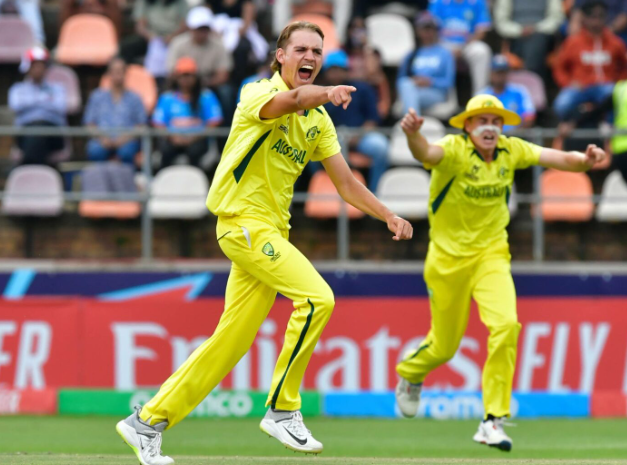
PERTH, Nov 13: Australian fast bowler Mahli Beardman announced his arrival on the international stage with an extraordinary six-wicket performance on debut, helping Australia defeat England by seven wickets in the opening One-Day International at Perth Stadium on Friday.
The 21 year old delivered a memorable bowling display, claiming six wickets for just 24 runs as England were dismissed for 131 in 33.4 overs.
Australia subsequently completed the chase comfortably, reaching 132 for three in 23.3 overs, with captain Mitchell Marsh leading the response through an aggressive half-century.
The result gave Australia a 1-0 lead in the three-match series and provided the home side with an encouraging start to its international campaign, despite the controversy surrounding the team away from the field.
Beardman’s performance was the defining moment of the match. Making his first appearance in ODI cricket, the Western Australian fast bowler demonstrated impressive control, consistency and an ability to exploit the conditions at his home venue.
His six-wicket haul also placed him among the most successful Australian bowlers on debut in the format.
The young pacer became the first Australian since Tony Dodemaide in 1988 to take five wickets in his first ODI appearance. Beardman went one step further by claiming a sixth dismissal, finishing with figures that made an immediate impression on international cricket.
For England, the defeat represented another disappointing batting performance in Perth, where the visitors struggled to deal with Australia’s pace attack and the bounce available from the surface.
England struggle against Australia’s pace attack
After losing the toss, England were sent in to bat on a fast and bouncy Perth pitch. The conditions initially offered opportunities for Australia’s seamers, who quickly put the visiting batting order under pressure.
Spencer Johnson and Xavier Bartlett provided the early breakthroughs, preventing England from establishing a stable opening partnership.
Johnson claimed three wickets for 42 runs, while Bartlett finished with one wicket for 46.
England opener Ben Duckett was dismissed for nine runs, while Tom Banton managed 25 before Australia’s bowlers tightened their control over the innings.
The early wickets brought England captain Harry Brook to the crease, but he could not provide the recovery the team needed.
Beardman then took charge of the contest with a remarkable spell of fast bowling.
Operating with an accurate length and generating movement away from the right-handed batters, he repeatedly troubled England’s middle order.
Wicketkeeper Josh Inglis played an important role behind the stumps, completing catches as Beardman removed Brook for one, Joe Root for 17 and Jordan Cox for two.
The dismissals left England in a vulnerable position and increased the pressure on the remaining batters.
Beardman’s control was particularly impressive considering that he was making his first appearance at the international level. Rather than attempting overly aggressive deliveries, he concentrated on maintaining accuracy and forcing England’s batters into difficult decisions.
Sam Curran and Liam Dawson were unable to score before becoming Beardman’s next victims.
With five wickets already to his name, the young pacer had matched a rare achievement last accomplished by Dodemaide nearly four decades earlier.
He subsequently dismissed Jofra Archer, who was caught at gully for 11, to complete his six-wicket haul.
Gus Atkinson remained unbeaten on 29, the highest score for England, but had little support from the other end as the innings ended at 131.
Beardman celebrates dream international debut
For Beardman, the performance represented a significant personal milestone and the reward for his development through Australia’s domestic cricket structure.
The young fast bowler expressed his happiness at representing his country and said taking wickets during his first international appearance made the experience even more special.
His ability to perform under pressure was particularly noteworthy, given the expectations associated with making an ODI debut against a competitive England side.
Beardman’s performance also highlighted the depth of Australia’s fast-bowling resources, with the team continuing to introduce younger players capable of contributing at the highest level.
The conditions at Perth Stadium suited his bowling style, but his success was not based solely on the pitch. His accuracy, consistency and ability to maintain pressure were important factors in England’s collapse.
The six-wicket haul also gave Australia a major advantage in the contest, allowing the batting unit to approach the chase without the pressure of a substantial target.
Marsh leads Australia’s comfortable chase
Australia’s response began with an early setback when Travis Head was dismissed for a golden duck by Atkinson in the second over.
However, the early breakthrough did not create any sustained pressure on the home side.
Captain Mitchell Marsh took responsibility for accelerating the scoring and played an attacking innings that brought Australia closer to the target.
He reached his half-century with an aggressive approach, striking four sixes during his innings and putting England’s bowlers under pressure.
Marsh was eventually caught in the deep off Jamie Overton, who finished with one wicket for 35 runs.
By that stage, Australia had already taken firm control of the chase.
Cooper Connolly contributed 27 before becoming Archer’s victim, but the dismissal did little to alter the direction of the match.
Matt Renshaw joined Josh Inglis at the crease, and the pair ensured that Australia reached the required total without further difficulty.
The hosts finished on 132 for three in 23.3 overs, securing a convincing seven-wicket victory with plenty of overs remaining.
The result reflected the difference between the two sides’ performances with the ball. Australia’s attack consistently challenged England’s batters, while the visiting bowling unit struggled to defend a relatively modest total.
Sandpapergate controversy creates tension in Australian cricket
While Beardman’s performance dominated the sporting discussion, the match also took place against the backdrop of renewed controversy surrounding Australia’s 2018 ball-tampering scandal, commonly known as Sandpapergate.
The issue resurfaced following the release of former Australian batter Usman Khawaja’s autobiography, in which he discussed the events surrounding the Cape Town Test against South Africa.
Khawaja suggested that knowledge of the ball-tampering plan extended beyond the three players who were eventually punished.
The controversy led to renewed questions about the extent of awareness within the Australian dressing room during the incident.
Australia’s current Test captain Pat Cummins strongly rejected the allegations, describing them as completely inaccurate.
Speaking at a lengthy press conference in Sydney on Friday, Cummins said he had no knowledge that sandpaper was being used on the ball and denied being involved in any plan to manipulate its condition.
He also criticised the suggestion that he and other members of the team had helped organise the incident.
Cummins said he had consistently maintained his position over the past eight years and believed the claims misrepresented what had happened.
The controversy has remained sensitive within Australian cricket because of the significant disciplinary action taken against the players involved.
In 2018, former captain Steve Smith and vice-captain David Warner received 12-month bans, while Cameron Bancroft was suspended for nine months after being caught using sandpaper on the ball.
Warner backs Khawaja’s account
Former Australian opener David Warner publicly supported Khawaja’s account, adding another dimension to the disagreement.
Warner, who was among the players sanctioned following the 2018 incident, questioned the investigation conducted at the time and suggested that the matter had not been properly resolved.
He also expressed disappointment with Cummins’ criticism of Khawaja, arguing that former teammates could have different recollections of the events.
Warner maintained that he supported Khawaja’s comments and believed the discussion should not be dismissed simply because the incident had taken place several years earlier.
The exchange demonstrated that disagreements surrounding the scandal remain unresolved among some former and current Australian players.
Meanwhile, Cricket Australia’s leadership has indicated that the investigation will not be reopened.
The controversy has attracted attention because it concerns the reputation of Australian cricket and the efforts made by the organisation to rebuild trust following the 2018 incident.
Despite the renewed debate, the players remained focused on the opening ODI against England.
Brook looks for a comeback in the remaining matches
England captain Harry Brook acknowledged the disappointing start but remained optimistic about his team’s ability to recover in the series.
He pointed out that England had previously fallen behind in a series before managing to turn the situation around.
Brook said the immediate objective would be to respond positively in the next match and avoid allowing the opening defeat to affect the team’s confidence.
England’s batting performance, however, will require considerable improvement if the visitors are to challenge Australia in the remaining encounters.
The early dismissals of key players, including Brook and Root, exposed the team’s vulnerability against accurate fast bowling.
The visitors will need to reassess their batting approach, particularly on pitches offering pace and bounce, while also finding ways to build partnerships after losing early wickets.
Australia, meanwhile, will take considerable confidence from the performance of its bowling attack.
Beardman’s remarkable debut has given the selectors another promising option, while Johnson and the other bowlers demonstrated their ability to create pressure throughout an innings.
The three-match ODI series will continue in Adelaide on Sunday before concluding in Hobart on Wednesday.
With Australia leading 1-0, England must produce a stronger performance to keep the contest alive.
For Beardman, the opening encounter will remain a landmark moment in his career. His six-wicket performance not only helped Australia secure victory but also established him as one of the most exciting young fast bowling prospects to emerge from the country’s domestic system.

