


Modi Reflects RSS Vision in Governance, Says Hosabale
RSS outlines long term societal vision as Hosabale highlights alignment between organisational philosophy and government initiatives
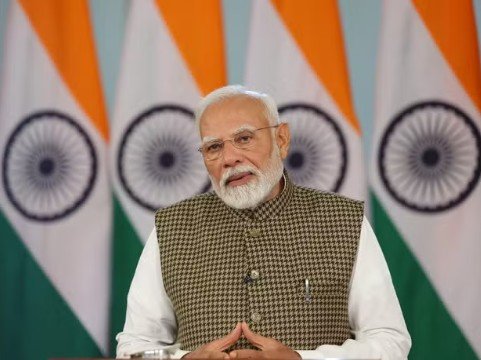
New Delhi, Apr 25 : In a significant statement reflecting ideological continuity, Rashtriya Swayamsevak Sangh (RSS) General Secretary Dattatreya Hosabale on April 25 described Prime Minister Narendra Modi as one of the most effective representatives of the organisation’s core principles, emphasising the Prime Minister’s distinctive approach in translating those values into governance.
Speaking during an interaction in Washington, Hosabale underlined that while Modi may not always articulate ideas in the same language as the RSS, his initiatives consistently echo the organisation’s foundational philosophy. He pointed out that the Prime Minister adapts these values innovatively, aligning them with contemporary governance needs and public outreach.
Citing examples, Hosabale referred to Modi’s environmental campaign encouraging citizens to plant trees, including initiatives framed with emotional and cultural resonance. According to him, such programmes reflect the broader ethos of environmental responsibility long advocated by the RSS, albeit expressed in a more personalised and accessible manner.
The RSS leader further elaborated that the organisation has identified five priority areas for the coming decades. These include fostering social harmony and unity, promoting self-awareness rooted in indigenous identity, eliminating remnants of colonial mindset, strengthening civic discipline, reinforcing family structures, and advancing sustainable models of development. He suggested that many of these themes are already visible in national policy frameworks and public campaigns.
Hosabale observed that several flagship government initiatives mirror these objectives. He specifically mentioned the push for self-reliance under national development strategies and the articulation of long-term national goals by the Prime Minister during major public addresses. According to him, these initiatives demonstrate a natural alignment between ideological grounding and administrative execution.
Highlighting Modi’s long association with the RSS, Hosabale remarked that his background as a Swayamsevak continues to shape his outlook and decision-making. He noted that despite holding a democratically elected position, the Prime Minister remains conscious of his cultural and ideological roots, which he believes strengthens his leadership perspective.
Reflecting on historical ties, Hosabale also revisited the origins of the political relationship between the RSS and the Bharatiya Janata Party (BJP). He stated that when the BJP was established in 1980, its founders deliberately sought to maintain a close connection with the RSS after their departure from the Janata Party. This relationship, he said, was foundational and continues to influence the broader political and ideological landscape.
He emphasised that this enduring link has played a crucial role in shaping policy direction and organisational coherence over the decades. According to Hosabale, the continuity of values has enabled a consistent approach to nation-building efforts, blending cultural perspectives with governance priorities.
The remarks come at a time when discussions around ideology and governance are increasingly prominent in political discourse. Hosabale’s observations highlight the ongoing interplay between cultural organisations and political leadership in shaping India’s long-term vision.
Concluding his remarks, the RSS leader reiterated that Modi’s leadership reflects a synthesis of tradition and modernity, positioning him as a significant figure in carrying forward the organisation’s ideals in a democratic framework.

