


Mohan Bhagwat Calls for Stronger Push to Promote Sanskrit Across India
RSS chief highlights Sanskrit as a unifying force connecting languages, traditions, and India’s civilizational knowledge
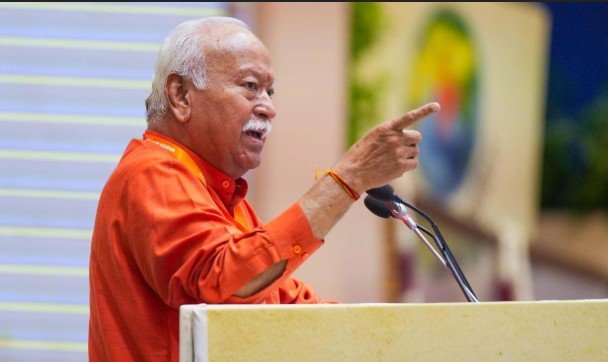
New Delhi, Apr 20: Emphasising the cultural and intellectual significance of Sanskrit, Mohan Bhagwat on Monday strongly advocated for its wider promotion across India, describing the ancient language as a vital link binding the nation’s diverse linguistic and philosophical traditions.
Speaking at the inauguration of the new central office of Sanskrit Bharati in the national capital, Bhagwat underlined that the essence of “Bharat” extends far beyond geography or political identity. He described it as a living tradition that continues to sustain life and thought across generations.
“Bharat is not merely a geographical or political entity. It is a continuous civilizational tradition that nurtures life and knowledge. Understanding this tradition is essential for every Indian,” he said.
Sanskrit as the Key to India’s Knowledge System
Highlighting the role of language in preserving heritage, Bhagwat stated that a deeper understanding of Sanskrit is essential to fully grasp India’s vast repository of knowledge. He noted that while India is home to numerous languages—each deserving recognition as a national language Sanskrit serves as the connecting thread among them.
“Every Indian language has its own importance, but the link that binds them together is Sanskrit. It acts as a bridge that connects linguistic diversity into a unified cultural framework,” he said.
He further stressed that the promotion of Sanskrit should not remain limited to academic or ceremonial use but should extend into everyday communication. Calling upon Rashtriya Swayamsevak Sangh affiliated initiatives to intensify their efforts, Bhagwat urged that the language be brought closer to the masses.
A Living Language, Not a Replacement
Clarifying concerns about linguistic dominance, Bhagwat emphasized that Sanskrit has never grown at the expense of other Indian languages. Instead, it has coexisted and enriched them over centuries.
“Sanskrit does not replace any language. Its nature is to strengthen and support. It has always contributed to the growth of other languages and will continue to do so,” he remarked.
He pointed out that a significant portion of vocabulary in many Indian languages originates from Sanskrit or its derivatives, reinforcing its foundational role in shaping the country’s linguistic landscape.
Cultural Identity and National Integration
Bhagwat described Sanskrit as more than just a medium of communication, calling it the “prana” or life force of the nation. According to him, the language carries the essence of India’s oldest surviving traditions, encompassing philosophy, literature, and ways of life.
He also highlighted the continued presence of Sanskrit in modern India, noting that certain families and villages still actively use it in daily conversation—demonstrating that the language remains alive despite changing times.
“The stream of sentiment across India’s languages is fundamentally one. Sanskrit serves as the vehicle that carries this shared cultural expression,” he said.
Call for Broader Adoption
Concluding his address, Bhagwat urged institutions and citizens alike to work collectively toward expanding the reach of Sanskrit. He suggested that its promotion could strengthen national unity while reconnecting people with India’s ancient intellectual heritage.
The remarks come at a time when discussions around cultural identity, language preservation, and education policy are gaining renewed attention across the country, positioning Sanskrit once again at the center of India’s linguistic and civilizational discourse.

