


NASA’s Anil Menon, Two Russian Cosmonauts Launch on 8-Month Mission to the ISS
Soyuz MS-29 lifts off from Kazakhstan’s Baikonur Cosmodrome, carrying an international crew to begin a long-duration scientific expedition aboard the ISS.
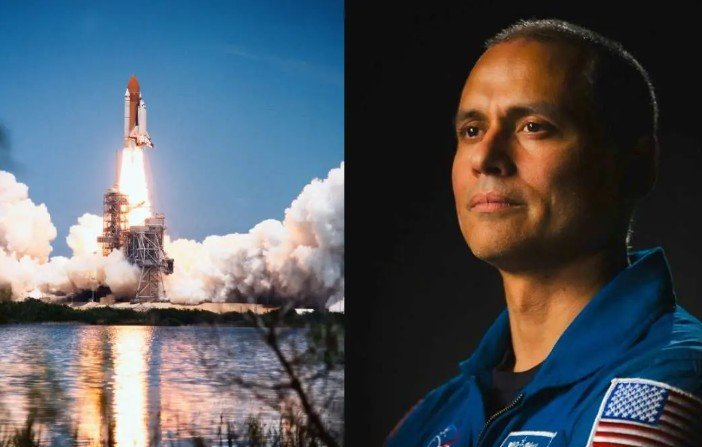
WASHINGTON, Jul 14: NASA astronaut Anil Menon and two Russian cosmonauts successfully launched aboard the Soyuz MS-29 spacecraft on Tuesday, marking the start of an eight month scientific mission aboard the International Space Station (ISS). The launch highlights continued international cooperation in human spaceflight despite global geopolitical challenges.
The spacecraft lifted off from the historic Baikonur Cosmodrome in Kazakhstan at 8:17 p.m. IST, carrying Menon alongside veteran Roscosmos cosmonauts Pyotr Dubrov and Anna Kikina. The crew is scheduled to spend approximately eight months conducting scientific experiments, technology demonstrations, and maintenance activities aboard the orbiting laboratory.
Following a smooth launch, Soyuz MS-29 entered its planned orbital trajectory and began a rapid rendezvous with the ISS. The spacecraft is expected to complete a two-orbit journey lasting around three hours before automatically docking with the station’s Prichal docking module at approximately 11:56 p.m. IST.
International Crew Strengthens ISS Operations
After arriving at the ISS, the newly launched astronauts will integrate with the station’s existing international crew. The orbital laboratory is currently home to NASA astronauts Jessica Meir, Jack Hathaway, and Chris Williams, European Space Agency astronaut Sophie Adenot, and Roscosmos cosmonauts Sergey Kud-Sverchkov, Sergei Mikaev, and Andrey Fedyaev.
Together, the expanded crew will support a wide range of scientific investigations spanning human health, biology, materials science, Earth observation, and advanced technologies that could benefit future deep-space missions as well as life on Earth.
Anil Menon’s First Long-Duration Spaceflight
The mission represents a significant milestone for Anil Menon, who begins his first long-duration stay aboard the International Space Station. Menon, a physician and aerospace engineer, joined NASA’s astronaut corps after serving in key medical and operational roles supporting both government and commercial spaceflight programs.
During the expedition, he is expected to participate in medical research, technology validation projects, and station maintenance while contributing to experiments designed to improve understanding of how the human body adapts to extended periods in microgravity.
Science at the Heart of the Mission
The International Space Station continues to serve as one of the world’s most advanced research laboratories, enabling scientists from multiple countries to conduct experiments that cannot be performed under Earth’s gravity.
The new crew will help carry out studies related to human physiology, plant growth, advanced manufacturing, fluid dynamics, and space medicine. These investigations are expected to provide valuable data for future lunar missions under NASA’s Artemis programme and eventual human exploration of Mars.
In addition to scientific work, astronauts will perform routine maintenance, inspect station systems, install new equipment, and prepare for upcoming cargo deliveries and future crew rotations.
Soyuz Remains a Reliable Crew Transport Vehicle
The Soyuz spacecraft continues to play a crucial role in transporting astronauts to and from the ISS. Over decades of service, it has built a reputation for reliability and remains an essential component of international space operations.
The mission also reflects the ongoing collaboration between NASA and Roscosmos, with both agencies continuing joint operations aboard the ISS to ensure uninterrupted scientific research and safe station management.
Mission Expected to Continue Until 2027
The crew is scheduled to remain aboard the International Space Station for roughly eight months before returning to Earth. During their stay, they will oversee hundreds of experiments, support visiting cargo spacecraft, and help maintain the station’s critical systems.
As the ISS enters another productive phase of scientific exploration, Anil Menon and his fellow crew members are expected to contribute significantly to research that will shape the future of human space exploration while advancing scientific knowledge for the benefit of people worldwide.

