


NDA Wins 16 MLC Seats Across Four States, Congress Fails to Open Account, SP Bags Five in UP
BJP and allies dominate the legislative council polls, while Jan Suraaj Party registers its first victory in Bihar; counting continues in one Maharashtra constituency.
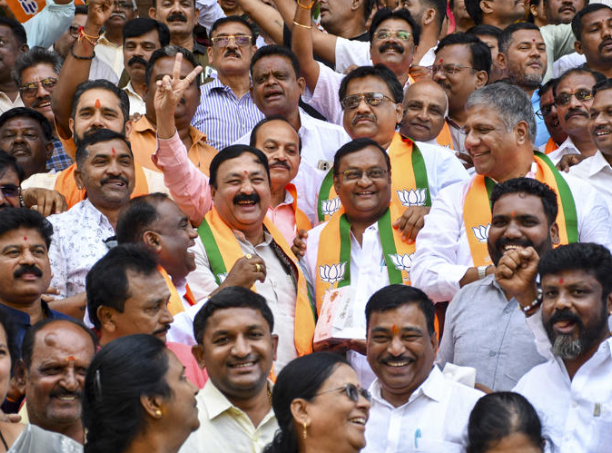
LUCKNOW, Oct 28: The BJP led National Democratic Alliance (NDA) secured 16 of the 28 legislative council seats contested across Uttar Pradesh, Maharashtra, Bihar and Karnataka, while the Congress failed to win a single seat. The Samajwadi Party (SP) won five seats in Uttar Pradesh, including two in Varanasi, in a closely watched electoral contest ahead of the state’s 2027 Assembly elections.
Results were declared for all but one constituency, with counting continuing in Maharashtra’s Nagpur Graduates’ seat. The contest remained tight between BJP candidate Sudhakar Kohale and Congress’ sitting MLC Abhijeet Wanjari.
The elections also witnessed setbacks for several sitting members. Five incumbent MLCs lost their seats in Bihar, where the Jan Suraaj Party secured its first victory through Suresh Prasad Rai, who defeated Congress leader Madan Mohan Jha by 324 votes in the Darbhanga Teachers’ constituency. Two Independent candidates also emerged victorious in the state.
In Karnataka, the ruling Congress suffered a major setback, losing all four seats. The BJP secured three constituencies, while its ally, the Janata Dal (Secular), won one.
Prime Minister Narendra Modi took a swipe at the Congress over its performance, pointing out that the elections were conducted using ballot papers rather than electronic voting machines (EVMs).
In a post on X, Modi referred to the elections across the four states and questioned how many seats the Congress had managed to win despite the use of paper ballots. His remarks came amid the opposition’s repeated allegations regarding the credibility of EVM-based elections.
The BJP also criticised Congress leader Rahul Gandhi over the results. Party spokesperson Sudhanshu Trivedi said electoral support had to be earned through sustained public engagement and hard work rather than what he described as leisure trips.
The Congress responded by challenging the prime minister to support ballot-paper voting in future Lok Sabha and Assembly elections if he was confident that the voting system did not influence electoral outcomes.
In Maharashtra, the ruling Mahayuti alliance won two seats, while the opposition Nationalist Congress Party (Sharadchandra Pawar) secured two. Shiv Sena candidate Kiran Sarnaik won the Amravati Teachers’ constituency, and BJP nominee Kaustubh Gawade emerged victorious in Pune Teachers’ seat.
The NCP (SP) won the Pune Graduates’ constituency through Harshada Deshmukh-Jadhav and the Chhatrapati Sambhajinagar Graduates’ seat through Pratapsinh Patil.
In Bihar, the BJP won three seats, while the JD(U) and Rashtriya Janata Dal (RJD) secured one each. BJP candidates Narendra Prasad Singh, Sarvesh Kumar and N K Yadav registered victories in the Tirhut Teachers’, Darbhanga Graduates’ and Kosi Graduates’ constituencies, respectively.
JD(U) candidate Neeraj Kumar defeated his RJD rival in the Patna Graduates’ constituency. However, the BJP suffered a setback in Patna Teachers’ seat, where fifth-term MLC Nawal Kishor Yadav lost to RJD candidate Sanjeev Kumar.
Independent candidate Rahul Raj defeated sitting MLC Afaq Ahmed in the Saran Teachers’ constituency. Bansi Dhar Brajwasi retained the Tirhut Graduates’ seat as an Independent.
In Uttar Pradesh, the SP secured five seats, strengthening its position in the contest against the BJP ahead of next year’s Assembly elections. Mansingh Yadav won the Allahabad-Jhansi Graduates’ constituency, while Lal Bihari Yadav retained the Varanasi Teachers’ seat.
SP candidates also won the Varanasi and Lucknow Graduates’ constituencies. Akash Agrawal defeated BJP nominee Hari Kishore Tiwari in the Agra-Aligarh Teachers’ constituency.
The BJP registered victories in several other constituencies. Manvendra Pratap Singh, popularly known as Guruji, won the Agra Graduates’ seat, while Hari Singh Dhillon retained the Bareilly-Moradabad Teachers’ constituency by defeating SP candidate Danish Akhtar.
BJP nominee Umesh Dwivedi won the Lucknow Teachers’ constituency against SP’s Sushil Kumar. The party also secured both the Teachers’ and Graduates’ seats in Meerut, while Dhruv Kumar Tripathi won the Gorakhpur-Faizabad Teachers’ constituency.
SP president Akhilesh Yadav asked the party’s winning candidates to avoid victory processions and use social media to communicate their achievements. He alleged that the BJP could attempt to create disturbances and subsequently blame the SP ahead of the Assembly elections.
Yadav also raised concerns over an alleged assault on Akash Agrawal. Sharing a video showing the winning candidate wearing a torn kurta, he questioned the treatment meted out to the SP leader and urged the Election Commission, the Supreme Court and the President to take immediate cognisance of the matter.
The legislative council elections were held on October 23 across teachers’ and graduates’ constituencies in the four states. The polls covered 11 constituencies in Uttar Pradesh, eight in Bihar, four in Karnataka and five in Maharashtra.
Unlike general elections, these contests are restricted to eligible graduate and teacher voters, with ballot papers used instead of EVMs.
Although the results will not affect the stability of the Congress government in Karnataka, the BJP-JD(S) alliance has described its performance as a significant political gain. Karnataka BJP president B Y Vijayendra said the outcome reflected public rejection of the ruling Congress and offered an indication of the political contest expected in the 2028 Assembly elections.
Chief Minister Siddaramaiah’s deputy, D K Shivakumar, said the Congress accepted the verdict and would examine the reasons behind its disappointing performance before taking corrective measures.
With the Uttar Pradesh Assembly elections approaching in 2027, the MLC results have emerged as an important political indicator for the BJP and the SP. While the NDA maintained an overall advantage across the four states, the SP’s gains in Uttar Pradesh and the Congress’ losses in Karnataka are likely to shape political strategies in the months ahead.

