


PM Modi Accuses Congress of Stalling Sikkim’s Growth, Reaffirms ‘Act East, Act Fast’ Vision
Prime Minister highlights Northeast as ‘Ashtalakshmi’, reiterates Centre’s commitment to rapid regional growth
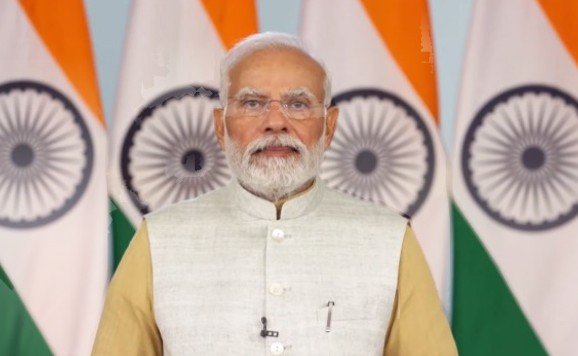
Gangtok, April 28: Prime Minister Narendra Modi on Tuesday launched a sharp political attack on the Congress, accusing previous governments of delaying Sikkim’s development, while asserting that the current administration has accelerated infrastructure and connectivity in the region.
Addressing the closing ceremony of Sikkim’s 50th Statehood celebrations in Gangtok, the Prime Minister described Sikkim and the broader Northeast as India’s “Ashtalakshmi,” underlining their strategic and cultural significance. He reaffirmed the government’s dual commitment to the Act East and Act Fast policy, emphasizing faster execution of development initiatives.
Speaking at the event, Modi said that several key infrastructure projects, which could have been completed years ago, were delayed under earlier administrations. He cited the long-pending Sivok–Rangpo railway project as a key example, noting that despite being sanctioned in 2008–09, it saw little progress until recent years.
He asserted that renewed efforts under the current government have brought the project closer to completion, marking a historic step toward connecting Sikkim to the national railway network for the first time.
Major Projects Worth ₹4,000 Crore Launched
During his visit, the Prime Minister inaugurated and laid the foundation stone for more than 30 development projects collectively valued at over ₹4,000 crore. These initiatives span multiple sectors, including infrastructure, connectivity, and public services, aimed at strengthening the state’s growth trajectory.
He highlighted that the Centre is focusing not just on policy declarations but also on timely implementation, ensuring that development reaches remote and strategically important regions like Sikkim.
Northeast as India’s Growth Engine
Modi reiterated that the Northeast holds a central place in India’s development vision. Referring to the region as “Ashtalakshmi,” he emphasized that it represents prosperity and potential across eight states.
He noted that the government’s approach goes beyond the traditional Act East framework, incorporating a faster execution model to unlock economic opportunities, improve connectivity, and enhance regional integration with Southeast Asia.
Tourism Emerges as Key Economic Driver
Highlighting Sikkim’s natural wealth, the Prime Minister praised the state’s thriving tourism sector. Despite covering less than one percent of India’s total land area, Sikkim is home to over a quarter of the country’s floral diversity.
He pointed out that the state hosts more than 500 bird species and approximately 700 varieties of butterflies, along with dense forests and the towering presence of Kangchenjunga, the world’s third-highest mountain.
According to him, this unique ecological richness makes Sikkim a major attraction for domestic and international tourists, contributing significantly to the local economy.
Visit Highlights and Cultural Engagement
As part of his two-day visit, Modi also toured the Swarnajayanti Maitri Manjari Park in Gangtok. He visited the Orchid Experience Centre, which showcases the region’s biodiversity through modern, world-class exhibits.
The visit underscored the Centre’s focus on promoting eco-tourism and preserving the natural heritage of the Himalayan state.
Political and Developmental Messaging
The Prime Minister’s remarks carried both political and developmental undertones, drawing a contrast between past governance and current progress. By emphasizing completed and ongoing projects, he sought to position the government’s approach as action-oriented and results-driven.
The address also highlighted the strategic importance of Sikkim, not only as a tourist destination but also as a key player in India’s broader regional and economic ambitions.

