


PM Modi, UAE President Discuss West Asia Crisis, Stress Dialogue at G7 Summit
India and the UAE reaffirm strategic partnership while stressing maritime security, regional peace, and uninterrupted global trade routes.
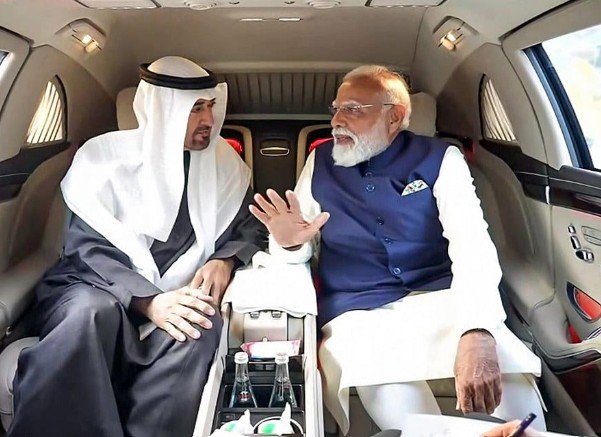
France, June 17: Against the backdrop of evolving geopolitical developments in West Asia and growing concerns over the security of critical maritime routes, Prime Minister Narendra Modi and UAE President Sheikh Mohamed bin Zayed Al Nahyan held extensive discussions on regional stability, peace efforts, and bilateral cooperation during the G7 Summit in France.
The meeting, held on the sidelines of the summit in Evian-les-Bains, underscored the shared commitment of India and the United Arab Emirates to promoting dialogue, diplomatic engagement, and adherence to international law as essential tools for resolving conflicts and ensuring long-term stability across the region.
Prime Minister Modi described the interaction as productive and forward looking, highlighting the strength of ties between the two nations. In a message shared on social media, he noted that discussions covered a broad spectrum of areas, including trade, investment, technology, energy, and defence cooperation.
The leaders reviewed ongoing initiatives under the India-UAE Comprehensive Strategic Partnership and explored new opportunities to deepen collaboration in sectors that are increasingly shaping the global economy. Both sides acknowledged the significant progress achieved in recent years and expressed confidence in the continued expansion of bilateral engagement.
A major focus of the meeting was the situation in West Asia, where recent tensions have raised concerns among governments and markets worldwide. The leaders exchanged perspectives on developments in the region and emphasized the importance of peaceful solutions to complex challenges.
According to officials, Prime Minister Modi reiterated that sustainable peace can only be achieved through constructive dialogue, diplomacy, and respect for the principles of sovereignty, territorial integrity, and international law. The Indian leader stressed that these principles remain fundamental to maintaining stability and preventing further escalation in conflict-prone regions.
The discussions also highlighted the strategic importance of maritime security, particularly in relation to the Strait of Hormuz, one of the world’s most vital energy corridors. Both countries underlined the necessity of ensuring uninterrupted navigation and the smooth flow of international trade through the waterway.
The Strait of Hormuz serves as a critical route for global energy transportation, carrying a substantial share of the world’s oil and gas supplies. Any disruption in the region has the potential to affect international markets, energy prices, and economic growth across continents.
India and the UAE agreed on the importance of preserving freedom of navigation and maintaining secure sea lanes to support global commerce. The leaders emphasized that maritime routes must remain open, safe, and accessible to all nations in accordance with international norms.
The meeting came shortly after major diplomatic developments involving the United States and Iran. Recent announcements regarding an agreement aimed at ending hostilities between the two countries have generated optimism about reducing regional tensions and restoring stability to energy markets.
Observers believe that the easing of conflict could significantly improve confidence in global supply chains and strengthen economic recovery efforts in many parts of the world. For energy importing countries such as India, stability in West Asia remains a matter of strategic importance.
Beyond regional security, the leaders also assessed progress in bilateral initiatives launched following their recent interactions. The UAE President visited India earlier this year, while Prime Minister Modi travelled to the UAE in May, resulting in several new agreements and collaborative projects.
Officials noted that cooperation between the two countries has expanded rapidly across multiple sectors. Trade volumes have grown steadily, investment partnerships have strengthened, and collaboration in emerging technologies continues to gain momentum.
Energy remains one of the pillars of the relationship, with both countries working closely to enhance energy security and diversify cooperation in renewable and sustainable energy solutions. Joint efforts in innovation, digital transformation, and advanced manufacturing have also emerged as important areas of engagement.
Defence and security cooperation featured prominently in the review, reflecting the shared interest in combating transnational challenges and maintaining regional stability. Regular exchanges and institutional mechanisms have contributed to closer strategic coordination between the two nations.
The meeting marked the third interaction between Prime Minister Modi and Sheikh Mohamed bin Zayed Al Nahyan in 2026, highlighting the frequency of high-level engagement and the strong personal rapport between the leaders. Such interactions have played a significant role in accelerating the pace of bilateral cooperation and strengthening mutual trust.
Analysts view the India-UAE relationship as one of the most dynamic partnerships in the region. The Comprehensive Strategic Partnership framework has enabled both nations to align their priorities across economic, technological, and security domains while responding effectively to emerging global challenges.
As geopolitical uncertainties continue to shape international affairs, India and the UAE reaffirmed their commitment to working together in support of peace, stability, and prosperity. The discussions at the G7 Summit reflected a shared vision of strengthening regional cooperation while safeguarding the interests of global trade and energy security.
With both countries seeking deeper collaboration in key sectors and advocating diplomatic solutions to regional challenges, the meeting reinforced the growing significance of the India-UAE partnership on the international stage.

