


Priyanka Gandhi Takes Veiled Dig at Govt Over Controversy Surrounding Son’s Exhibition
The Congress leader says authorities who fear artistic expression have already lost their power, after several photographs documenting recent Delhi protests were removed from her son’s exhibition at Bikaner House.
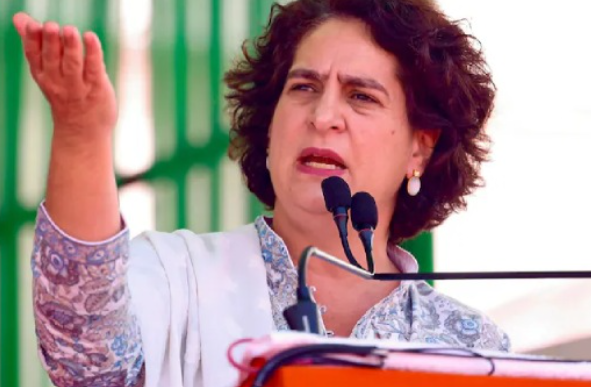
NEW DELHI, October 22: Congress leader Priyanka Gandhi Vadra on Thursday criticised the removal of photographs documenting recent protests in Delhi from an exhibition by her son, artist and photographer Raihan Vadra, saying that those in positions of authority undermine their own power when they become fearful of others’ expression.
In a message posted on social media and addressed to Raihan, Priyanka said, “When someone with power becomes afraid of the expression of another, he doesn’t know it, but he has already lost the very power he is trying to protect.”
She also expressed support for her son, writing, “You stand for what is true and everything beautiful will find its way to you. I am proud of you, always will be.”
The controversy erupted after Raihan alleged that the administration at Bikaner House had removed several photographs from his solo exhibition, titled No Idea is Final, ahead of its public opening on Thursday. The exhibition was previewed on Wednesday.
Raihan said the photographs documented protests held in Delhi over the preceding six months and maintained that the images did not promote any particular political message.
Photographer Alleges Last-Minute Removal of Images
According to Raihan, he was informed at around 3.30 pm on Wednesday that the photographs had to be removed by 5 pm, failing which the exhibition would be cancelled.
He claimed that the administration told him it was not an appropriate time to display the images. Raihan also said he had submitted the exhibition proposal and layout to the Bikaner House management well in advance.
Despite the prior communication, he alleged, the administration proceeded to take down several photographs shortly before the show.
The incident affected two large rooms on the first floor of the Bikaner House CCA building, where around 74 photographs had reportedly been removed.
Raihan said the photographs were intended to document developments taking place around him rather than convey a specific political position. He argued that documenting public demonstrations was part of his responsibility as an Indian artist.
“I felt it is my duty as an Indian artist, not just because I am doing a show right now, but it is my duty as an Indian artist to document what is going on,” he said.
He further alleged that the removal amounted to censorship of artistic work and questioned why the administration had objected to the images, including one featuring the Indian national flag.
Priyanka Calls Action ‘Muzzling’ of Young Voices
Priyanka described the incident as an attempt to suppress the expression of young people and artists across the country.
She warned that such actions could extend beyond one individual, arguing that other artists might face similar restrictions in the future.
“Today it’s him, tomorrow it’ll be another artist,” she said.
Her remarks turned the dispute over the exhibition into a wider debate about artistic freedom, the documentation of public events and the ability of cultural institutions to regulate the material displayed on their premises.
The Congress leader’s comments amounted to a veiled criticism of the government, although her statement focused on the broader question of how those in authority respond to expressions they find uncomfortable.
Raihan, meanwhile, maintained that political themes are an integral part of artistic practice and cannot always be separated from the circumstances in which an artist works.
He argued that the photographs should be viewed as documentation of events rather than as an attempt to promote a political organisation or ideology.
Bikaner House Administration Yet to Explain Decision
A Bikaner House official declined to comment on the controversy when approached for a response.
The administration’s reported objections, as recounted by Raihan, were linked to the prevailing political circumstances and the timing of the exhibition. An independent explanation from the authorities was not available in the account of the incident.
The absence of a detailed official response has left questions about the precise grounds for removing the photographs unanswered.
The episode has also highlighted the challenges that artists may encounter when presenting work involving politically sensitive events in public or institutional spaces.
While organisers and venue administrators may have rules governing exhibitions, the circumstances surrounding the removal of the photographs have prompted questions about how such decisions are communicated and justified.
Raihan’s central contention is that his work recorded public demonstrations and that the images should not have been removed merely because of the political context in which they were created.
The exhibition, No Idea is Final, was scheduled to open to visitors on Thursday, following its preview a day earlier.
The controversy comes as Priyanka’s public message of support for her son has drawn attention to the relationship between artistic expression and the exercise of institutional authority. The incident has also renewed discussion about the role of photographers in documenting protests and other significant public events.
For Raihan, the dispute concerns the freedom to present photographs that record contemporary developments. For Priyanka, it raises a broader concern about the consequences when those with authority seek to restrict expression.
The Bikaner House administration’s reported decision and the lack of a detailed official explanation have left the matter open to further scrutiny.

