


Rajkummar Rao Unveiled as Sourav Ganguly in Dada First Look, Launching One of Bollywood’s Most Watched Sports Biopics
The first look of Dada released on July 8 on Sourav Ganguly’s birthday, with Rajkummar Rao recreating the former India captain’s iconic shirt-swinging moment and setting the stage for a high-stakes cricket biopic.
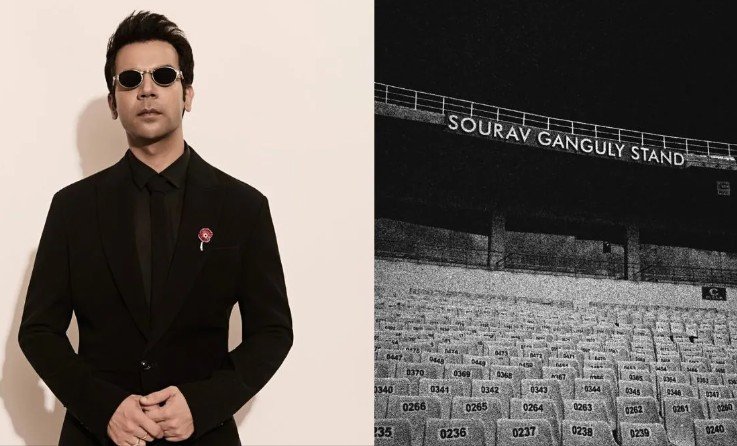
Mumbai, July 08 : Bollywood’s sports biopic pipeline received a major jolt of attention on July 8 after the makers of Dada unveiled the first look of actor Rajkummar Rao as former India captain Sourav Ganguly. Timed to coincide with Ganguly’s birthday, the reveal immediately became one of the day’s most discussed entertainment developments, not only because of the stature of the cricketer at the centre of the story but also because of the challenge the film has set for itself: to dramatise the life of one of Indian cricket’s most politically layered, emotionally resonant and publicly scrutinised figures.
The first-look image was carefully designed to tap into memory, nostalgia and instant recognition. Rajkummar Rao was shown recreating Ganguly’s iconic shirt-swinging celebration at Lord’s one of the most enduring images in modern Indian cricket history. The visual was a strategic choice. Rather than merely introducing the actor in costume, the film chose to anchor itself in a single defining moment that captures Ganguly’s swagger, aggression and transformative impact on Indian cricket. In one frame, Dada announced the tone of its ambition: this would not be a generic cradle to glory sports film, but a cinematic retelling of a captain who changed the emotional vocabulary of Indian cricket.
The release of the first look immediately triggered discussion across entertainment and sports circles because Ganguly’s story is not easy to compress into a familiar inspirational template. He is remembered not just for runs and records, but for a style of leadership that reshaped India’s self-image in overseas cricket, backed young talent during a period of transition and introduced a more combative public posture to the national team. Any film built around him must therefore grapple with multiple narratives at once the gifted left handed batter, the bold captain, the selector of a new generation, the polarising administrator and the public personality who has remained relevant long after retirement. The first poster did not answer those questions, but it made clear that the film intends to enter that terrain.
For Rajkummar Rao, the casting is one of the most intriguing turns of his recent career. He has long been associated with performance-heavy roles rooted in realism, psychological nuance and middle-class social detail rather than star athlete spectacle. That history makes his presence in Dada especially interesting. He is not the most obvious physical match for Ganguly in the way some sports biopics lean on lookalikes or star bodies. Instead, the bet seems to be on performance, transformation and emotional interpretation. The first look, then, functions as a test of imagination: can Rao capture not just Ganguly’s face or stance, but the mixture of arrogance, vulnerability, steel and theatre that defined him in public life?
The answer will matter because Ganguly is one of those rare Indian sports figures whose image is built as much on symbolism as on statistics. He represents a particular turning point in Indian cricket history the era when the team began to believe it could confront the world’s best not merely with talent but with attitude. The shirt-waving image at Lord’s after the NatWest final remains a shorthand for that transition. It is remembered as an act of defiance, release and swagger all at once. By using that image as the film’s first formal introduction, the makers of Dada have essentially told audiences what emotional register they want to operate in: bold, dramatic and rooted in national sporting memory.
The timing of the reveal also helped the film cut through a crowded entertainment cycle. July 8 was already active with film promotions, box-office updates and celebrity coverage, but the Ganguly first look had a built-in advantage. It connected Bollywood to cricket, and in India that crossover almost always carries outsized attention. Sports biopics have become a dependable genre in Hindi cinema, but not all athletes command the same cinematic anticipation. Ganguly does, because his life spans several eras of Indian public culture—satellite television cricket, the rise of post-liberalisation sports celebrity, the politics of selection and captaincy, the IPL adjacent transformation of cricket economics, and the newer age of administrative power and television commentary. That breadth gives Dada a much larger canvas than the average athlete-origin story.
The film’s challenge, however, lies precisely in that abundance. Sourav Ganguly’s career is filled with dramatic episodes, but not all of them fit neatly into the moral arc that sports biopics often prefer. There are triumphs that lend themselves to rousing cinema: his debut Test century at Lord’s, his role in backing players like Harbhajan Singh, Yuvraj Singh, Virender Sehwag and Zaheer Khan, his overseas wins as captain, and his central role in rebuilding India after the match-fixing crisis years. But there are also tensions and contradictions: his feud-ridden years, the Greg Chappell fallout, the pain of being dropped, the comeback, and later his own complicated public life as an administrator and establishment figure. A serious film about Ganguly cannot afford to flatten those contradictions into simple hero worship.
That is where Rajkummar Rao’s casting could become an advantage. He has built a reputation on inhabiting morally mixed, emotionally layered characters rather than playing them as unambiguous icons. If Dada leans into that strength, it could produce a more textured portrait of Ganguly than the genre usually allows. Instead of reducing him to a montage of sixes, speeches and patriotic crescendos, the film has the opportunity to examine the insecurity behind the swagger, the politics behind the captaincy, and the cost of building a new cricketing culture while constantly being judged by an unforgiving public and media environment.
The unveiling of the first look also revived a larger conversation about why sports biopics remain so attractive to Bollywood. Part of the answer is obvious: they come preloaded with audience familiarity, emotional investment and dramatic milestones. But the deeper reason is that they allow Hindi cinema to retell national transformation through individual bodies. A cricketer’s rise can be framed as the rise of a new India; a boxer’s struggle can stand in for class mobility; a captain’s aggression can mirror a country’s changing self-confidence. In that sense, Ganguly is a near-perfect biopic subject. His cricketing years coincide with a period when India itself was renegotiating its place in the world—economically more assertive, culturally more visible and increasingly unwilling to settle for moral victories.
The first look release on Ganguly’s birthday was also a savvy reminder of how biopics now market themselves in stages rather than through a single trailer cycle. A modern film campaign often begins with a symbolic image, then expands through casting interviews, behind-the-scenes anecdotes, motion posters, teaser reveals and controlled nostalgia. Dada has now entered that phase. The shirt-swinging still is not just a poster; it is the first chapter in a carefully managed act of collective remembering. It invites audiences to revisit not merely Ganguly the player, but the era he represented.
There is another reason the project is attracting attention: sports films in India are increasingly expected to do more than celebrate achievement. Viewers now ask whether the film adds something new to the public understanding of its subject. In Ganguly’s case, that bar is high because his life has already been exhaustively discussed in commentary boxes, autobiographical fragments, interviews, documentaries and cricket media. A film must therefore offer either fresh emotional access or a fresh interpretive lens. If Dada simply reproduces the public myth, it may struggle to justify itself. But if it uses cinema to explore the making of that myth how Ganguly became “Dada,” what that persona cost him, and how it altered Indian cricket it could become one of the more substantial sports biopics in recent years.
The project also arrives at a time when cricket itself is being narrated differently on screen. Earlier cricket films often centred on underdog teams, rural aspiration or fictional redemption arcs. More recent projects have begun to explore institutional politics, gender, memory and celebrity. Ganguly’s life sits comfortably in this newer mode because it contains all those elements. He was both insider and outsider, establishment figure and rebel, adored leader and controversial public personality. That complexity gives the film narrative tension beyond the scoreboard.
From a performance perspective, the most interesting question is how Rajkummar Rao will approach Ganguly’s body language. Ganguly was never just a batsman with a recognisable cover drive; he carried himself with a very particular mixture of elegance and provocation. His pauses, glances, press-conference tone, smile, and slightly theatrical public bearing were all part of his mythology. A successful performance in Dada will likely depend less on prosthetics or mimicry and more on whether Rao can capture that strange combination of Bengali poise and competitive fire that made Ganguly such a compelling figure.
The biopic’s commercial potential is obvious. Cricket remains India’s biggest shared cultural theatre, and Ganguly belongs to the generation of players whose stories still activate both memory and argument. Older viewers remember him as the captain who made India fearless overseas. Younger viewers know him as a larger than life cricket administrator, commentator and public figure whose name remains in circulation. That cross-generational recall gives Dada a broad audience base before a single trailer has dropped. The first look, therefore, was never just a reveal; it was a market signal that one of Bollywood’s next big sports events is officially in motion.
There is also a regional dimension to the film’s anticipation. Ganguly is not only a national cricket icon but also one of West Bengal’s most prominent public figures. Any screen version of his life will inevitably be read through regional pride as well as national sporting memory. That creates both opportunity and pressure. The film will need to speak to pan-Indian audiences while remaining attentive to the specific cultural textures of Ganguly’s upbringing, family environment, Kolkata identity and Bengali public image. If it gets that balance right, it could broaden the emotional reach of the story rather than reduce it to generic sports drama.
The first look has already done one crucial thing: it has fixed expectations around scale. A shirt-swinging Lord’s image is not a modest opening move. It promises emotion, grandeur and crowd memory. Now the film will be judged against that promise. Audiences will expect major cricket recreations, sharp writing around locker-room politics, and a lead performance capable of carrying both swagger and introspection. They will also expect the film to answer a difficult question that sits at the heart of every major biopic: what does cinema know about this person that the public does not?
As of July 8, Dada has succeeded in becoming one of the most closely watched entertainment developments of the week without releasing more than a single first-look image. That is a testament to the power of its subject, the intelligence of its timing and the curiosity surrounding Rajkummar Rao’s transformation. In a crowded film market where attention is increasingly fragmented, Dada has found a clean narrative hook: one of India’s most cerebral actors stepping into the role of one of India’s most instinctive cricketing leaders.
Whether the finished film will justify the excitement is a question for later. But the first look has already accomplished its most important task. It has turned Dada from a project announcement into an event. It has reminded audiences of the emotional electricity of Ganguly’s era, invited speculation about the scale and tone of the film, and placed Rajkummar Rao at the centre of one of Bollywood’s most demanding upcoming transformations. In the weeks ahead, the conversation will shift to directors, co-stars, training, screenplay details and release strategy. For now, though, the image of Rao in Ganguly’s shirt-swinging pose has done exactly what a first look is supposed to do: it has reopened a national memory and made a future film feel suddenly immediate.

